Why UK Homes Are Built to Trap Heat (And What That Means Now)
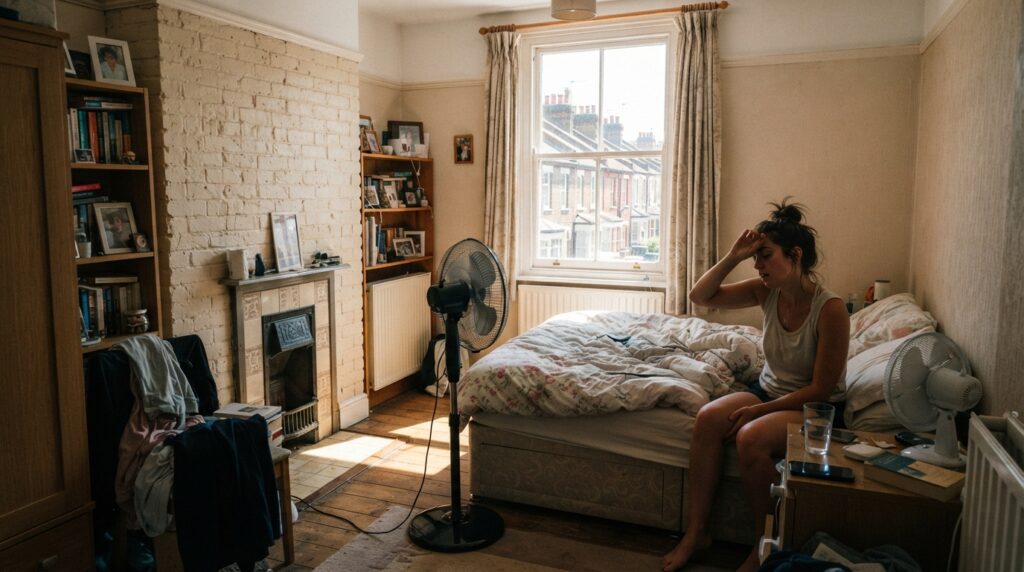
For most of their history, British homes had one climate problem to solve: keeping warm in a cool, damp country. Everything we’ve done to make them better at that — insulation, draught-proofing, double glazing, airtight construction — also makes them better at holding on to heat in summer. Meanwhile the climate has shifted. The Met Office says the decade 2016–2025 was 1.33°C warmer than 1961–1990, and Parliament’s science office estimates 4.6 million English homes already experience bedroom overheating in summer. Yet only a small minority have air conditioning: University of Reading analysis of the English Housing Survey puts it at 4.3% of homes in England. The fixes that work start with keeping sun off the glass and moving heat out at night.
British homes aren’t badly designed. They were designed for a different problem. Understanding that explains why your well-insulated flat feels like an oven in July, and why the solutions that work in hotter countries don’t always translate directly.
The original design problem
The UK’s building tradition grew up around cold, wet winters and mild summers. The priorities were keeping rain out, keeping warmth in, and letting in as much daylight as possible during short winter days. Heavy masonry walls, pitched roofs and windows placed to catch the sun made sense. Summer overheating simply wasn’t a design consideration for most of that history, which is why British homes almost never have the external shutters, deep eaves and shaded courtyards you see across southern Europe.
How every efficiency improvement made summer harder
Over the last few decades, homes have been made far more energy efficient — rightly so, because heating is where most household energy goes. But the physics works both ways:
- Insulation slows heat moving through walls and roofs in either direction. In summer that helps during the day, but once heat has got inside, it holds it in overnight. Our loft insulation guide explains the trade-off.
- Airtightness and draught-proofing stop warm air escaping in winter, and stop it escaping in summer too.
- Large areas of glazing, popular in extensions and newer flats, let in a lot of solar heat that then can’t easily get out.
- Flats and top floors collect heat rising from below and from the roof, as our guide to why upstairs is hotter explains.
None of this means insulation is a mistake. Cold remains the bigger killer in the UK: ONS figures for England covering 1988 to 2025 associate 138,944 deaths with the coldest days against 40,063 with the hottest. But ONS also notes that the share of deaths linked to the hottest days has increased in recent years and the gap is narrowing.
What has actually changed in the climate
The shift is measurable. Parliament’s science office, POST, compared 2013–2022 with 1961–1990 and found mean temperatures up 1.1°C and the hottest day of the year up 2.8°C. The Met Office’s July 2026 update goes further: 2016–2025 was 1.33°C warmer than 1961–1990, and the average hottest day has warmed by more than 4.5°C across a swathe from Kent to Lincolnshire.
The air conditioning gap
Very few British homes have any cooling. The government’s 2021 “Cooling in the UK” research found about 2–3% of households surveyed had some form of portable or fixed cooling, citing an industry estimate of around 5%, with fewer than 1% having fixed systems. More recent University of Reading analysis of English Housing Survey data, published in June 2026, puts it at 4.3% of homes in England — about 1.06 million — under the headline that those most at risk from heat have the least air conditioning. The same research warns that take-up could reach around 18 million of England’s 25 million homes by 2050, which raises its own questions about electricity demand, covered in our piece on whether the grid can cope.
New homes are starting to catch up
Building regulations now recognise the problem. Approved Document O, which took effect in England on 15 June 2022, requires new residential buildings to limit unwanted solar gains in summer and provide an adequate means of removing heat. That applies to homes built since then; it doesn’t touch the millions of existing homes. Our guide to why new-build homes overheat covers the homes built just before it came in.
Where this leaves a UK household
The order of priorities is the same for almost every home:
- Stop the sun reaching the glass. External shading works best, because it stops heat before it’s inside. See our external shading guide.
- If you can’t shade outside, shade inside. Thermal blackout curtains closed on the sunny side during the day make a real difference — see our curtain guide.
- Move heat out at night. Open up when the outside air is cooler than inside, and close up again in the morning.
- Cool the room you sleep in if the first three aren’t enough, particularly for older or vulnerable people.
Frequently asked questions
Why do UK homes get so hot in summer?
They’re designed to keep heat in during cold, damp winters. Insulation, airtightness and large windows help in winter but also trap heat in summer, and the UK’s climate has warmed measurably, with more hot nights when homes can’t cool down.
How many UK homes have air conditioning?
Very few. University of Reading analysis of English Housing Survey data published in 2026 found 4.3% of homes in England use air conditioning, about 1.06 million. The government’s 2021 “Cooling in the UK” research put it at around 2–3% of households surveyed.
Is insulation making homes overheat?
It can hold heat in once it’s inside, but it also slows heat getting in. The answer is to pair insulation with shading and night-time ventilation, not to remove it — cold is still linked to far more deaths in England than heat.
Sources
- Met Office — Climate extremes are becoming the new normal for the UK
- UK Parliament POST — Public health impacts of heat (PN-0723)
- Met Office, via Carbon Brief — The UK’s August 2020 heatwave
- Met Office — Understanding tropical nights and their impact
- BEIS — Cooling in the UK (2021)
- University of Reading — The most at-risk from heat have the least air con
- GOV.UK — Approved Document O: overheating
- ONS — Climate-related mortality, England and Wales: 1988 to 2025
Related reading: our new-build overheating guide, urban heat island explainer and why the UK keeps breaking heat records.
Compare current thermal blackout curtains at Amazon UK.