Why the UK Keeps Breaking Heat Records
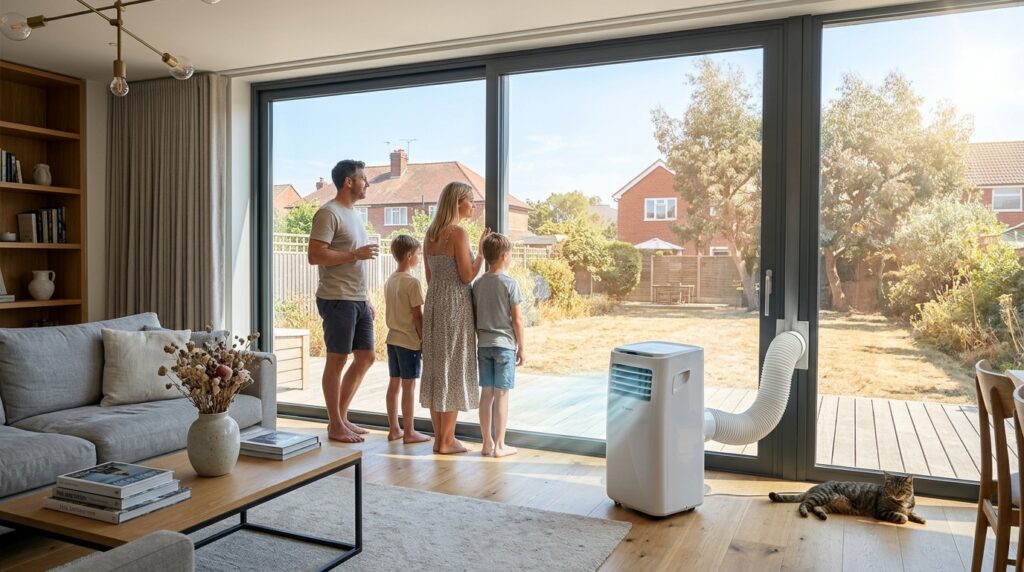
Two things are happening at once, and separating them explains a lot. The background climate is warming, so the whole distribution of temperatures has shifted — the same weather pattern that would once have produced a warm day now produces a hot one. And British houses are unusually badly suited to heat, because they were designed for the opposite problem: heavy curtains, small windows, insulation, and no cooling. The result is that a temperature an Italian house shrugs off makes a British one unbearable. Records break because the baseline moved; homes struggle because they were never built for it.
This page explains the context behind everything else on this site. No products — just what the data actually shows.
The distribution has shifted
The clearest way to think about it.
Weather is variable: some summers are hot, some are cool, driven by atmospheric patterns that vary year to year. That variability hasn’t gone away. What’s changed is the baseline it varies around.
Shift the whole distribution warmer by even a small amount and the extremes move disproportionately. A pattern that once delivered 30°C now delivers something higher. Records that stood for decades fall, and then fall again.
That’s why “we’ve always had hot summers” is true and also beside the point. The question isn’t whether hot weather happened before — it’s how often, and how hot.
What the Met Office reports
The Met Office publishes the UK’s climate observations and its annual State of the UK Climate reports, which are the authoritative source for this. The consistent finding across those reports is that the UK’s climate is warming, that recent decades have been warmer than earlier ones, and that hot extremes have become more frequent.
One figure worth knowing, because it captures the change in a way daytime maxima don’t: Met Office analysis has found that the chance of three consecutive nights above 20°C in July has risen from less than 1% in the pre-industrial climate to around 20% today.
That’s a roughly twentyfold change in the likelihood of the specific thing that stops people sleeping.
Why nights matter more than days
Underappreciated, and it’s where the health consequences concentrate.
The body relies on cooler night-time temperatures to recover from daytime heat. A hot day followed by a cool night is manageable. A hot day followed by a night that never drops below 20°C — a tropical night — is where cumulative strain builds.
It’s also where British housing fails worst. A well-insulated, airtight home that gained heat all day has no way to shed it overnight, and the traditional answer — open the windows — doesn’t work when the outside air is no cooler. Our tropical nights guide covers it.
The health picture
UKHSA publishes heat mortality estimates for England, and the figures are substantial:
- 2022: an estimated 2,985 heat-associated deaths
- 2023: an estimated 2,295
- 2024: an estimated 1,311
The year-to-year variation reflects how hot each summer actually was — these aren’t a smooth upward line, and it would be misleading to present them as one. But the scale is the point: heat in the UK is a public health issue rather than a comfort issue, and the burden falls heavily on the oldest age groups.
Our elderly heatwave guide covers what that means practically, and our heat health alerts guide covers the warning system UKHSA and the Met Office run jointly.
Why British homes struggle
The other half of the explanation, and the half you can actually do something about.
UK housing was designed around keeping heat in. That’s rational for a climate where cold has historically killed far more people than heat. It produces:
- Insulation that works in both directions — excellent in January, unhelpful once heat is indoors
- Airtight modern construction, so the building won’t ventilate itself
- Little external shading — no shutters, no deep eaves, no awnings as standard
- Large glazed areas in modern housing, oriented for light rather than for managing solar gain
- Lightweight construction with minimal thermal mass to flatten the daily swing
- No cooling, and no expectation of it
Compare that with housing in hotter climates: shutters closed by day, thick walls, small deep-set windows, tiled floors. Those are not aesthetic choices — they’re heat management, developed over centuries.
Our homes and heat guide covers this in detail, and our new build guide covers why newer housing is often worse rather than better.
What’s changing in policy
Approved Document O — Overheating came into effect in 2022 for new residential buildings in England, requiring designers to limit unwanted solar gain and provide a means of removing excess heat. Notably, it recognises that “open a window” isn’t a universal answer — noise and security are considered.
That’s a meaningful change of direction. It applies to new work only, though, so it does nothing for the existing housing stock where most people live.
What this means practically
Not a reason to panic, and not a reason to buy anything in particular. But it does change the calculation on a few things:
- Shading is now worth doing properly. External shading is standard in hot climates for good reason, and it’s the single most effective domestic measure.
- Overnight temperature matters more than daytime peaks for health and for sleep.
- Insulation is still worth doing. It cuts winter bills and slows summer heat gain through the roof — our loft guide covers checking yours.
- Plan rather than panic-buy. Stock disappears within days of a forecast hot spell — our timing guide covers buying out of season.
- Check on people. The mortality figures concentrate in the oldest age groups, and a phone call costs nothing.
Frequently asked questions
Wasn’t 1976 hotter?
1976 was an exceptional summer and remains notable for its duration and drought. But individual record temperatures have since been exceeded, and the relevant question is frequency rather than whether any single past summer was hot. The Met Office’s climate reports are the place to check specific records.
Is every hot summer caused by climate change?
No single weather event is “caused by” it in a simple sense — weather patterns still drive individual summers. What’s changed is the likelihood and intensity of hot extremes. Attribution studies assess how much more likely a specific event was made; the Met Office publishes on this.
What about El Niño?
A separate, natural cycle in the Pacific that influences global temperatures, typically peaking in the year after the oceanic event. It affects global averages; it doesn’t reliably predict a British summer. Our El Niño guide covers what the research does and doesn’t say.
Should I install air conditioning?
That’s a personal decision, and this page isn’t the place to push it. Shading, ventilation timing and insulation cost far less and work first. Our fan comparison covers when cooling genuinely earns its cost.
Sources
- Met Office — State of the UK Climate
- Met Office — Tropical nights and their impact (the <1% to ~20% figure)
- Met Office — Effects of climate change
- UKHSA — Adverse Weather and Health Plan (heat mortality reporting)
- Met Office — Heat-Health Alerts
- GOV.UK — Approved Document O: Overheating
- Climate Change Committee — Climate Change Committee
Related reading: our why UK homes trap heat and heat health alerts guide.
Related guides




Compare current prices, stock and reviews on portable air conditioners at Amazon UK. Prices and stock move fast in a heatwave, so it is worth checking before you commit.
Browse air conditioners →