Why New Build Homes Overheat in the UK, and What Actually Helps
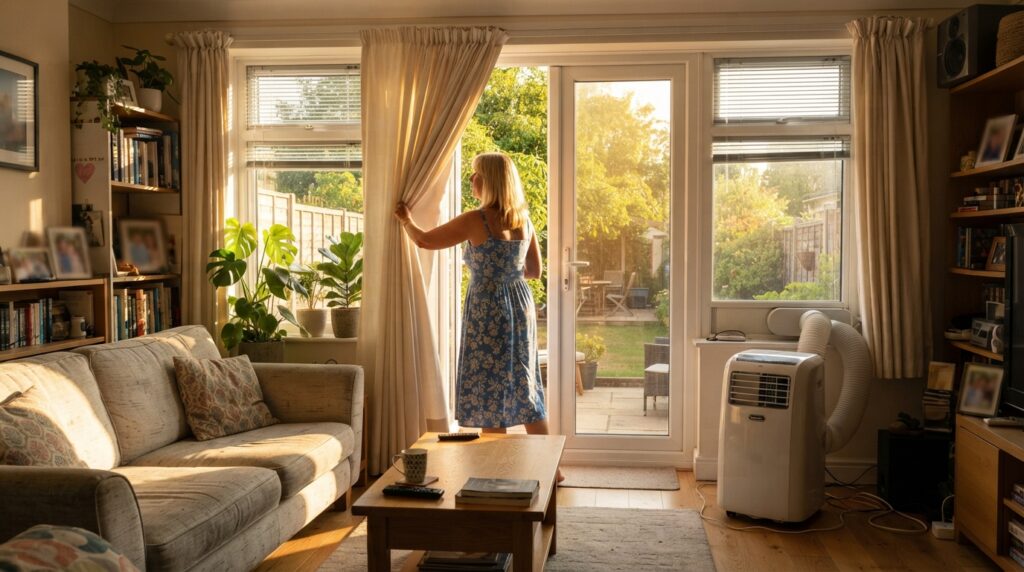
It isn’t your imagination, and it isn’t poor construction — it’s the predictable result of building for winter. New homes are highly insulated and very airtight, which is excellent for heating bills and terrible once heat gets inside, because the same fabric that keeps warmth in during January keeps it in during July. Add large glazed areas and very little thermal mass in lightweight modern construction, and you get a house that heats fast and won’t shed it. The regulations caught up in 2022 with Approved Document O, but that applies to newer approvals — many homes built in the preceding decade had no overheating requirement at all.
This is one of the most common complaints we see, and it usually arrives with a note of disbelief: the house is two years old, so why is it worse than the Victorian terrace they left?
The four reasons
1. Insulation works both ways
Insulation slows heat transfer. In winter that keeps warmth inside. In summer, once solar gain and internal heat have accumulated indoors, that same barrier slows it leaving.
An older, leakier house sheds heat overnight almost by accident. A well-insulated modern one doesn’t.
2. Airtightness
Modern homes are built to demanding air permeability standards, with sealed junctions and taped membranes. Uncontrolled draughts — which in an older house provide constant unintentional ventilation — are largely designed out.
That’s deliberate and correct for energy efficiency. It also means you have to ventilate on purpose, because the building won’t do it for you.
3. Large glazed areas
Modern housing favours big windows, bi-folds and full-height glazing. Glass admits solar radiation freely, and a south or west-facing elevation with substantial glazing gains a great deal of heat through the afternoon.
Our west-facing room guide covers why evening sun is the worst case — it arrives almost horizontally, straight through the glass.
4. Almost no thermal mass
This is the one people miss, and it explains the comparison with the old terrace.
Solid masonry absorbs heat slowly and releases it slowly, flattening the daily temperature swing. Lightweight modern construction — timber frame, plasterboard, thin blockwork — has very little capacity to absorb heat. So the internal temperature tracks the heat input closely: it spikes fast in the afternoon, and there’s no mass to have stored overnight coolness.
Our Victorian house guide covers the other side of that comparison.
The regulations: Approved Document O
Worth knowing, because it affects what you can expect and what you might raise with a developer.
Approved Document O — Overheating came into effect in 2022 for new residential buildings in England. It introduced a requirement to limit unwanted solar gains in summer and to provide a means of removing excess heat, assessed either by a simplified method or by dynamic thermal modelling.
The practical points:
- It applies to newer approvals. Homes built before it came in were designed under regulations that addressed winter heat loss but had no equivalent overheating requirement — which is precisely why a lot of 2010s housing stock has this problem.
- It considers noise and security. The guidance recognises that “open a window” isn’t a universal answer — on a noisy road, or at ground floor level, occupants won’t or can’t.
- It doesn’t retrofit. It applies to new work, not to your existing home.
Scotland, Wales and Northern Ireland have their own building standards; check the relevant authority rather than assuming Approved Document O applies.
The ventilation question — get this right first
If you have MVHR with a summer bypass, it stops recovering heat when outside air is cooler than inside — which is exactly what you want overnight. Worth confirming it’s enabled and the filters are clean; neglected MVHR filters are extremely common and they reduce the system’s effectiveness considerably.
What actually helps, cheapest first
- Shade the glass from mid-morning, before the room heats. The single highest-value action. Closing blinds at 6pm achieves very little when the fabric has been absorbing energy all day. A reflective outward face matters more than opacity — our blinds guide covers it.
- External shading beats internal decisively, because it stops the energy outside the glass. Awnings, external blinds, or planting. Check your deeds and any estate management terms first — new developments frequently restrict external alterations. Our shading guide covers the options.
- Purge ventilate at the right time. Windows wide once outside is genuinely cooler than inside — often later than people assume — then shut everything in the morning. In an airtight house this matters more, not less, because the building won’t do it passively. Our timing guide covers judging it.
- Get a cross-draught where the layout allows — openings on two elevations, and internal doors open, to move air through rather than just in.
- Close the stairwell if you can. Warm air collects upstairs, and in an open-plan new build the stairs are an efficient chimney. Our stack effect guide covers it.
- Reduce internal gains. Cook early, use the extractor, switch off electronics, avoid the tumble dryer in the afternoon.
- Solar control film on the worst windows — cheaper than external shading, and it reflects a portion before it enters. Trade-off: it works year-round and reduces welcome winter gain.
Where cooling fits
After shading, not instead of it. A unit fighting unshaded south-facing glazing on a July afternoon is fighting continuous gain and may not win.
Venting is the practical obstacle in a new build. Windows are often top-opening or restricted, the standard slider kit rarely fits, and drilling an external wall may breach warranty terms, estate management rules, or a leasehold agreement. Check before you drill.
Our seal kits guide covers making a panel for an awkward opening, and our leasehold guide covers permissions.
MeacoCool MC Series Pro 9000
For a bedroom that won’t cool
16–26m²
52 dB low fan
App control
Meaco publish 52 dB on low fan, a 16–26m² range, an A rating and a two-year warranty. In a new build the app matters: an airtight, well-insulated room holds its temperature once cooled, so pre-cooling before bed and switching off works better here than in a draughty older house.
Good for: one bedroom in an airtight home, where the coasting effect is strong; pre-cooling rather than running overnight.
Less good for: an open-plan ground floor, which is too much volume for a portable unit. Venting is also frequently awkward in new builds — confirm your window can take a kit before ordering. And Trusted Reviews measured 58.5 dB fan-only against the published 52 dB low-fan figure, so it’s audible.
Frequently asked questions
Why is my new house hotter than my old one?
Insulation and airtightness keep heat in as effectively as they keep it out, and lightweight construction has little thermal mass to flatten the daily swing. Your old house probably shed heat overnight through draughts you never noticed.
Can I complain to the developer?
Possibly, particularly within a warranty period — but document it with temperature logs over several weeks first. Whether it succeeds depends on when the home was approved and what standard applied. It’s difficult to pursue and outcomes vary.
Should I turn off the MVHR in summer?
No. It’s part of how the building ventilates, and switching it off risks condensation and poor air quality. Check whether it has a summer bypass, and clean the filters — both are commonly overlooked.
Would trickle vents help?
They provide background ventilation, not cooling. Leave them open, but they won’t shift a hot room — purge ventilation at the right time will.
Sources
- GOV.UK — Approved Document O: Overheating
- GOV.UK — Approved Document F: Ventilation
- GOV.UK — Approved Document L
- Energy Saving Trust — Ventilation
- NHBC — NHBC homeowner information
- UKHSA — Adverse Weather and Health Plan
- Trusted Reviews — MeacoCool MC Series Pro 9000 review
Related reading: our why UK homes trap heat and top floor flat guide.
Compare current specifications at Amazon UK — and confirm your windows can take a venting kit before ordering, since new-build openings are often restricted.