How to Install a Portable Air Conditioner Without a Window
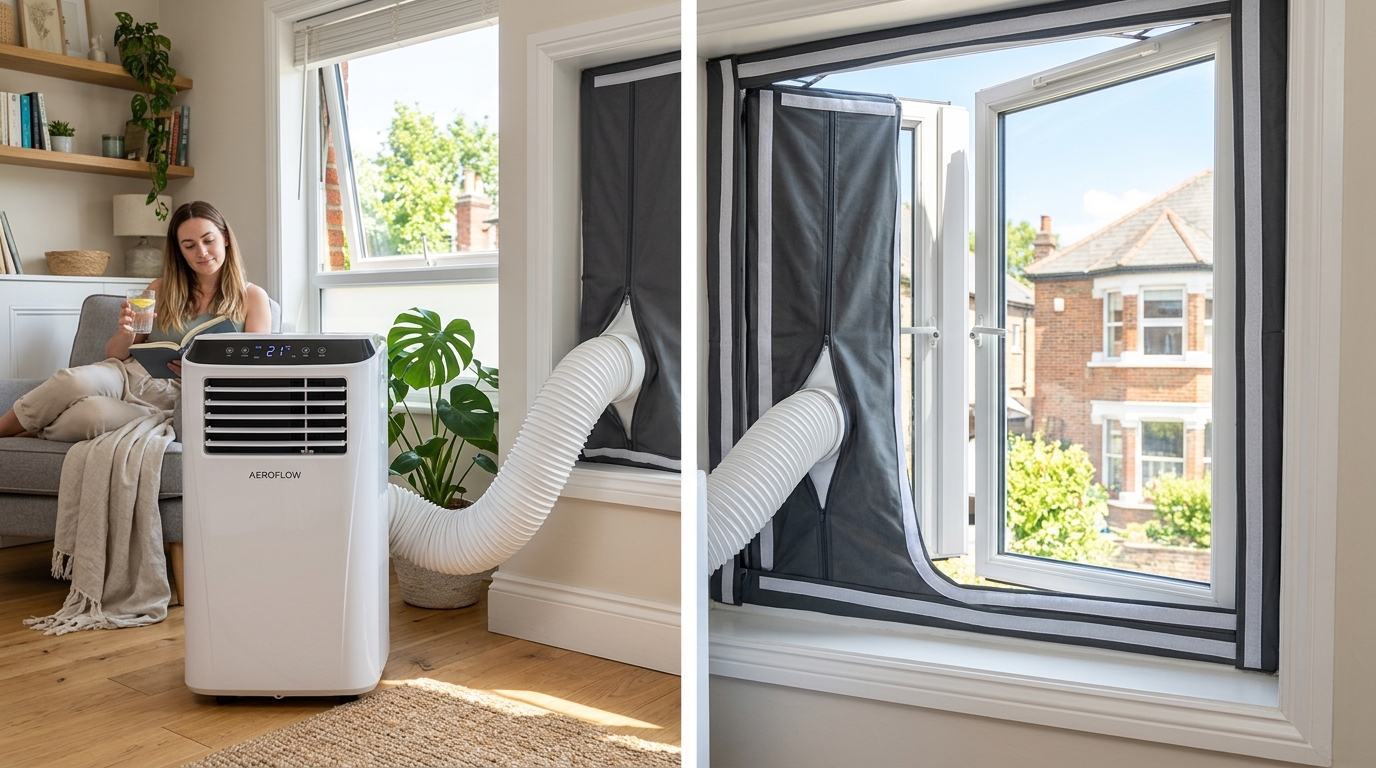
A portable air conditioner still has to send its hot exhaust outside the building — that part isn’t optional, because the unit works by moving heat out of the room, and if the heat has nowhere to go you’re just running an expensive heater. What’s negotiable is the route. Without a standard opening window you have four real options: a through-wall vent, an adjacent door to outside, a trickle vent or air brick you can adapt, or a roof/skylight route. The one true no-venting alternative is an evaporative cooler — a different machine that doesn’t cool nearly as well in humid UK conditions and adds moisture to the room. What you must not do is vent into a loft, a cupboard or another room: that just relocates the heat.
People search this hoping there’s a trick. There isn’t a trick — but there are several genuine routes that don’t involve an opening window, and one honest alternative product. Here’s all of it.
First, why the hose can’t just go anywhere
A portable air conditioner is a heat pump: it takes heat out of your room’s air and pumps it out through the exhaust hose. If that hot air is released anywhere inside your home’s insulated shell — a loft, a hallway, a cupboard, the room next door — the heat is still in the building, and with a single-hose unit it’s promptly drawn back toward the room you’re cooling.
So the exhaust has to cross the thermal envelope — the insulated boundary between inside and outside. Every method below is just a different way of getting the hose across that line. Our extension hose guide covers why lengthening the hose to reach a distant opening is usually the wrong move.
Route 1: A through-wall vent
The most permanent and, for a genuinely windowless room, often the best answer. A circular vent is cut through an external wall, fitted with a cap or louvre outside, and the hose connects to it — the same principle as a tumble dryer or extractor vent.
- It frees the window entirely (if you have one you’d rather keep usable) and looks tidy.
- It’s a permanent alteration, so it needs the right permissions — see the warning below.
- It’s a job for someone competent: an external wall means a core drill, correct making-good, and a weatherproof, insect-proof external fitting. Cavity walls need a proper sleeve.
Route 2: An external door
If the room opens onto a garden, balcony or the outside, a door is a perfectly good venting point — and it needs no drilling.
The problem is sealing the gap around the hose while the door is ajar, which otherwise lets warm air (and insects) straight back in and undoes the cooling. A door seal kit — the same fabric-panel idea as a window kit, made for a door opening — closes that gap. Our seal kits guide covers the fabric-panel approach, which adapts to a door.
Security is the catch: a door propped open, even a little, is a weak point. This route suits a door onto an enclosed, secure garden or balcony far better than a front door onto the street.
Route 3: An air brick, trickle vent or existing opening
Some rooms have no opening window but do have an existing route to outside — a redundant air brick, an old extractor hole, a boarded-up fireplace with a flue, or generous trickle vents. Any of these can sometimes be adapted to take an exhaust hose, temporarily and reversibly.
This is case-by-case and you shouldn’t force it: a flue may serve a working appliance elsewhere, and blocking ventilation that’s there for a reason (combustion air, damp control) causes its own problems. But where a genuinely disused opening exists, it can save cutting a new one.
Route 4: A skylight or roof window
A loft room or top-floor room with a roof window can vent through it. The honest complication is that the hose has to rise to reach a roof light, and a rising hose fights the airflow and lets condensation run back toward the unit. Our skylight guide covers doing it properly — keeping the run as short and as close to horizontal as the geometry allows, and sealing the opening.
The genuine no-vent alternative: an evaporative cooler
If none of the above is possible, the only honest product that needs no venting at all is an evaporative cooler (a “swamp cooler”). It’s a fundamentally different machine — it blows air over water and cools by evaporation, so there’s no compressor and no hot exhaust to expel.
An evaporative cooler
The only true no-vent option
Just needs water + a socket
Portable, light
Because it needs no exhaust route, it’s the one thing you can genuinely run in a sealed, windowless room. It uses little electricity and adds no external fittings.
Good for: a windowless room where nothing can be vented; dry heat; spot cooling right in front of it; anyone who can’t drill and has no door or opening to use.
Less good for: humid weather — and this is the decisive UK limitation. Evaporative cooling works by adding moisture to the air, so in the muggy conditions that make a British summer night miserable it does little and can make the room feel clammier. It also can’t hit a set temperature the way a compressor unit does. Treat it as a fan-plus, not as air conditioning. Our fan comparison covers where this sits.
What not to do
- Don’t vent into the loft. You dump heat and moisture into the roof space, risking condensation on timbers and insulation — a genuine damp problem in exchange for a briefly cooler room.
- Don’t vent into a cupboard or another room. The heat stays in the house and comes back. It achieves nothing.
- Don’t run a compressor unit with the hose detached “just in the room”. It will pump its own waste heat straight back out, and the room gets warmer, not cooler.
- Don’t block a ventilation opening that’s there for a reason — combustion air for a boiler or fire, or a damp-control vent.
If you rent and can’t alter anything
If drilling is out and there’s no door or opening to use, be realistic: a compressor portable may not suit that room. An evaporative cooler, good shading and well-timed ventilation elsewhere in the home may serve you better. Our windowless room guide covers the wider options, and our renter’s setup guide covers cooling without permanent changes.
Frequently asked questions
Can I really not run a portable AC with no venting at all?
Not a compressor one, no — it produces hot exhaust that has to leave the building, or it warms the room. The only genuinely ventless machine is an evaporative cooler, which is a different and much weaker device in humid conditions.
Is a through-wall vent worth it?
For a windowless room you’ll cool every summer, often yes — it’s tidy and permanent. But it’s an alteration needing permission if you rent or hold a lease, and a proper job on an external wall, so factor both in.
Can I vent through a wall into my garage or conservatory?
Only if that space is genuinely outside your insulated envelope and well ventilated to outside itself. A sealed integral garage or a closed conservatory will just heat up and send the warmth back. When in doubt, vent to true outside.
Does an evaporative cooler need emptying like a dehumidifier?
The opposite — you top it up with water (and often ice). It consumes water rather than collecting it. Refill frequency depends on the tank and how hard it’s running.
Sources
- GOV.UK — Approved Document F: Ventilation
- GOV.UK — Planning: when is permission required
- Energy Saving Trust — Home appliances and energy use
- Leasehold Advisory Service — LEASE (alterations and consent)
Related reading: our windowless room guide and seal kits guide.
An evaporative cooler is the only machine that runs with no hose — useful in a sealed room, but weaker in humid weather. Compare current options at Amazon UK.