Cooling a Top Floor Flat in Summer
A top floor flat gets heat from three directions at once: the roof above, the sun through the windows, and warm air rising from every flat below you. That last one is invisible and genuinely significant — you’re at the top of the building’s chimney. The complication is that the usual fixes are the ones you’re least able to do: you don’t own the roof, you probably can’t alter the exterior, and windows may be restricted for safety. So the work concentrates on shading, purge ventilation timing, and sealing one room properly.
Top floor flats are consistently the hottest homes in any block, and their occupants have the fewest options. Here’s what’s actually available.
Where the heat comes from
The roof
The biggest single factor. A roof takes the full solar load all day and radiates it downward. In a converted loft or a flat with a flat roof directly above the ceiling, that’s the dominant heat source.
Loft insulation between you and the roof is what slows it — but in a flat you may have no access to check it, and in many conversions there’s very little depth available.
The rest of the building
Warm air rises. Every flat below you is heating its own space through cooking, appliances, people and solar gain, and that warmth migrates upward through the building — stairwells, service risers, the structure itself.
You’re at the end of that chain. Our stack effect guide covers the mechanism.
The windows
Usually the one you can actually do something about. A top floor flat often has less external shading than lower floors — no trees, no neighbouring buildings casting shade, no overhang.
What you can do
1. Shade the glass — from mid-morning
The highest-value free action, and the timing is what people get wrong. Close blinds and curtains on sun-facing windows before the room heats, not when you notice it’s hot. Once the energy is in, the fabric has absorbed it.
A reflective outward face matters more than opacity — a dark blackout blind absorbs energy and radiates it into the room. Our blinds guide covers what to look for.
Solar control film is worth considering here specifically, because it’s the one measure that works like external shading without altering the building’s appearance. Static-cling film is fully removable, which matters if you rent or hold a lease with an alterations clause.
2. Purge ventilate at the right time
Windows wide once outside is genuinely cooler than inside — which on a hot day may not be until quite late — then shut everything in the morning before outside overtakes inside.
Most households get this backwards by hours. A cheap thermometer showing indoor and outdoor readings settles it — our timing guide covers judging it.
Top floor flats often ventilate well if you can get openings on two sides, because you’re above surrounding obstructions and there’s usually more air movement up there.
3. Seal and cool one room
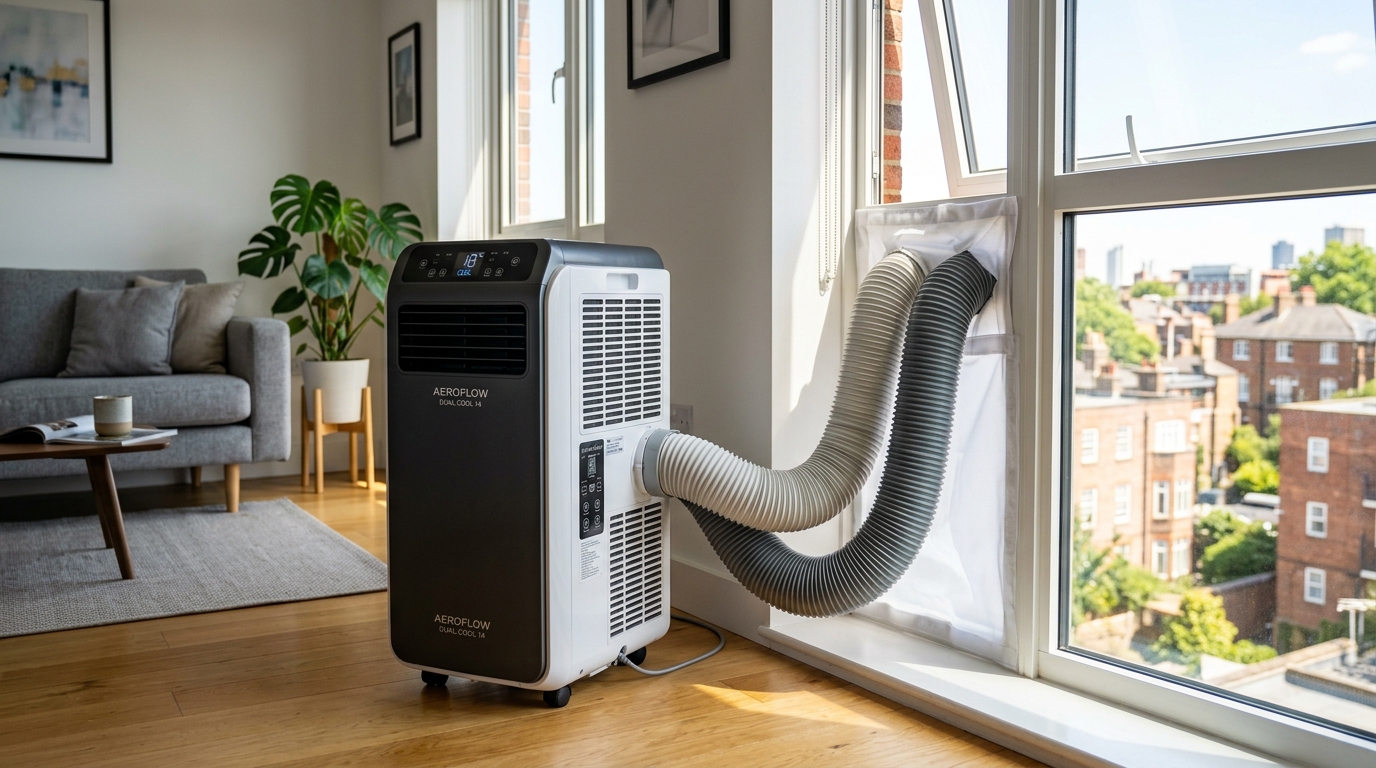
A flat is too much volume for a portable unit to handle whole. Pick the bedroom, seal it, close the door, and accept that’s what you’re cooling.
4. Reduce what you add
Cook early or use the hob less, run the extractor, switch off electronics, and avoid the tumble dryer in the afternoon. In a small flat these matter more than in a house.
The constraints specific to a flat
Never obstruct an escape route with a hose, cable or unit. In a purpose-built block the communal corridor and stairwell are part of the fire strategy, and your front door is a fire door — don’t prop it open for airflow.
External alterations: in a leasehold flat the freeholder controls the structure and exterior. A wall vent, an external condenser, or anything fixed to the building almost certainly needs written consent, and permitted development rights are more limited for flats than houses. Our leasehold guide covers the process, and our flats and HMOs guide covers the wider picture.
A portable unit vented through your own opening window alters nothing and is normally fine — that’s why it’s the practical answer for almost everyone in this situation.
Noise: most leases contain a nuisance clause, and in a converted building sound carries. A compressor running overnight against a party wall is worth raising with your neighbour before it becomes a complaint.
Is the roof insulation your problem or the freeholder’s?
Worth establishing, because it’s the single most effective fix and it may not be yours to make.
In many leases the roof is part of the structure the freeholder maintains, funded through service charges. If insulation above your ceiling is inadequate or has been disturbed, that’s worth raising in writing with the managing agent — it affects your heating bills in winter as well as your temperature in summer, which is often the more persuasive argument.
If you have access to a loft space above your flat, our loft insulation guide covers checking the depth with a ruler. Don’t assume there’s nothing there, and don’t assume it’s adequate.
The picks
MeacoCool MC Series 9000 (MC9000)
For one room
16–26m²
53 dB minimum
A-rated
Meaco publish 16–26m², an A rating and a 53 dB minimum noise figure. Sized for a bedroom or a small living room, which is the realistic scope in a flat. The A rating matters if you’ll run it regularly — efficiency shows up on the bill over a hot fortnight.
Good for: one sealed room, which is what a portable unit can actually manage; anyone who wants documented specifications rather than a marketplace listing.
Less good for: an open-plan flat, where it won’t cool the whole space. Venting is the practical question — restricted window openings are common in flats, so confirm yours will take a kit before ordering. It’s also 20kg-plus to get up several flights if there’s no lift, and storage space in a flat is usually short.
Removable solar control film
The flat-friendly fix
No power
Fully removable
Worth calling out for this situation specifically. Static-cling film reflects a portion of solar energy before it passes fully into the room, which is closer to how external shading works — and it alters nothing about the building, so there’s no permission question and nothing to reinstate when you move.
Good for: leaseholders and tenants who can’t fit anything externally; south and west-facing windows; keeping a room cooler while you’re out.
Less good for: winter, since it works year-round and reduces welcome solar gain. It also changes how the glass looks from inside and out, and application takes patience to avoid bubbles. Check compatibility with your glazing — some manufacturers advise against film on certain sealed units, and damaging a unit you don’t own is an expensive mistake.
Frequently asked questions
Why is my flat hotter than the one below?
The roof, plus warm air rising from the whole building. You’re at the top of the chimney and directly under the largest sun-facing surface.
Can I put a unit on the balcony?
Check your lease. Balconies are frequently common parts or subject to restrictions, and anything fixed or visible usually needs freeholder consent. Fire safety rules on balconies have also tightened in many blocks.
Would roof insulation help in summer?
Yes — it slows heat transfer in both directions. Whether you can do anything about it depends on your lease and whether you have access. Raising it with the managing agent on energy-efficiency grounds often lands better than on comfort grounds.
Can I sleep with the windows open?
If outside is genuinely cooler, that’s how the flat sheds heat. Consider security and any window restrictors, and note that on a tropical night there may be no cooler air to bring in — our tropical nights guide covers those.
Sources
- GOV.UK — Approved Document O: Overheating
- GOV.UK — Approved Document B: Fire safety
- Energy Saving Trust — Roof and loft insulation
- Leasehold Advisory Service — LEASE
- Planning Portal — Do you need permission?
- UKHSA — Adverse Weather and Health Plan
Related reading: our loft conversion guide and flats and HMOs guide.
Compare options at Amazon UK. In a flat, confirm your window opening will take a venting kit before ordering — restricted openings are common.