Do Solar Panels Make Your House Hotter or Cooler?
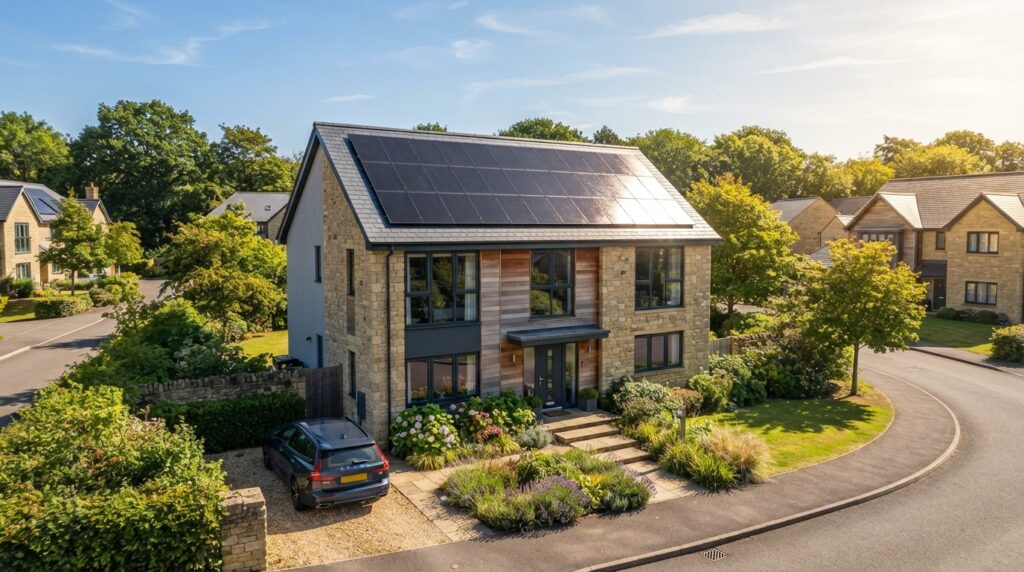
Solar panels do not make your house hotter — if anything they make the roof beneath them slightly cooler, because they shade the tiles from direct sun and the air gap behind them carries heat away. The confusion comes from the fact that panels themselves get very hot to touch, which people assume transfers inside. It doesn’t, in any meaningful way: there’s a ventilated gap, a roof covering, a loft void and your insulation between the panel and your ceiling. The cooling effect at room level is small — don’t buy panels to cool your house. The genuinely useful connection is different and much more valuable: solar output peaks at exactly the times cooling demand peaks, so panels are an unusually good match for running air conditioning cheaply.
This question gets asked from both directions — people worried panels will cook the bedrooms, and people hoping they’ll cool them. The honest answer disappoints both, but the practical takeaway is genuinely useful.
Why people think panels heat the house
It’s an understandable inference. A solar panel in full sun gets hot — noticeably hotter than the air around it — because it’s a dark surface absorbing sunlight, and only some of that energy leaves as electricity. Put a hot object on your roof, the reasoning goes, and the heat must end up inside.
What that reasoning misses is everything between the panel and you.
What actually happens to that heat
- The panel shades the roof beneath it. This is the key point. The tiles or slates under an array are no longer in direct sun, so they run cooler than the exposed parts of the same roof. You’ve effectively put a parasol over part of your roof.
- There’s a ventilated air gap. Standard on-roof mounting holds panels clear of the roof surface, and air moves through that gap, carrying heat away by convection before it reaches the tiles. Installers want this gap anyway, because panels work better when cooler.
- The roof covering and loft void come next. Any heat that does reach the tiles has to cross a ventilated loft — which is itself designed to dump hot air — before it gets anywhere near your rooms.
- Then your insulation. The ceiling-level insulation is the real barrier, and it’s doing most of the work regardless of panels. Our summer insulation guide explains how that layer behaves when heat is coming downwards.
Net effect: research into rooftop arrays has generally found panels act as shading and can modestly reduce roof and loft temperatures rather than raise them. The effect on the temperature of the rooms you live in, though, is small — because insulation was already handling that path.
The nuance: on-roof versus in-roof panels
Hot weather actually reduces panel output
A counter-intuitive fact worth knowing, and it cuts against the “panels love heatwaves” assumption: photovoltaic efficiency falls as panel temperature rises. Panels are rated at a standard test temperature, and above that, output per panel drops slightly for every degree the cells get hotter.
The practical consequence is that a bright, cool day can generate better than a blazing, still, very hot day. It also explains why installers care about that ventilation gap, and why panels are mounted clear of the roof rather than flat against it. In a UK heatwave you’ll still generate a lot — long days and strong sun outweigh the temperature penalty — just not quite proportionally to how hot it feels.
The genuinely useful part: solar and cooling are well matched
Here’s where panels really do help with heat, and it has nothing to do with roof temperature.
Cooling demand and solar generation peak at the same time. You want air conditioning most on bright, hot afternoons — which is precisely when a rooftop array is producing most. That’s an unusually good match between a load and a generator, and much better than the match for heating, where demand peaks on dark winter evenings when panels produce almost nothing.
What that means in practice:
- Running a portable or split air conditioner on a sunny afternoon can be substantially or largely covered by your own generation, rather than imported electricity — so the marginal cost of cooling on the hottest days falls.
- Pre-cooling during peak generation is a smart strategy: cool the room while the sun is high and your panels are producing, then let a shaded, sealed room coast into the evening. That exploits both the solar match and the physics in our leave-it-on vs turn-it-off guide.
- A battery extends it into the evening, which is when bedrooms are still hot and generation has stopped — the weak point of solar-powered cooling without storage.
- Check the electrical side before assuming: whether it works for you depends on your array size, your tariff, and what else is drawing power. Our running cost guide covers doing the sums with current figures, and our efficiency ratings guide explains why a higher-rated unit needs less of that generation.
So should you get panels to keep your house cool?
No — that’s the wrong reason. The direct cooling effect on your rooms is small, and there are far cheaper ways to buy the same comfort: external shading, night ventilation, sealing and insulation all cost a fraction of a solar array and do far more for indoor temperature. Our no-AC cooling guide sets out the order.
Get panels to generate electricity. If you’re getting them anyway, the fact that they pair well with cooling is a genuine bonus worth factoring in — and it’s a reasonable argument for sizing an array with summer cooling loads in mind if you know you’ll be running air conditioning. But the panels are an energy decision, not a cooling one.
A few related practicalities
- Panels don’t replace insulation. If your top floor bakes, the insulation, the roof windows and the shading are what to look at — not the array.
- Installation should be by a certified installer (MCS certification is the usual route, and matters for eligibility under export arrangements), and the roof structure needs to be suitable.
- Planning: domestic rooftop solar often falls within permitted development, but conditions apply and listed buildings and conservation areas are the usual exceptions — the same pattern as our air conditioning planning guide. Check the Planning Portal and your local authority.
- Solar thermal is a different thing. Panels that heat water (solar thermal) are not the same as photovoltaic panels that generate electricity — this page is about PV.
Frequently asked questions
Do solar panels make the roof hotter?
No — they shade the roof surface beneath them, which typically runs cooler than exposed parts of the same roof, and the ventilated gap behind on-roof panels carries heat away. The panels themselves get hot; the roof under them does not.
Will panels make my bedrooms cooler?
Only marginally. Any benefit is mostly at roof and loft level, and your ceiling insulation is already doing that job. Don’t expect a noticeable drop in room temperature — shading your windows will do far more.
Can I run air conditioning off solar panels?
Often substantially, yes — cooling demand peaks on sunny afternoons when generation peaks, which is an unusually good match. Evening cooling is the gap, which a battery fills. How much depends on your array size, tariff and unit efficiency.
Do panels work worse in a heatwave?
Per panel, slightly — PV efficiency falls as cell temperature rises, so a bright cool day can outperform a very hot one. You’ll still generate strongly in a UK heatwave thanks to long days and strong sun.
Are in-roof panels worse for heat?
They have less airflow behind them than on-roof panels, so the panels run hotter and shed less heat by convection. The shading benefit to the roof remains. It’s a detailing consideration for installers rather than a problem for your indoor temperature.
Sources
- Energy Saving Trust — Solar panels
- MCS — Microgeneration Certification Scheme
- Planning Portal — Solar panels: planning
- GOV.UK — Approved Document O: Overheating
Related reading: our summer insulation guide and running cost guide.
Solar output and cooling demand peak together — an efficient unit makes the most of it. Compare current options at Amazon UK.