How to Keep a West-Facing Room Cool in the Evening
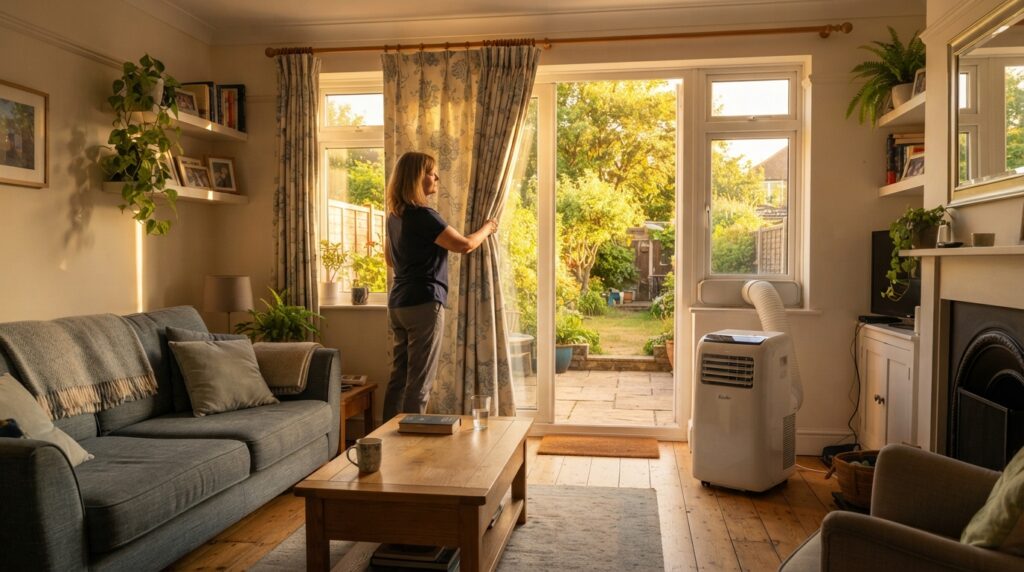
West-facing rooms are the worst orientation in a British house for evening comfort, and it’s a timing problem rather than an intensity one. The sun hits that elevation in the late afternoon, when the building has already absorbed a full day of heat, and it strikes at a low angle — meaning it comes in through the glass almost horizontally rather than being partly deflected. Then the room releases that stored heat for hours, exactly when you want to sit in it or sleep in it. The fix is to shade the glass before mid-afternoon, because once the low sun is on the window it’s too late.
If your living room or bedroom is unusable between five and nine on a hot day while the rest of the house is fine, this is why.
Why west is worse than south
Counterintuitive, since south-facing gets more sun overall. Three reasons west wins on discomfort.
The angle
A south-facing window at midday receives sun from high overhead. Some is deflected, and modest overhangs, eaves or a small awning can shade a lot of it.
Late afternoon sun is low. It comes in almost horizontally, straight through the glass, deep into the room — reaching the back wall, the sofa and the bed rather than just the windowsill. Overhangs do almost nothing against a low angle.
The timing
By late afternoon the house has been absorbing heat all day. Walls, floors and furniture are already warm. West-facing gain lands on top of an already-loaded building rather than at the start of the day.
The release
Materials release stored heat slowly. A west-facing room absorbs its heaviest load between four and eight, then radiates it back through the evening and into the night — which is precisely when you’re trying to relax or sleep in it. Our companion piece on radiant temperature explains why warm surfaces make a room feel hotter than the thermometer suggests.
What actually works
1. Shade before 2pm, not at 5pm
The single most important habit, and it’s free.
By the time the sun is visibly on the window, energy is already pouring in. Close blinds and curtains on that elevation early afternoon at the latest — ideally as part of the same routine that closes south-facing windows in the morning.
People resist this because it means sitting in a dark room on a sunny afternoon. It’s the trade-off, and it’s the difference between a comfortable evening and an uncomfortable one.
2. External shading, if you can
Substantially more effective than anything internal, because it stops the energy before it passes through the glass. Once solar radiation is inside, an internal blind absorbs it and re-radiates most of that heat into the room.
For a low western sun specifically, vertical shading works where horizontal doesn’t — external roller blinds, shutters, or vertical fins. A horizontal awning designed for high midday sun won’t intercept a low evening one.
Our shading guide covers the options, and our blackout blinds piece covers what internal coverings can and can’t do. Note that fitting anything externally may need permission in a leasehold flat or consent on a listed or conservation area property.
3. Solar control film
Applied to the glass, reflecting a portion of solar energy before it enters. Cheaper than external shading, permanent, doesn’t block the view, and doesn’t need permission in most circumstances.
The trade-off is that it works all year — so it reduces welcome winter solar gain too. On a west-facing room that’s usually an acceptable exchange, since winter afternoon sun is brief.
4. Plant something
A deciduous tree or tall shrub on the western side shades in summer and drops its leaves to admit light in winter. Slow, but genuinely effective, free to run, and it helps with the urban heat effect too.
Check for any tree preservation orders before removing or heavily pruning existing planting, and remember overhanging branches from a neighbour’s tree have their own rules — our garden guide covers that.
5. Ventilate late, not early
Opening windows at 6pm on a hot day frequently makes a west-facing room worse, because outside is still hot and the sun is on that elevation.
Wait until outside is genuinely cooler than inside — often not until well after sunset — then open wide and get a through-draught. Shut everything in the morning. A cheap thermometer removes the guesswork; our window timing guide covers the discipline.
6. Move the heat sources
West-facing living rooms often contain the television, the games console and the router — all generating heat during exactly the hours the room is worst. Our electronics guide covers how much they contribute.
If it’s a bedroom
West-facing bedrooms are a particular problem, because the room peaks in the early evening and is still releasing heat at bedtime.
- Shade from early afternoon, without exception.
- Open the window and door as late as possible to purge stored heat before you go up.
- A fan pointed at the bed, not at the room. You feel cooler at the same temperature because of increased evaporation — our fan explainer covers it.
- Pre-cool if you have air conditioning — run it in the late afternoon rather than starting at bedtime from a baked room.
Overnight heat is where the health consequence sits, which is why the increase in tropical nights covered in our tropical nights guide matters more than daytime peaks.
Where a portable unit fits
West-facing rooms are among the better candidates, because the problem is confined to a few hours in one room rather than being a whole-house issue.
Two points on getting it right:
Size up. A west-facing room with substantial glazing has a higher heat load than its floor area suggests — the standard 500–600 BTU per square metre is a starting point that needs adjusting upward for aspect and glazing. Our sizing guide covers the adjustments.
Pre-cool rather than chase. Running from mid-afternoon means the room never peaks. Starting at 8pm means the unit spends the evening recovering from a deficit and may never catch up. A timer or smart plug automates it — check the plug’s load rating first, as covered in our electrical safety guide.
Frequently asked questions
Is east-facing better?
For evening comfort, yes considerably. East-facing rooms take their solar gain in the morning, when the building is at its coolest, and have all day to shed it before you use the room at night. They can be uncomfortably bright early, which is a different problem.
Would triple glazing help?
Less than you’d hope for solar gain specifically. Extra panes improve insulation, but solar radiation still passes through clear glass. Solar control glazing or external shading targets the actual problem.
Why is it still hot at 10pm?
Thermal mass. The walls, floor and furniture absorbed heat through the late afternoon and release it for hours afterwards. Purge ventilation once outside is cooler is what clears it.
Does closing the door help?
During the day, yes — it stops the heat spreading. At night, opening it along with a window on the opposite side of the house creates the through-draught that clears stored heat.
Sources
- GOV.UK — Approved Document O: Overheating (solar gain and shading by orientation)
- UKHSA — Adverse Weather and Health Plan
- Met Office — Tropical nights and their impact
- NHS — Heatwave: how to cope in hot weather
- Energy Saving Trust — Windows and doors
Related reading: our shading guide and window timing guide.
Compare current specifications at Amazon UK — for a west-facing room, size up from the floor-area figure and look for a timer or app control so you can pre-cool.