Should Windows Be Open or Closed When Running Air Conditioning?
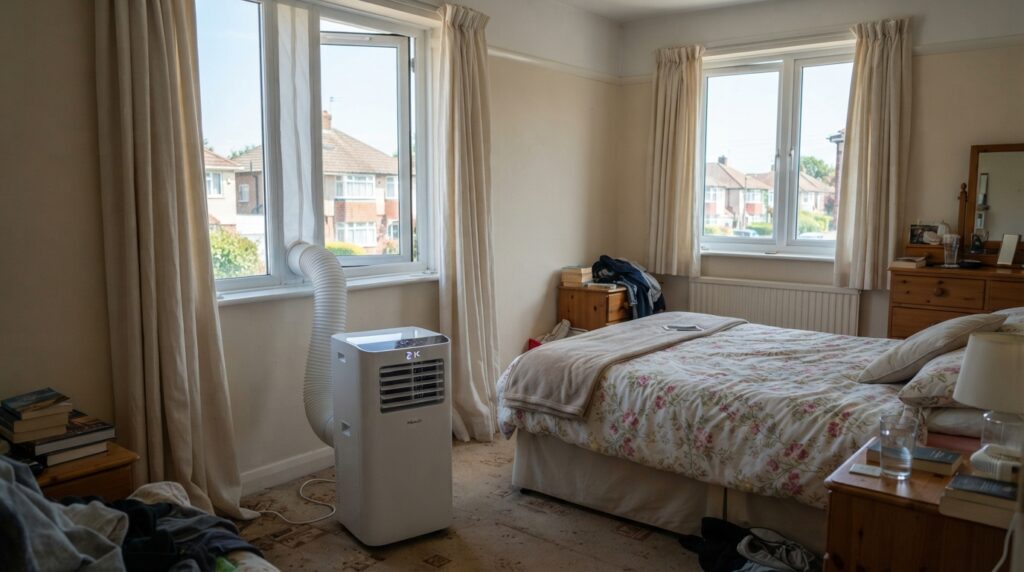
Closed — with the single exception of the small, well-sealed opening the exhaust hose passes through. An open window while the unit runs means you’re cooling outside air as fast as it arrives, which is a task with no end. This matters more with a portable unit than people realise: a single-hose unit expels room air outside, putting the room under slight negative pressure, so any gap you leave is actively pulling warm outside air in. Close the door too, while you’re at it.
A common question, and one where the answer is unusually clear-cut. Here’s why, plus the two situations where opening a window genuinely is the right call.
Why closed
An air conditioner works by removing heat from a defined volume of air and pumping it outside. That only works if the volume stays defined.
Leave a window open and warm outside air flows continuously in. The unit removes heat; the window replaces it. The compressor runs indefinitely, the room never reaches temperature, and your bill climbs.
The negative pressure problem
This part is specific to portable units and worth understanding, because it explains why sealing matters so much more than for a fixed system.
A single-hose portable unit draws air from the room, passes it over the condenser, and blows it out of the window. That air has to be replaced, and it’s replaced by outside air drawn in through every gap in the room — around the window kit, under the door, through the letterbox if the room has one.
So the room is under slight negative pressure. It isn’t passively leaking; it’s actively sucking. Which is why a gap in the window kit costs you far more than intuition suggests, and why sealing it properly is the highest-value free improvement available. Our hose comparison covers the mechanism, and our seal kits guide covers doing something about it.
A dual-hose unit draws its condenser air from outside instead, which largely removes the effect — one of the genuine advantages of that design.
Close the door as well
Same logic, applied internally.
An open door means the unit is cooling the hallway, the stairs and everything connected to them. In a house with an open staircase, warm air rises continuously from downstairs — our stack effect guide covers why that’s a losing battle.
Closing the door is free and does more for performance than most upgrades to the machine.
The two exceptions
1. Before and after, not during
Windows have an important role in cooling — just not at the same time as the air conditioner.
Purge ventilation means opening windows wide once outside is genuinely cooler than inside, getting a through-draught, and letting the building shed its stored heat. Then shutting everything in the morning before outside overtakes inside.
Done properly, that reduces how much work the air conditioner has to do the following day. Done at the wrong time, it actively fills the house with hot air. Most households get the timing wrong, usually opening up in the early evening when it’s still hotter outside than in. A cheap thermometer settles it — our window timing guide covers the discipline.
The sequence that works: purge overnight, close up in the morning, shade the glass, run the unit in a sealed room during the day.
2. Ventilation you shouldn’t block
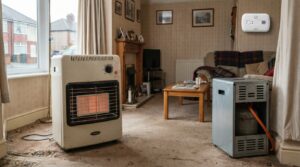
Sealing a room for cooling doesn’t mean sealing a house.
Trickle vents are a smaller consideration. They admit a little warm air, but they’re providing background ventilation for air quality and moisture. Leaving them open is a minor efficiency cost for a real benefit — particularly in a bedroom with the door closed overnight.
The sealing checklist
Once you’ve decided the window is closed, these are worth ten minutes:
- Fill the gaps around the window kit with foam tape or draught strip. The supplied kit fits approximately; approximate isn’t good enough when the room is under negative pressure.
- Check the hose seal at the unit end as well as the window end.
- Draught-strip the door, or use a brush strip at the bottom.
- Check for an open chimney if the room has a disused fireplace — that’s a large permanent opening.
- Close internal doors elsewhere so the room isn’t drawing from the whole house.
Our ten things that improve performance covers the rest, and almost all of it costs nothing.
What about air quality?
A fair concern, since a sealed room means no fresh air.
A portable air conditioner doesn’t ventilate — it recirculates room air over a cold coil. It filters dust, but it doesn’t bring in fresh air or remove carbon dioxide. Our air purification guide covers what these units can and can’t do for air quality.
For a normal room with a person or two, closed for an evening or overnight, that’s not a problem — buildings are not airtight. Leave trickle vents open, and air the room properly at some point in the day. If you’re running it in a small sealed room with several people for extended periods, open up periodically.
Frequently asked questions
Can I leave a window slightly ajar for fresh air?
You can, and it will cost you cooling — particularly with a single-hose unit, where the room actively draws through any gap. Trickle vents are the better compromise: enough background ventilation without an open sash.
What if the exhaust hose window won’t seal properly?
Worth fixing rather than living with, because it’s the largest single leak in the system. Foam board cut to fit, or a purpose-made kit for your window type, will pay for itself quickly. Sash and casement windows are the awkward cases — our period property guide covers them.
Should I open windows overnight instead of running the unit?
Often yes, and it’s free. If outside is genuinely cooler than inside, purge ventilation does the job. On a tropical night — where the temperature doesn’t drop below 20°C — there simply isn’t cooler air to bring in, and that’s when the unit earns its keep.
Does the same apply to heating mode on a heat pump unit?
Yes. Heating mode still exchanges air with outside through the hose, so the same sealing logic applies — a leaky window kit undermines heating exactly as it undermines cooling. Our heating mode guide covers it.
Sources
- GOV.UK — Approved Document F: Ventilation (purge ventilation, trickle vents)
- GOV.UK — Approved Document O: Overheating
- Gas Safe Register — Carbon monoxide safety
- UKHSA — Adverse Weather and Health Plan
- Energy Saving Trust — Draught-proofing
Related reading: our window timing guide and seal kits guide.
Compare portable air conditioners at Amazon UK. Check whether a flexible window kit is included — fit is what determines whether you can seal the opening properly.