How to Cool a Conservatory in Summer (Without Wasting Money)
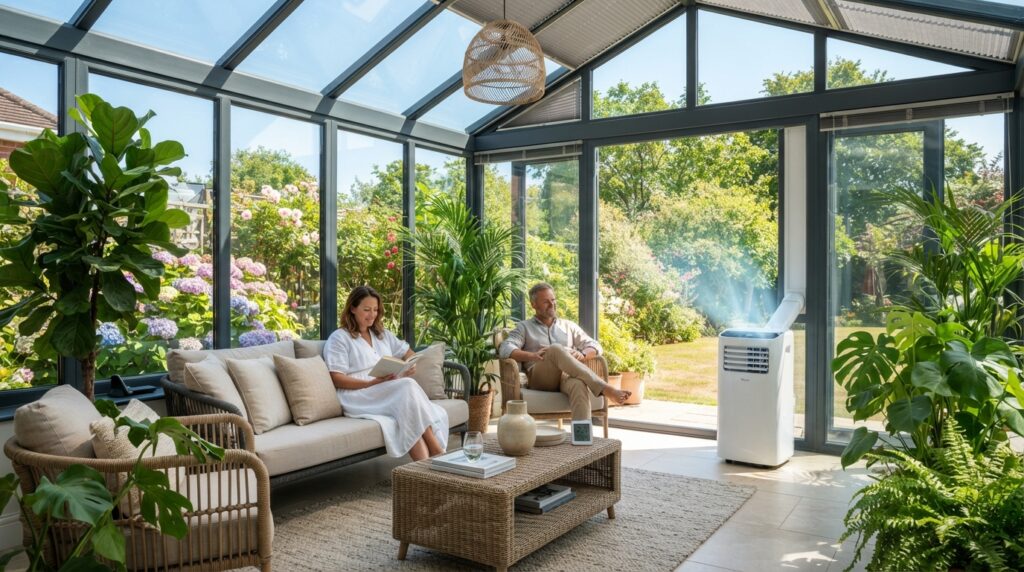
A conservatory is the hardest room in any British house to cool, and the reason is structural rather than a failure of your equipment: it is almost entirely glass, including overhead, with very little thermal mass and minimal insulation. Air conditioning alone will lose that fight on a July afternoon. The order that works is shade the roof first, ventilate properly second, and only then cool — because shading reduces the heat load the machine has to handle, which means a smaller, quieter, cheaper unit is enough. Do it the other way round and you’ll buy an expensive machine that still can’t keep up.
Conservatories get used for about eight weeks a year in practice: too hot in summer, too cold in winter. Here’s what actually changes that.
Why it’s genuinely harder than a normal room
Four things compound, and it’s worth understanding them because they determine which fixes are worth paying for.
Glass roof. The single biggest factor. Upward-facing glazing is the worst possible orientation for solar gain — it takes sun from mid-morning to late afternoon regardless of which way the conservatory faces, and around midday the sun strikes it close to perpendicular, which is the angle at which most energy passes through rather than reflecting off. Our skylight guide covers the physics.
Glass walls. Far more glazing per square metre of floor than any other room.
No thermal mass. A brick room absorbs heat slowly and releases it slowly, which flattens the daily swing. A conservatory has almost nothing to absorb it, so it spikes fast and hard.
Minimal insulation. Thin frames, often single or basic double glazing, and a roof that’s essentially a sheet.
Step one: shade the roof
If you do one thing, do this. It addresses the largest heat source, and it reduces what everything else has to cope with.
External shading beats internal decisively. Once solar radiation passes through glass and hits an internal blind, the energy is already inside — the blind absorbs it, heats up and radiates into the room. External shade absorbs it outside, where moving air carries it away.
- External roof blinds or awnings — the most effective option, and the one that genuinely transforms a conservatory. Expensive, and they need to cope with wind and weather.
- Shade sails or a pergola over the roof — cheaper, less tidy, effective.
- Solar control film applied to the glazing — reflects a portion before it enters. Much cheaper than blinds, permanent, and it doesn’t block the view. The trade-off is that it works year-round and reduces welcome winter solar gain. Check compatibility with your glazing type first; some manufacturers advise against film on certain sealed units.
- Internal roof blinds — better than nothing and good for glare, but subject to the limitation above. If buying internal, get a reflective or foil-backed type, because the outward-facing surface is what matters.
- A solid or insulated roof replacement — the permanent answer, and increasingly common. Note this usually takes the structure outside the conservatory exemption, so Building Regulations approval is likely to apply and it becomes a proper extension. Worth getting right rather than assuming.
Our external shading guide covers the general principle.
Step two: ventilate properly, at the right time
Conservatories often have excellent ventilation potential that goes unused because people open up at the wrong moment.
- Roof vents are the priority. Hot air collects at the top. A roof vent lets it leave by convection, which is far more effective than an open door at floor level. If your conservatory has them, use them; if it doesn’t, retrofitting is worth pricing.
- You need air coming in low. A roof vent alone does relatively little. Open a door or low window at the same time and you get a genuine stack effect drawing hot air up and out.
- Timing decides everything. Open wide once outside is genuinely cooler than inside — which on a hot day may not be until quite late — then shut everything in the morning before outside overtakes inside. Most households get this backwards by several hours. Our window timing guide covers judging it, and a cheap thermometer removes the guesswork.
- Keep the separating doors to the house closed during the day, or the conservatory heats the rest of your home.
Step three: then consider cooling
Now, and only now, does a machine make sense — because the load it faces is far smaller than it was.
Sizing
Standard guidance of roughly 500–600 BTU per square metre assumes a normal room. A conservatory needs substantially more — extensive glazing, a glass roof, minimal insulation and often a sunny aspect all push the requirement up sharply.
Our BTU sizing guide covers the adjustments. Undersizing is the common mistake here, and it produces a unit that runs continuously without ever reaching temperature.
Venting
The practical obstacle people don’t anticipate. Conservatory windows are often top-opening, narrow, or don’t open at all, and the standard slider kit rarely fits.
Realistic routes: a cut panel in an opening casement, a fabric window seal kit designed for awning windows, or a permanent wall vent through the dwarf wall if there is one. Our seal kits guide covers the options, and our bay window guide covers making a cut panel properly.
Work out where the hose is going before you buy, not after.
The picks
MeacoCool MC Series 9000 (MC9000)
For a small, shaded conservatory
16–26m²
53 dB minimum
A-rated
Meaco publish this as suitable for rooms of 16–26m², with an A energy rating and a stated 53 dB minimum noise level. The reason it’s the pick rather than an unbranded unit: Meaco’s specifications are consistent across their own site and major retailers, which matters when you’re making a sizing judgement rather than guessing. Two fan speeds and a dehumidify mode, which is useful in a conservatory that also gets damp.
Good for: a smaller conservatory where the roof is already shaded, used in the evening rather than through the afternoon peak.
Less good for: a large unshaded conservatory in full sun — it will run continuously and still lose. It’s also a mono-block unit with the compressor inside, so it’s audible in a glass room where sound reflects off every surface. And the window kit almost certainly won’t fit a conservatory casement without modification.
MeacoCool MC Series 9000 CH
Cools and heats
8,000 BTU heating
16–26m²
R290
Worth serious consideration for a conservatory specifically, because this room has a problem in both seasons. The MC Series manual publishes 9,000 BTU cooling and 8,000 BTU heating separately, which is the figure you need and which many “4-in-1” listings don’t provide. Instead of sitting unused for eight months, it works through autumn and spring too.
Good for: anyone who wants to use the conservatory more than eight weeks a year; rooms that are unusable in both directions.
Less good for: deep winter. Heat pump output falls as outside temperature drops, and a conservatory loses heat rapidly through its glazing — so it will extend your season rather than make the room usable in January. Note the heating figure is lower than the cooling figure, so size on heating if winter is the main reason.
What about a fan?
A fan removes no heat, but it increases evaporation from your skin so you feel cooler at the same temperature — and it costs a fraction of a penny per hour. In a conservatory used in the evening, after the sun is off the roof, a fan is often enough.
One limit worth knowing: evaporative cooling becomes less effective as air temperature approaches body temperature, and heat guidance for extreme conditions treats fans with more caution for that reason — particularly for older people and anyone unwell. UK conservatories can genuinely exceed that threshold on a hot afternoon. If the room is that hot, the answer is to leave it rather than sit in front of a fan. NHS heatwave guidance is linked below.
Our fan explainer covers using one properly — point it at people, not at the room.
What doesn’t work
- An evaporative air cooler. These add moisture to the air, and a sealed conservatory on a muggy day is the worst place for that — you’d be making the air more humid, which makes heat feel worse. Our comparison covers why.
- Running an air conditioner with the doors to the house open. You’re cooling the house through a glass box. Close them.
- Internal blinds alone on an unshaded roof. They help with glare and a little with heat, but the energy is already inside.
- Opening the doors at 2pm. If it’s hotter outside, you’re making it worse.
The winter half
Worth planning for at the same time, because the same features cause both problems. A conservatory loses heat as fast as it gains it, which is why it’s unusable in January.
Our cold conservatory guide covers that side — including why extending your central heating into a conservatory may remove its Building Regulations exemption, which is a genuine trap.
Frequently asked questions
Is it worth replacing the glass roof with a solid one?
It’s the most effective permanent fix, and it transforms the room in both seasons. Be aware it usually takes the structure outside the conservatory exemption, so Building Regulations approval is likely to apply and structural checks will be needed — the existing frame may not be designed for the weight. Get it assessed properly rather than assuming.
Do I need planning permission for external blinds?
Usually not for a rear conservatory, but if the property is listed or in a conservation area, or you’re leasehold, check first. Our heritage guide and leasehold guide cover those situations.
Why does it get hot even on a cloudy day?
Diffuse solar radiation still passes through glass, and with no thermal mass and little insulation the room responds quickly to whatever it receives. Cloud reduces the effect rather than removing it.
Would a bigger air conditioner fix it?
Only up to a point, and it’s the expensive way round. Shading the roof reduces the heat load permanently and at lower cost, which then makes a modest unit sufficient. If you’ve shaded properly and it’s still too hot, then size up.
Sources
- Planning Portal — Conservatories (exemption conditions)
- GOV.UK — Approved Document L
- GOV.UK — Approved Document O: Overheating
- NHS — Heatwave: how to cope in hot weather
- UKHSA — Adverse Weather and Health Plan
- Meaco Dehumidifiers — MeacoCool MC9000 specifications
- ManualsLib — MeacoCool MC Series manual (CH cooling and heating outputs)
Related reading: our skylight guide and cold conservatory guide.
Compare current specifications at Amazon UK. For a conservatory, size up from the floor-area figure and confirm where the hose will vent before ordering.