Is It Safe to Leave an Oil-Filled Radiator On Overnight? (UK)
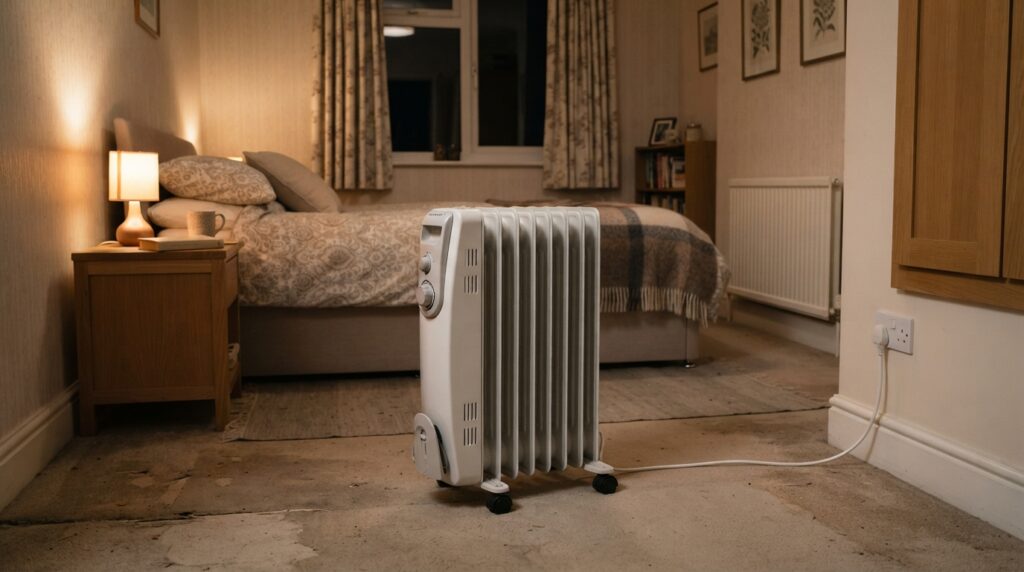
The default advice is no. Hertfordshire Fire and Rescue Service says to turn portable heaters off when you leave the room, leave the house or go to bed, “unless the manufacturer specifically states that the heater is designed for safe overnight use”. So check your heater’s manual first. If you do use one in a bedroom, the fire service and manufacturer rules still apply: keep it at least one metre from anything that can burn, never dry clothes on it, plug it straight into a wall socket (De’Longhi says extension leads must not be used), and have a working smoke alarm. Oil-filled radiators have no exposed glowing element, which is why they’re often thought of as safer than fan or bar heaters, but they still get hot enough to burn, and the manuals ban covering them. A safer approach is to run it while you’re in the room, for example while you get ready for bed, and switch it off before you sleep.
Oil-filled radiators are one of the most popular plug-in heaters in the UK. They’re quiet, they give off a gentle heat, and they keep warming the room for a while after they switch off. That makes it tempting to leave one ticking over in the bedroom all night. Here’s what the fire services and the manufacturers actually say, what it costs, and how to use one safely.
What the fire services say
- Hertfordshire Fire and Rescue Service: “Turn them off when you leave the room, leave the house or go to bed,” “unless the manufacturer specifically states that the heater is designed for safe overnight use.”
- West Sussex Fire and Rescue Service: don’t “leave the heater unattended while it is ignited or you are asleep”.
- Electrical Safety First, as quoted by the Fire Industry Association: make sure a heater “is never left unattended for long periods while in use, or while you are asleep”.
Hertfordshire’s wording is the useful one, because it tells you what to look for: a clear statement from the manufacturer. If your heater’s manual doesn’t say it’s designed for safe overnight use, follow the fire service and switch it off at bedtime.
What the manuals say
We read the instruction manuals for popular models. They don’t directly address sleeping with the heater on, but they’re firm on how and where to use it:
- Clearances. De’Longhi’s Dragon 4 manual says: “The heater must be positioned at least 50cm from furniture or other objects.” Dimplex’s OFX manual asks for at least 75mm of clear space around the radiator. The fire service figure of a metre from anything that can burn is the stricter one, so use that.
- Never cover it. De’Longhi: “never under any circumstances cover the appliances during operation, as this would lead to dangerous overheating.” Another of its Dragon 4 manuals says not to place items over the radiator, “such as to dry washing”.
- Upright only. “Always operate the heater in upright position only (wheels on the bottom, controls on top).”
- No extension leads. De’Longhi says “extension leads must not be used in powering this appliance”.
- Not in the bathroom. Both De’Longhi and Dimplex warn against bathroom use. Our guide to electrics and plug-in appliances explains why sockets and water don’t mix.
- Vulnerable people. De’Longhi says not to use the heater in small rooms occupied by people who can’t leave the room on their own, unless “constant supervision is provided”, and that children under 3 should be kept away unless continuously supervised. It also warns that “some parts of this product can become very hot and cause burns.”
The bedroom checklist
If your manual allows overnight use, or you’re using the heater in a bedroom while you’re awake, these are the rules from the fire services and manufacturers above:
- One metre clear from the bed, bedding, curtains, clothes and anything else that can burn.
- Nothing on it. No drying socks or towels on the fins, ever. Hertfordshire Fire and Rescue says: “Never use a portable heater for drying clothes or towels.”
- Wall socket, not a lead. Hertfordshire also warns against overloading sockets and using “coiled cable drums”. Our guide to extension leads and tripping fuses explains why leads overheat with high-power appliances.
- Stable and upright, on a flat floor where it can’t be knocked over. Hertfordshire suggests choosing a model with tip-over protection if possible.
- A working smoke alarm on every level, tested regularly.
- Children and pets kept away from the hot fins, as the manual warns.
A better way: heat the room while you’re in it
Hertfordshire Fire and Rescue says portable heaters “shouldn’t be left running when a room is unoccupied”, so don’t set a timer to heat an empty bedroom while you’re downstairs. Instead, switch the heater on when you go up, run it while you read or get ready for bed, then switch it off before you sleep. Many oil-filled radiators have a thermostat, and some, like the De’Longhi below, also have a timer, which is useful as a back-up switch-off if you forget. The oil inside stays warm and keeps giving off heat for a while after it switches off, and the radiator stays hot to the touch for a while too. If you still feel the cold overnight, a better-insulated duvet, or an electric blanket designed for all-night use, heats you directly for far less power. And if you wake up cold in the small hours, our guide to waking up at 3am because of bedroom temperature looks at why.
What it costs to run all night
At Ofgem’s price cap rate of 26.32p per kWh for October to December 2026 (Direct Debit), here’s the maximum cost per hour at each setting of a typical 2kW model with three power levels:
| Setting | Power | Max per hour | Max for 8 hours |
|---|---|---|---|
| Low | 900W | About 23.7p | About £1.90 |
| Medium | 1,100W | About 29.0p | About £2.32 |
| High | 2,000W | About 52.6p | About £4.21 |
Those are worst-case figures, assuming the heater draws full power for the whole time. With the thermostat set, it should switch on and off to hold the room temperature: De’Longhi’s manual says that once set, “the thermostat will then adjust the set temperature automatically and keep it constant”. So the real cost depends on how cold the room is and how well it holds heat. Our cheapest way to heat one room guide compares other options.
Check it’s not on a recall list
Heaters do get recalled. West Sussex Fire and Rescue suggests registering appliances up to 12 years old on the Register My Appliance website, which says registering means you’ll “be the first to know of any safety repairs or recalls”. The government also publishes product safety alerts and recalls on GOV.UK. Hertfordshire Fire and Rescue also says to check heaters, plugs and cables regularly for damage and replace unsafe equipment. Stop using a radiator that smells of burning or leaks oil.
De’Longhi Dragon 4 TRDX40820E
Best for: thermostat-controlled heat while you’re in the room
Digital thermostat, 24-hour timer
Safety thermostat, child lock
De’Longhi lists this Dragon 4 as a 2kW oil-filled radiator with three power settings (900, 1,100 and 2,000W), a digital room thermostat, a timer programmable over 24 hours, a safety thermostat, a child lock and an anti-frost setting. The thermostat holds the room at the temperature you set while you’re in it, and the timer is a useful back-up to switch it off if you forget. Follow De’Longhi’s Dragon 4 manuals: at least 50cm from furniture (a metre, per the fire services, from anything that can burn), upright only, never covered, and no extension leads.
Good for: a cold bedroom or home office while you’re using it; a back-up switch-off if you forget.
Less good for: leaving on all night, unless your own model’s manual says it’s designed for that; quick heat, as oil-filled radiators take a while to warm up; homes with toddlers, as the fins get hot.
FireAngel ST-622T smoke alarm
Best for: peace of mind with any plug-in heater
BS EN 14604
Standalone
FireAngel says the ST-622T combines optical smoke sensing with thermal enhancement, runs on a sealed 10-year lithium battery, and meets BS EN 14604. It suggests fitting it in hallways, landings, living rooms, dining rooms and bedrooms. If you use a plug-in heater in a bedroom, a working alarm on that floor is essential.
Good for: replacing old alarms on every level; no battery changes for ten years.
Less good for: kitchens, where FireAngel suggests a heat alarm instead; homes in Scotland, where the law requires interlinked alarms, as this one is standalone.
Frequently asked questions
Can I sleep with an oil-filled radiator on?
Only if your heater’s manufacturer specifically says it’s designed for safe overnight use. Otherwise, Hertfordshire Fire and Rescue Service says to turn portable heaters off when you go to bed, and West Sussex Fire and Rescue Service says not to leave a heater on while you’re asleep.
How far should an oil-filled radiator be from the bed?
Fire services say at least one metre from anything that can burn, which includes bedding and curtains. Manufacturers’ figures are smaller, such as De’Longhi’s 50cm from furniture, so the fire service distance is the safer one to follow.
Can oil-filled radiators catch fire?
They don’t have an exposed glowing element, but they get hot, and De’Longhi warns that covering one “would lead to dangerous overheating”. Fires are more likely when heaters are covered, used to dry clothes, placed close to things that burn or run from overloaded extension leads.
How much does it cost to run an oil-filled radiator overnight?
At most about £4.21 for eight hours on a 2kW setting at the October to December 2026 price cap rate of 26.32p per kWh, or about £1.90 on a 900W setting. With the thermostat cycling, the real cost is usually lower.
Can I dry clothes on an oil-filled radiator?
No. Hertfordshire Fire and Rescue Service says never to use a portable heater for drying clothes or towels, and De’Longhi’s manual says not to place items over the radiator, such as washing.
Sources
- Hertfordshire Fire and Rescue Service — Portable heater safety
- West Sussex Fire and Rescue Service — Electrical safety
- Fire Industry Association, quoting Electrical Safety First — Electric heaters may pose fire risks
- De’Longhi, via Appliances Direct — Dragon 4 instruction manual
- De’Longhi — Dragon 4 instructions (TRD4)
- De’Longhi — Dragon 4 instructions (TRDS4)
- De’Longhi — Dragon 4 TRDX40820E
- Dimplex, via Heatershop — OFX oil-filled radiator instructions
- Register My Appliance — Register my appliance
- GOV.UK — Product safety alerts, reports and recalls
- Ofgem — Changes to the energy price cap, 1 October to 31 December 2026
- FireAngel — ST-622T standalone smoke alarm
- Scottish Government — Fire and smoke alarms in Scottish homes
Related reading: our cheapest way to heat one room, heat pump vs electric heater running costs and should I turn the heating off at night?
Compare the De’Longhi Dragon 4 with timer at Amazon UK.