Do Cool Roof Coatings and White Paint Actually Work?
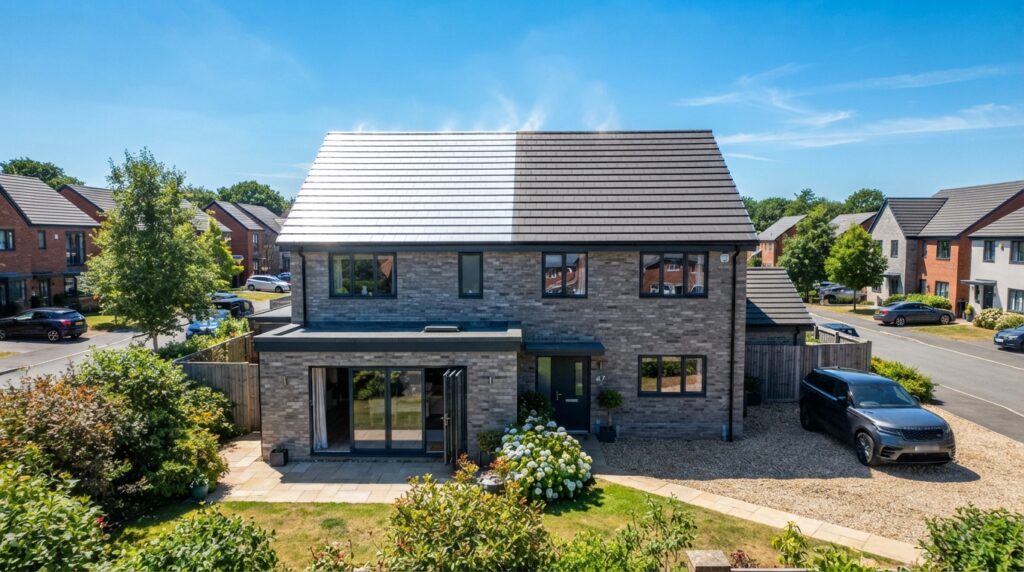
Yes — the physics is solid and well proven. A reflective roof surface bounces back a large share of the sunlight a dark roof would absorb, and the surface temperature difference on a sunny day is dramatic. Cool roofs are a mainstream measure in hot countries for exactly this reason. The honest UK caveats: the benefit is smaller here than in a hot climate, you lose a little useful winter warmth, and — crucially — it only helps much where the roof is directly above the room you’re trying to cool. So it’s genuinely worth doing on a dark flat roof over a top-floor flat, extension, garden room or outbuilding, and largely a waste of effort on a normal pitched roof with a well-insulated, ventilated loft underneath, where the insulation is already doing that job.
“Just paint the roof white” is one of those ideas that’s completely right in principle and often wrong in application. Here’s when it genuinely pays off in a British climate.
The physics, briefly
Two properties determine how hot a roof gets in the sun:
- Solar reflectance (albedo) — the fraction of incoming sunlight the surface bounces straight back rather than absorbing. A dark grey or black roof absorbs the great majority of it; a bright white reflective surface sends much of it back to the sky.
- Thermal emittance — how readily the surface radiates away the heat it has absorbed. A good cool-roof product is high on both: it reflects most of what arrives and efficiently sheds what it takes in.
The result is a roof surface that runs far cooler in direct sun. Since heat flows from hot to cold in proportion to the temperature difference, a cooler roof surface means less heat driven down through the roof build-up into whatever is below. That’s the whole mechanism, and it’s why the approach is standard practice on commercial and residential buildings across hot regions.
The critical question: what’s directly under the roof?
Roof directly over a habitable room — a flat-roofed extension, a top-floor flat, a garden room, a dormer, a converted loft. Here there’s no ventilated void to buffer the heat, so the roof surface temperature translates fairly directly into how hot that room gets. A reflective coating can make a real, felt difference.
Pitched roof over a ventilated loft with good insulation — the standard British house. Here the hot roof heats the loft air, the loft ventilation dumps much of it, and your ceiling insulation blocks most of the rest. The benefit at room level is much smaller, and your money is usually better spent on insulation depth and shading your windows. Our summer insulation guide explains that path in detail.
Where it’s genuinely worth doing in the UK
- Dark flat or shallow-pitched roofs over rooms — the classic case. Flat-roofed extensions and top-floor flats with dark mineral felt or asphalt are often unbearable in a heatwave, and the roof is the main reason.
- Garden rooms and outdoor offices — small, accessible, usually dark-roofed, with the ceiling right under the roof and no loft void. Close to the ideal candidate, and covered in our garden room cooling guide.
- Outbuildings, workshops, sheds and static caravans — often poorly insulated with dark roofs, where a reflective coating is cheap and the difference is obvious.
- Poorly insulated roofs generally — counter-intuitively, the worse your insulation, the more a reflective surface helps, because more of the roof’s heat was getting through.
The honest UK caveats
- Less sun means less benefit. The dramatic figures quoted for cool roofs come from places with far more intense, sustained solar radiation than Britain. The effect is real here; it’s just smaller, which lengthens the payback.
- You lose a little winter solar gain. A dark roof absorbs some useful warmth on sunny winter days. In the UK this is a genuine but minor trade-off — winter sun is weak and low-angle — and it matters more the better your heating and worse your cooling problem.
- The roof must be sound first. A coating is not a repair. Applying reflective paint over a failing, blistered or leaking roof hides a problem rather than fixing it, and it won’t adhere properly to a degraded surface. Fix the roof, then coat it.
- Compatibility matters — don’t just use white masonry paint. Coatings must suit the roof covering (felt, asphalt, single-ply membrane, metal, fibre cement). The wrong product can fail fast, or attack the covering. Use a product specified for your roof type and follow the preparation instructions.
- Lifespan and reapplication. Coatings weather, and reflectivity declines as they get dirty — a grubby white roof reflects noticeably less than a clean one. Expect periodic cleaning and eventual recoating.
- Warranties. Coating a roof can affect the roof covering’s or installer’s warranty. Check before you do it, particularly on a newer flat roof.
- Condensation risk if you change the build-up. Flat roofs are designed as warm or cold constructions with specific vapour control. Adding layers, or changing the thermal behaviour significantly, can shift where condensation forms within the build-up. For anything beyond a surface coating on a sound roof, take advice from a roofing professional.
- Appearance and permissions. A brilliant white roof is visible. In a conservation area, or on a listed building, changing the appearance of a roof can require consent — the same pattern as our external shutters guide. Check with your local planning authority if the roof is visible or the building is protected. Flat roofs hidden behind a parapet rarely raise this issue.
The options
- Elastomeric / acrylic reflective coatings — liquid-applied, flexible, designed for flat roof coverings. The mainstream choice, and many also add a waterproofing layer to a sound roof.
- White single-ply membranes — if the roof is being replaced anyway, specifying a light-coloured membrane gets you the cool-roof benefit built in, at no extra ongoing effort. Easily the best-value route when a flat roof is due renewal.
- Reflective paint for outbuildings and sheds — the cheap and cheerful end, fine for a workshop or shed roof where appearance and longevity matter less.
- Lighter tiles or slates when a pitched roof is being re-covered — a marginal gain in the UK given the loft buffer, but free to choose at the time.
- Green (living) roofs — also cool the roof, via shading and evaporation, with drainage and biodiversity benefits. Much heavier and more involved; structural advice essential.
How it compares with the alternatives
If you have a room baking under a flat roof, you have three broad options, and it’s worth being honest about the ranking:
- Insulate the roof properly — usually the most effective and durable fix, especially if the roof is being renewed anyway. Denser insulation with good decrement delay performs best in summer.
- Reflective coating — far cheaper and less disruptive than re-roofing, and a strong option on a sound roof you’re not about to replace.
- Shade the windows and ventilate at night — still the biggest levers for most rooms, and cheaper than both. Our window and shading guide and no-AC cooling guide cover them.
These aren’t mutually exclusive, and a coating plus shading plus night ventilation will transform a hot top-floor room far more than any one of them alone — and reduce the size of cooling unit you’d need if you go that route.
Frequently asked questions
Does painting a roof white actually cool the building?
Yes, in principle — a reflective surface absorbs far less solar energy, so the roof runs much cooler and drives less heat downwards. Whether you feel it indoors depends on what’s under the roof: a lot on a flat roof over a room, very little on a pitched roof over a well-insulated ventilated loft.
Can I just use ordinary white masonry paint?
No — use a coating specified for your roof covering. Ordinary paint may not adhere, may not stay flexible, can fail quickly and could damage the covering. Roof coatings are formulated for the movement, water and UV exposure a roof gets.
Will it make my house colder in winter?
Very slightly — you give up some passive solar warmth on sunny winter days. In the UK that’s a minor trade-off because winter sun is weak, and it’s usually outweighed if you have a genuine summer overheating problem.
Do I need permission to change my roof colour?
Often not on an ordinary house with a hidden flat roof, but changing the appearance of a roof can require consent in a conservation area or on a listed building. Check with your local planning authority if the roof is visible or the building is protected.
How long does a reflective coating last?
It weathers and gets dirty over time, and reflectivity falls as it does, so expect periodic cleaning and eventual recoating. Check the manufacturer’s stated life and maintenance requirements for the specific product.
Sources
- GOV.UK — Approved Document O: Overheating
- GOV.UK — Approved Document L: Conservation of fuel and power
- Energy Saving Trust — Roof and loft insulation
- Planning Portal — Roof: planning permission
Related reading: our garden room cooling guide and summer insulation guide.
A reflective coating suits a sound, dark flat roof over a habitable space. Compare current options at Amazon UK.