Why Does My Bedroom Get Hotter When I Close the Door?
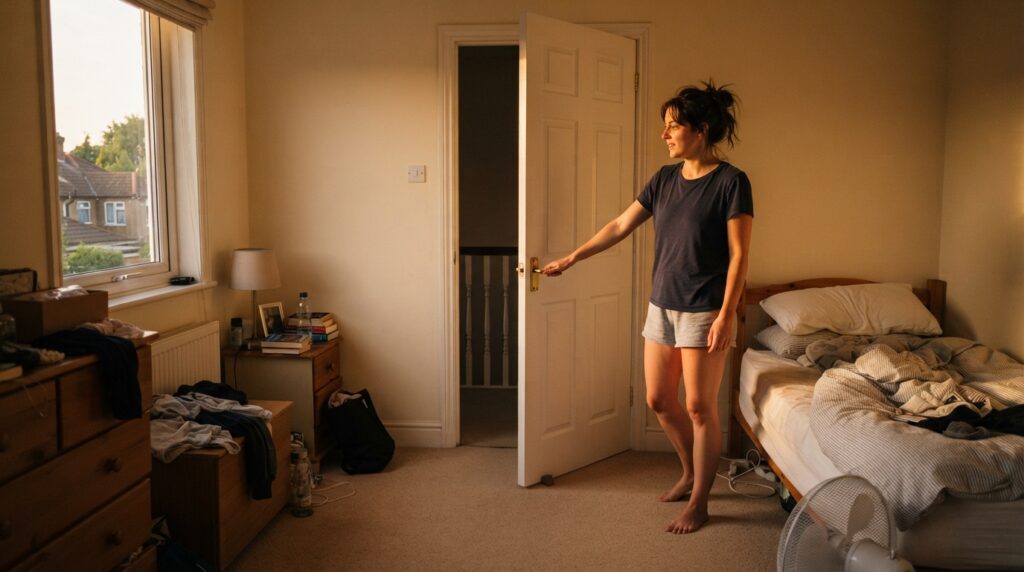
Because a closed door works both ways, and which way depends on where the heat is coming from. If your room’s heat is arriving from outside — through the window or down from the loft — closing the door traps it, along with the heat and moisture you produce overnight. If the heat is arriving from the rest of the house, closing the door keeps it out. The distinguishing test is simple: is the room hotter or cooler than the landing? If the room is the hotter one, the door is trapping heat. If the landing is hotter, the door is protecting you.
This confuses people because the standard advice — “close the door to keep the room cool” — is written for someone running air conditioning. Without it, the answer flips.
The two situations
Situation A: the heat is coming from your room
Most common in a south or west-facing bedroom, an upstairs room under an uninsulated loft, or a loft conversion.
Here the room is generating its own problem. Sunlight has been coming through the glass all day, the roof above has been radiating downward since mid-afternoon, and the walls and furniture have absorbed all of it. Close the door and that heat has nowhere to go — plus you add your own body heat and moisture through the night.
An open door helps, because it gives the heat somewhere to disperse into and lets cooler air from the rest of the house reach you.
Situation B: the heat is coming from the house
Common in a ground-floor bedroom, a north-facing room, or any bedroom in a house where cooking, appliances and a warm stairwell are the main heat sources.
Warm air rises up an open staircase continuously — our stack effect guide covers the mechanism. If your room is cooler than the landing, an open door invites that warm air in.
A closed door helps here, and closing the door at the foot of the stairs helps more.
The test
Two thermometers, or one moved between locations, settles it in an evening.
- Measure your bedroom at bedtime.
- Measure the landing or hallway at the same time.
- Room hotter than landing → your room is the heat source. Open the door, and address the window and the loft.
- Landing hotter than room → the house is the source. Close the door, and close the stairwell door if you have one.
A thermometer that records overnight minimum and maximum is more useful than a spot reading, because the crossover often happens during the night. Our thermometers guide covers options.
The overnight complication
The answer can change during the night, which is why people get contradictory results.
A west-facing bedroom is the hottest room in the house at 11pm, having taken the low evening sun full on the glass — our west-facing guide covers why. By 4am it may have shed that heat and be cooler than the rest of the house.
A practical compromise many people land on: door open while the room sheds its stored heat, closed later. Or simply left ajar, which splits the difference.
What you add to the room overnight
Underestimated, and it’s the reason a small sealed bedroom feels stuffy by morning regardless of the outside temperature.
A sleeping person produces heat continuously, and moisture through breathing and perspiration. In a small room with the door and window closed for eight hours, both accumulate. Rising humidity also makes evaporative cooling from your skin less effective, so you feel warmer even if the temperature hasn’t moved much — the mechanism in our “feels like” guide.
Leave trickle vents open even with the door and window shut. They provide background ventilation for air quality and moisture, and the heat penalty is minimal.
What actually fixes it
The door is a workaround. These address the cause:
- Shade the window from mid-morning, before the room heats. The highest-value free action, and closing curtains at bedtime achieves very little by comparison. Our blackout blinds guide covers what to look for — a reflective outward face matters more than opacity.
- Check the loft insulation if the room is upstairs. Around 270mm of mineral wool is current guidance, and many homes have far less. It slows heat coming down in summer as well as escaping in winter — our loft guide covers checking with a ruler.
- Purge ventilate properly. Window wide and door open once outside is genuinely cooler than inside, to get a through-draught. Then shut up in the morning. Our timing guide covers judging the crossover, which most households get wrong by hours.
- Move heat sources out. Phone chargers, a TV on standby, a laptop, a router. Individually small; collectively they add up in a closed room — our standby guide covers how much.
- Close the stairwell door, if you have one, rather than the bedroom door. It intercepts the heat before it reaches the landing.
If you run an air conditioner, the answer is unambiguous
Close the door. No exceptions.
With a unit running you’re cooling a defined volume, and an open door means attempting the hallway, the stairs and everything connected to them. This is the single biggest free improvement to a portable unit’s performance, and it’s covered in our windows and doors guide alongside why sealing the window kit matters so much with a single-hose unit.
The fire safety point
Frequently asked questions
Should I sleep with the window open too?
If outside is genuinely cooler than inside, yes — that’s how the room sheds stored heat. On a tropical night, where the temperature doesn’t drop below 20°C, there isn’t cooler air to bring in and you may be letting warm air and noise in for nothing. Our tropical nights guide covers why those nights matter.
Does an open door help if the rest of the house is air conditioned?
Yes, obviously — you’d be sharing the cooled air. But a portable unit can’t cool a whole house, so in most UK homes the choice is which single room gets cooled, not whether the house is cool.
Why does it feel stuffy rather than just hot?
Usually humidity from breathing and perspiration accumulating in a closed room. Trickle vents open, or a window ajar, addresses that without much heat penalty.
In winter, should the door be open or closed?
Closed, generally — it retains heat and slows fire spread. But turn the radiator down rather than off in rooms you close up, or cold surfaces produce condensation and mould. Our closing doors guide covers the winter version.
Sources
- National Fire Chiefs Council — Home fire safety (closing doors at night)
- GOV.UK — Approved Document F: Ventilation (trickle vents, purge ventilation)
- Energy Saving Trust — Roof and loft insulation
- Met Office — Tropical nights and their impact
- NHS — Heatwave: how to cope in hot weather
Related reading: our upstairs heat guide and night waking guide.
Related guides


Compare current prices, stock and reviews on portable air conditioners at Amazon UK. Prices and stock move fast in a heatwave, so it is worth checking before you commit.
Browse air conditioners →