Why Is My Electricity Bill So High in Summer?
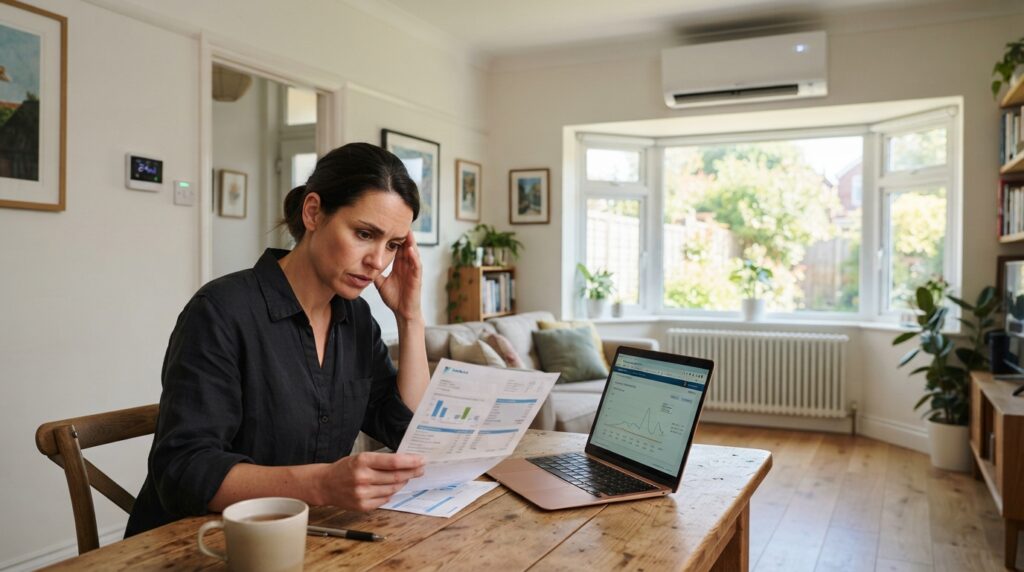
Usually one of five things, and it’s rarely the one people assume. Check in this order: an estimated rather than actual meter reading (the most common cause of a shock bill), a standing charge on a low-usage month, fridges and freezers working harder in the heat, cooling equipment running longer than you realise, and the tariff itself having changed. Take a meter reading before assuming anything — half of these bills resolve at that step.
A summer electricity bill that’s higher than expected is genuinely confusing, because the instinct is that summer should be the cheap season. Here’s how to work out what’s actually going on.
Start here: is it an estimate?
This is the single most common cause of a shock bill and it’s the first thing to check.
If your supplier hasn’t had an actual reading, they estimate — and estimates are frequently wrong in both directions. A run of low estimates followed by a correction produces a bill that looks alarming but is actually catching up on months of under-billing.
Look for the letter E next to the reading on your bill (estimated) versus A or C (actual or customer-provided). If it’s estimated, take a reading now and submit it. Do this before anything else — it either explains the bill or rules the explanation out.
Smart meters should remove this, but only if they’re actually communicating. Plenty are in “dumb” mode after a supplier switch or signal problem. Check your in-home display is showing current data.
The standing charge trap
Every electricity account pays a daily standing charge regardless of usage. In a low-consumption month it can be a large proportion of the bill.
So the bill may not be high in absolute terms — it may just feel disproportionate to how little you used. Worth checking how your bill splits between standing charge and unit consumption before concluding your usage has risen.
The genuine summer loads people forget
Fridges and freezers
Frequently the biggest hidden summer increase, and almost nobody thinks of it. A fridge or freezer works by moving heat from inside to the room. The warmer the room, the harder it works and the longer it runs.
A freezer in a hot garage or utility room in August can be running dramatically more than in February — and it’s on 24 hours a day, every day, unlike anything else. That accumulates.
Worth checking: door seals still sealing, coils at the back not clogged with dust, and adequate air gap around the unit.
Cooling equipment, running longer than you think
A portable air conditioner typically costs somewhere in the region of 19–39p an hour to run depending on capacity — our running cost guide has the detail.
That’s modest per hour. The catch is duration. Running eight hours a day for three weeks of a heatwave adds up in a way a single hourly figure doesn’t make obvious, and it’s the accumulation that catches people out rather than the rate.
Fans are cheap — a few pence a night — but several running continuously across a household is still something.
Everyone being home
School holidays mean more people in the house for more hours: more cooking, more laundry, more devices, more everything. This is a genuine and often overlooked summer effect.
The tumble dryer, ironically
You’d expect summer drying outdoors to reduce this. But hay fever sufferers often avoid line-drying during pollen season — our hay fever guide covers why — and a wet British summer means indoor drying anyway.
Hot tubs, pools and garden equipment
If you have a hot tub, it’s very likely your largest single summer load, and it runs continuously to maintain temperature. Paddling pool pumps, garden lighting and outdoor sockets all add up too.
Check whether the tariff changed
Sometimes the usage is fine and the price moved.
- Did a fixed deal end? Rolling onto a standard variable tariff can produce a significant jump with no change in behaviour.
- Has the price cap changed? Ofgem reviews it quarterly, and it moves both ways.
- Are you on a time-of-use tariff and using more at peak? Running cooling through the expensive evening window is worse than running it in the afternoon.
How to actually find the culprit
- Take a meter reading now and submit it. Rules out the estimate problem.
- Compare against the same month last year, not against last month. Summer versus spring tells you nothing useful; summer versus last summer does.
- Check the split between standing charge and unit consumption.
- Use your smart meter display to watch what happens when you switch things on and off. Genuinely revealing.
- Or use a plug-in energy monitor on individual appliances to get real numbers rather than guesses.
- Read your meter at bedtime and again first thing, before using anything. That gives you your overnight baseline — what’s running constantly. A high baseline points to fridges, freezers, a hot tub, or always-on equipment rather than anything you actively use.
That last step is the most useful diagnostic on this page.
What genuinely reduces summer cost
- Stop heat entering. Closing curtains and blinds on sun-facing windows before the room heats reduces how long cooling runs. External shading is better still — our shading guide covers it. This is free or cheap and reduces the largest controllable load.
- Don’t set cooling colder than needed. A lower target means longer running, not faster cooling — our temperature setting guide explains why.
- Seal the window kit properly. A leaking kit means the unit fights itself. Our seal kits guide covers the fit.
- Clean the filter. A clogged filter restricts airflow and extends run time — our maintenance guide covers it.
- Check the freezer’s location. Moving one out of a hot garage, or improving ventilation around it, has an outsized effect because it runs constantly.
- Switch off equipment that’s genuinely on. True standby is negligible; a desktop PC idling all day is not — our standby guide has the numbers, and that heat also makes your cooling work harder.
Pro Breeze 7000 BTU
Cheapest of our picks to run
53 dB
~£296
~19p/hr
If cooling is genuinely the driver of your summer bill and you’re replacing an older or oversized unit, running cost is the specification to compare — not BTU or price. This is the lowest-consumption unit in our range, suited to rooms up to around 20m². Correct sizing matters more than raw capacity: an oversized unit costs more to run without cooling better.
If the bill is genuinely unaffordable
Worth saying plainly rather than leaving out. If you’re struggling, contact your supplier early — they have obligations to help customers in difficulty, including affordable payment plans, and some operate hardship funds.
Citizens Advice can check what support you’re entitled to, and several schemes are widely under-claimed. There’s no advantage to waiting until the debt is larger.
Frequently asked questions
Shouldn’t summer bills be lower than winter?
Overall energy usually is, because heating dominates winter. But if your heating is gas, your electricity bill may not follow that pattern at all — electricity usage can genuinely be flat or higher in summer, especially with cooling, more time at home, and appliances working harder in the heat.
Is my air conditioner faulty if it’s costing more than expected?
Possibly, but check the simple things first: a clogged filter, a poorly sealed window kit, or a unit undersized for the room and therefore running constantly. Our not cooling properly guide covers genuine faults.
Can I dispute a bill I think is wrong?
Yes. Contact your supplier with an actual meter reading. If you can’t resolve it, the Energy Ombudsman can consider complaints after you’ve given the supplier a chance to respond — typically after eight weeks or a deadlock letter.
Would a smart meter help?
It removes estimated bills and lets you see live usage, which is genuinely useful for finding what’s expensive. It doesn’t reduce consumption by itself — that comes from acting on what you see.
Compare current prices, stock and reviews on portable air conditioners at Amazon UK.
Sources
- Ofgem — Energy price cap (unit rates and standing charges, reviewed quarterly)
- Ofgem — Getting help if you can’t afford your energy bills
- Citizens Advice — Check if your energy bill is wrong
- Citizens Advice — Grants and benefits to help pay energy bills
- Energy Saving Trust — Home appliances and energy use
- Energy Ombudsman — energyombudsman.org
Related reading: our running cost guide and appliance comparison guide.