Air Conditioning for a Server Room, Shop or Small Business
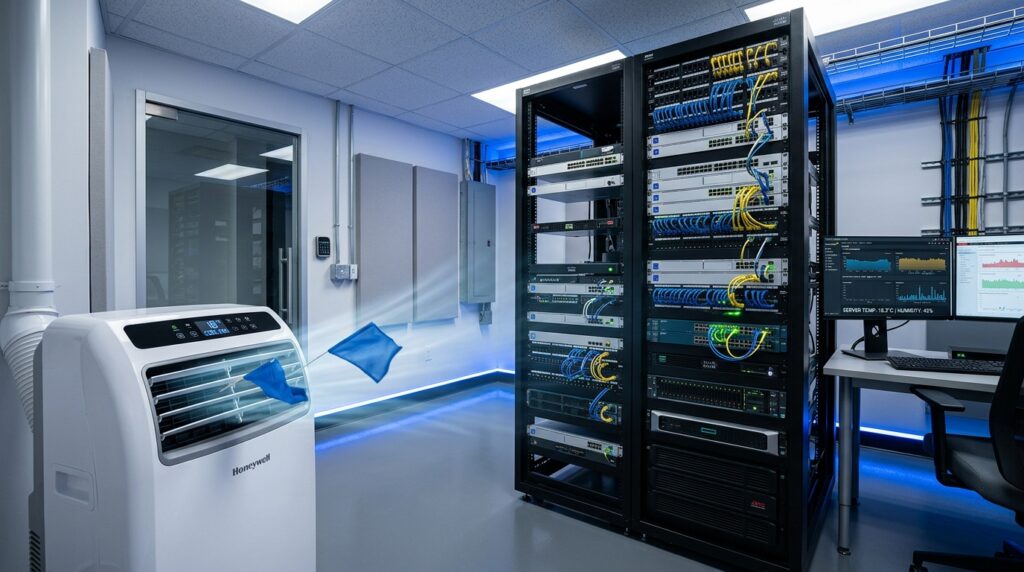
These are three different problems. A small comms cupboard needs continuous, unattended, reliable cooling — so continuous drainage is non-negotiable, and monitoring matters more than capacity. A shop floor needs enough capacity for a space with doors opening constantly, which is a losing battle for a portable unit unless the doorway is managed. An office is closest to a domestic situation. In all three, if this is a business premises, you have obligations that don’t apply at home — worth reading the last section.
Comms cupboards and small server rooms
Why heat matters here
Electronic equipment generates heat continuously and has no seasonal off-period. In a small, unventilated cupboard, that heat has nowhere to go and accumulates through the night and across weekends — when nobody is there to notice.
Check your equipment manufacturer’s stated operating temperature range rather than relying on a general figure. Ranges vary between manufacturers and between equipment classes, and the manufacturer’s documentation is the only authority for your specific kit.
What a portable unit can and can’t do
The disqualifying problem is drainage. A portable unit stops when the condensate tank fills. In a room nobody visits, it will fill and it will stop, and the first you’ll know is when something overheats.
If you use one anyway, as a stopgap:
- Set up continuous drainage — a hose to a drain with a continuous downhill run, so the tank never fills. This is not optional here. Our drainage guide covers it, including why “self-evaporating” isn’t the same thing.
- Fit a temperature monitor with alerts to your phone. Cheaper than the equipment it protects, and it turns a silent failure into a notification.
- Vent properly. Cooling a sealed cupboard while dumping the exhaust into the same room achieves nothing — the hose must go outside.
- Don’t block the equipment’s own airflow with the unit or hose.
- Watch the electrical load. A compressor on the same circuit as your IT equipment is a poor arrangement — a trip takes both down. Our electrical guide covers the diagnosis.
- Consider whether ventilation alone would do. For a cupboard with a switch and a router, an extract fan moving heat out may be sufficient and far more reliable than a compressor.
Shops and retail spaces
Honestly assessed, this is difficult for a portable unit.
The door is the problem. A shop door opening every few minutes means a continuous exchange of cooled air for outside air. A portable unit cannot keep up with that, and the single-hose negative-pressure effect makes it worse — our hose comparison explains the mechanism.
What helps more than a bigger machine:
- Managing the doorway. A closed door, an air curtain, or a lobby arrangement changes the arithmetic more than any amount of extra capacity.
- Shading the shopfront glass. A south or west-facing shopfront is a large area of glazing gaining heat all day. An awning is a substantial improvement and does other jobs too.
- Dealing with lighting. Older retail lighting generates real heat. LED replacement cuts both the heat and the electricity bill.
- Cooling the staff position rather than the whole floor — a fan at the till is cheap and effective.
For a shop floor you actually want cool, a fixed system is the real answer. That’s a commercial installation with a certified installer, and possibly planning considerations for an external unit — our installation law guide and heritage guide cover those, and high-street premises are frequently in conservation areas.
Small offices and treatment rooms
The most straightforward case, and closest to a domestic situation. A portable unit in a sealed room with a decent window kit works.
Points specific to a business setting:
- Noise matters more. In a consulting room, salon or treatment room, a loud unit affects the client experience. Check the decibel figure and the fan speed it was measured at.
- Positioning. Don’t blow cold air directly at anyone seated for an hour.
- Trip hazards. A hose across a floor used by the public is a liability question, not a tidiness one.
- Filter hygiene. In any setting with clients or treatment, a neglected filter blowing dust and mould is a bigger issue than at home. Our maintenance guide covers the routine.
The picks
MeacoCool MC Series 9000 (MC9000)
Small office or treatment room
16–26m²
53 dB minimum
A-rated
Meaco publish 16–26m², an A energy rating and a 53 dB minimum noise figure. For a small office or consulting room this is a sensible capacity with documented specifications and UK warranty support, which matters more in a business setting than at home — downtime costs you money.
Good for: a sealed office, consulting room or treatment room with a workable window; anywhere you need a documented specification rather than a marketplace listing.
Less good for: a shop floor with a door opening constantly, where it will run continuously and lose. Also not suitable for unattended critical cooling — the tank-full shutdown is the disqualifying issue, and a hose across a public floor is a hazard to manage.
A temperature monitor with phone alerts
Buy this before the cooling
Logs history
Cheap insurance
The item we’d buy first for any comms cupboard, and it costs a fraction of the equipment it protects. A monitor that alerts your phone when a threshold is crossed turns a silent overnight failure into a notification you can act on. Logging also tells you whether you have a real problem or an assumed one — which sometimes saves you the cost of the air conditioner entirely.
Good for: any unattended space with equipment in it; establishing whether cooling is actually needed before spending on it.
Less good for: doing anything about the heat. It tells you there’s a problem, it doesn’t fix one — and it depends on your Wi-Fi and power staying up, which is exactly what may fail. For genuinely critical equipment, a professionally specified system with proper monitoring is the answer rather than a consumer sensor.
Obligations that don’t apply at home
Worth knowing if these are business premises, and absent from most coverage.
- Workplace temperature. The Workplace (Health, Safety and Welfare) Regulations 1992 require a reasonable indoor temperature. There is no maximum legal figure — the widely repeated 30°C claim has no basis in law — but there is a duty to assess and control risk. Our workplace temperature guide covers this properly.
- Electrical safety. Business premises have obligations under the Electricity at Work Regulations 1989, and portable appliance inspection regimes apply to equipment in a workplace. A portable air conditioner in a shop is work equipment.
- Fire safety. The Regulatory Reform (Fire Safety) Order 2005 applies. Hoses and cables must not obstruct escape routes, and a responsible person must keep the fire risk assessment current.
- Installation. A fixed system needs a certified installer. For F-gas refrigerants that means F-Gas certification; note that R290 is a hydrocarbon and falls outside that regime, so ask specifically about competence with A3 flammable refrigerants — our R290 guide explains the gap.
- Lease terms. If you rent commercial premises, check what alterations your lease permits before anything is installed.
- Tax. Equipment for business use may be treated differently from domestic — an accountant question. Our business expense guide covers the questions to ask.
Frequently asked questions
What temperature should a server room be?
Check your equipment manufacturer’s stated operating range rather than a general figure — ranges vary by manufacturer and equipment class. Stability and humidity control matter alongside the temperature itself.
Can I leave a portable unit running unattended all weekend?
Only with continuous drainage set up, and even then we wouldn’t rely on it for anything critical. Without drainage the tank will fill and the unit will stop. Fit a monitor with alerts regardless.
Is a portable unit enough for a small shop?
Usually not, if the door is opening regularly. It may make the staff area behind the counter tolerable. For the shop floor itself, a fixed system or managing the doorway is the real answer.
Do I need to tell my landlord?
For a plug-in portable unit vented through an opening window, usually not — but check your lease. For anything fixed or drilled, yes, and get it in writing.
Sources
- HSE — Managing workplace temperature
- HSE — Temperature FAQs (no maximum temperature)
- Legislation.gov.uk — Workplace (Health, Safety and Welfare) Regulations 1992
- HSE — Electrical safety at work
- GOV.UK — Fire safety in the workplace
- GOV.UK — Fluorinated gases (F-gases): rules
- BESA — Rise of propane sparks safety fears
- Meaco Dehumidifiers — MeacoCool MC9000 specifications
Related reading: our workplace temperature guide and drainage guide.
Compare current specifications at Amazon UK. For any unattended space, budget for continuous drainage and a temperature monitor alongside the unit itself.