Air Conditioner Keeps Tripping the Fuse or RCD: Causes and Fixes
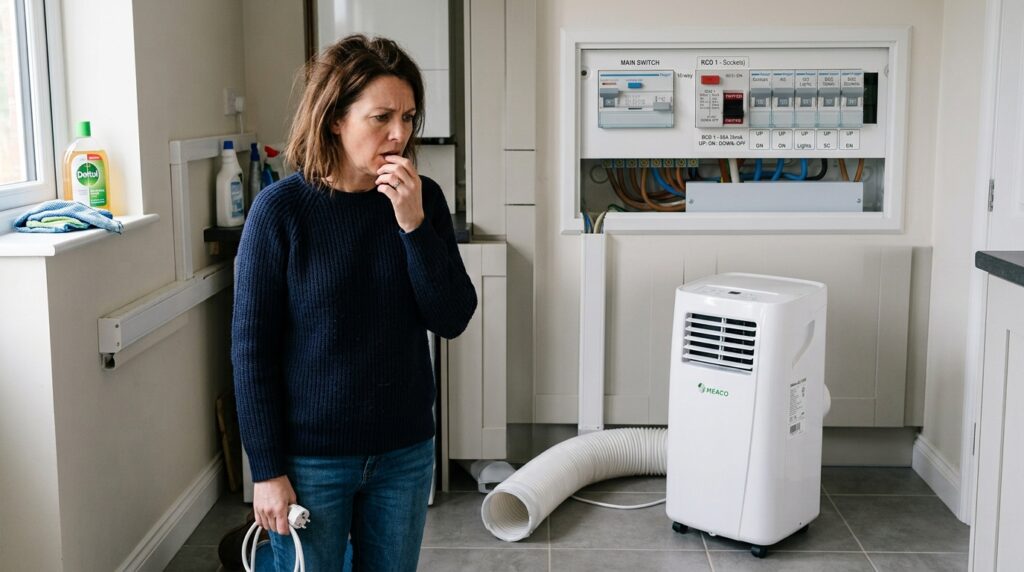
Start by identifying what actually tripped, because it tells you which problem you have. An MCB — a single circuit switch — means overload or a short circuit on that circuit, and the usual cause is too much on one ring or an extension lead that can’t cope. An RCD — the larger switch with a test button, covering several circuits — means an earth leakage fault, which is more serious and more likely to be the appliance itself. Most cases are the first kind and come down to plugging a high-current appliance into an extension lead. Plug it directly into a wall socket.
Portable air conditioners are among the most demanding plug-in appliances in a home — high current, for hours, with a repeated startup surge. UK domestic circuits are frequently closer to their limit than people realise.
Step 1: Work out what tripped
Go to the consumer unit and look at which switch has moved. This single step narrows the problem enormously, and most guides skip it.
- An MCB — one of the row of individual switches, each serving one circuit. If one of these has flipped, you have an overload or a short circuit on that circuit.
- An RCD — usually a larger switch with a test button, protecting a group of circuits. If this has tripped, there’s an earth leakage fault: current is going somewhere it shouldn’t. This is the more serious finding.
- An RCBO — combines both functions in one device per circuit. Common in newer installations, and it can trip for either reason.
An RCD tripping consistently when one specific appliance runs points at that appliance. Stop using it and get it checked, rather than working through the overload steps below.
Step 2: Get it off the extension lead
The single most common cause, and the one with a genuine safety dimension rather than just inconvenience.
Two things make air conditioners hard on extensions:
Sustained high current. A kettle draws a lot for two minutes. An air conditioner draws a significant load for six hours, often overnight. Heat builds in a marginal connection over time, and heat degrades insulation, which makes the connection worse — a self-worsening cycle.
Repeated startup surge. The compressor draws a spike well above its running figure every time it cycles, which may be many times an hour.
Plug directly into a wall socket. If the tripping stops, the extension was the problem — underrated, coiled, faulty or overloaded.
If your only socket is across the room, the right fix is another socket, not a longer lead. Having an electrician add one is not expensive, it’s permanent, and it removes a trip hazard. In England and Wales, adding a new circuit is notifiable under Part P of the Building Regulations; a registered electrician can self-certify.
Step 3: Reduce what’s on the circuit
A UK ring final circuit typically serves a whole floor or a large part of one. Everything plugged into it shares that capacity.
Unplug other high-draw items in the same area — kettle, microwave, tumble dryer, heater, another air conditioner — and try again. If it holds, you had an overload rather than a fault.
To work out your unit’s draw: find the wattage on the rating plate, divide by 230. A 1,000W unit draws roughly 4.3A; a 1,400W unit roughly 6A. Add everything else running at once. Electrical Safety First publishes a socket overload calculator, linked below, which takes a minute.
Worth checking: smart plugs are frequently rated well below 13A. Putting a high-wattage appliance through one that isn’t rated for it is exactly the kind of sustained overload that causes fires. Check the stated maximum load before using one. Our smart plugs guide covers this.
Step 4: Check the appliance itself
An air conditioner working harder than it should draws more current. Three things make it labour:
- A clogged filter restricts airflow, so the compressor runs longer and hotter for the same result. Clean it — our maintenance guide covers the routine, and this is the answer more often than people expect.
- An iced-up coil blocks airflow entirely. Our frozen coils guide covers the causes.
- A kinked or blocked exhaust hose, or insufficient clearance around the intake and outlet, means the unit can’t reject heat and works against itself.
Also check for moisture ingress. Water reaching electrical components is a classic cause of RCD trips, and these machines produce water continuously. Our leaking water guide covers the causes.
Step 5: Isolate the fault
If it’s still tripping, this establishes whether the problem is the appliance or the circuit:
- Try the unit on a different circuit — a socket on another floor, ideally. If it trips there too, the appliance is the likely fault.
- Try a different appliance on the original socket. If that trips too, the circuit or socket is the problem.
- Note whether it trips at startup or during running. Startup-only points at the surge and a marginal circuit; during-running points at a developing fault.
When to stop and call an electrician
- It trips on a bare wall socket with nothing else on the circuit
- The RCD trips consistently when this appliance runs
- Any burning smell, scorch marks, or a warm plug or socket — see our burning smell guide
- The RCD trips with nothing plugged in
- Multiple appliances trip the same circuit
- You’re in an older property where the installation hasn’t been inspected recently
Find a registered electrician via NICEIC, NAPIT or the Electrical Competent Person register, all linked below. If you rent, this is your landlord’s responsibility — landlords in the private rented sector have electrical safety obligations including periodic inspection, and you’re entitled to a copy of the report.
Why older properties trip more
Worth knowing rather than assuming your unit is faulty:
- Older installations were designed for far fewer appliances than a modern household runs.
- RCD sensitivity means small leakage currents that were previously unnoticed now trip the device — which is the RCD working correctly, not a nuisance.
- Cumulative leakage. Many modern appliances have a small inherent earth leakage. Individually negligible, collectively they can approach the RCD’s threshold, so adding one more tips it over.
- Shared circuits in flats and HMOs are frequently carrying more than intended. Our house share guide covers that situation.
Frequently asked questions
Is it safe to keep resetting the breaker?
No. An occasional trip after an obvious overload is one thing; repeated resetting on an unexplained fault is not safe. The device is protecting you.
Why does it only trip when the compressor starts?
The startup surge. On a circuit close to its limit, that spike pushes it over. Reducing other load usually resolves it; if it doesn’t, an electrician should look at the circuit.
Can I use a bigger fuse in the plug?
No. The fuse is sized to protect the appliance’s cable. Fitting a larger one removes that protection and is genuinely dangerous. If the correct fuse keeps blowing, there’s a fault.
Would a smaller unit solve it?
Possibly, if the problem is straightforward overload — a lower-wattage unit draws less. But an undersized unit runs continuously, which partly offsets the saving. Size to the room properly: our sizing guide covers it.
Is it safe to run overnight?
On a wall socket with a sound plug and a clean filter, that’s normal use. On an extension lead in a room where everyone’s asleep, it isn’t. Test your smoke alarms regardless.
Sources
- Electrical Safety First — Overloading sockets (includes the socket overload calculator)
- Electrical Safety First — Extension leads
- Electrical Safety First — RCDs explained
- GOV.UK — Approved Document P: Electrical safety
- GOV.UK — Electrical safety standards in the private rented sector
- Electrical Competent Person Register — Find a registered electrician
- NICEIC — Find a contractor
- National Fire Chiefs Council — Home fire safety
Related reading: our troubleshooting guide and maintenance guide.
If the diagnosis points to a unit drawing more than your circuit can carry, compare current specifications at Amazon UK — check the input wattage on the listing.