10 Portable Air Conditioner Hacks That Actually Make a Difference
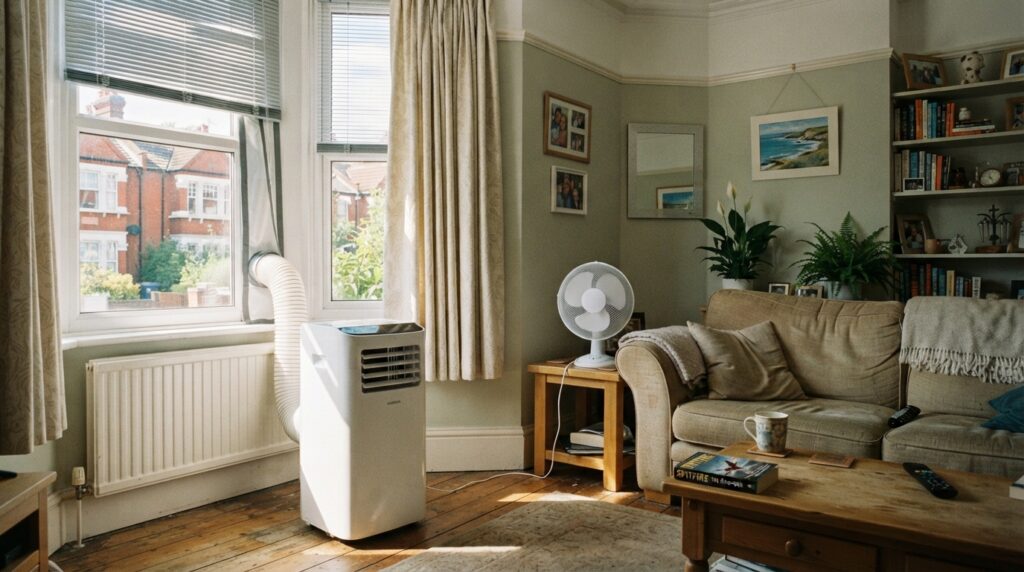
Most “air conditioner hacks” online are nonsense — ice in front of the exhaust, bowls of water, that sort of thing. These ten aren’t. They’re the things that measurably change how well a portable unit performs, and almost all of them are free. The biggest single one is sealing the window kit properly, which most people do badly and which undoes a large share of the unit’s work.
If you already own a portable air conditioner and it’s not performing as well as you hoped, work through this list before assuming the unit is at fault or too small.
1. Seal the window kit properly — the big one
Almost every portable unit ships with a plastic slider kit that fits approximately. Approximate isn’t good enough.
Every gap around that panel lets hot air straight back in. Worse, with a single-hose unit the room is under slight negative pressure — it’s actively pulling outside air in through every gap you leave. Our hose configuration guide explains the mechanism.
Fill the gaps with foam tape, draught-excluder strip, or for an awkward window, a cut acrylic or foam board. Our seal kits guide covers the options.
2. Keep the exhaust hose short and straight
That hose gets genuinely hot. Every extra metre of it inside your room is a radiator working against you, and every kink restricts exhaust flow, making the compressor work harder.
Position the unit as close to the window as the room allows. Don’t coil surplus hose behind the unit “to keep it tidy” — that’s the worst thing you can do with it.
3. Insulate the hose if it has to run long
Where a long run is unavoidable — a bay window, an awkward layout — wrap it in foil-faced pipe insulation or a purpose-made hose cover. You’re stopping the heat it carries from radiating back into the room before it reaches the window.
Cheap, takes ten minutes, and genuinely noticeable on a long run.
4. Close the door, and the curtains
Two free things people skip.
Closing the door reduces the volume the unit is cooling and limits the infiltration it’s fighting to that room’s own gaps.
Closing curtains or blinds on sun-facing windows — before the room heats up, from mid-morning — stops solar gain entering in the first place. This is worth more than any setting on the machine. External shading is better still, as covered in our shading guide.
5. Pre-cool rather than chase
Starting the unit at 10pm in a room that’s been baking all day means it spends hours catching up, running flat out the whole time.
Run it earlier — mid-to-late afternoon — and let the room coast. A basic plug-in timer or smart plug automates this, and if you have solar panels it means running on free generation, as covered in our solar guide. Our smart plugs guide covers the hardware.
6. Don’t set it colder than you want it
Setting 16°C when you want 23°C doesn’t cool the room faster. Air conditioners don’t have an accelerator — the compressor runs at its rate regardless. All you achieve is a longer run time and a colder room than you wanted.
Set your actual target. Our temperature setting guide covers the sensible range.
7. Clean the filter far more often than you think
A clogged filter restricts airflow across the evaporator coil, which means less heat removed per minute, which means the compressor runs longer for the same result. It shows up on your bill and, in severe cases, ices the coil and stops cooling entirely.
Fortnightly during heavy use. Weekly if you have a shedding pet — our pets guide covers why. And let it dry completely before refitting; a damp filter is the main cause of the musty smell in our smell guide.
8. Use a fan alongside it, not instead of it
A cheap fan costs a few pence a night and moves the cooled air around rather than letting it pool near the unit. It also increases your own evaporative heat loss, so you feel cooler at a higher room temperature — meaning you can set the air conditioner a degree or two warmer.
Point the fan at people, not at the room. Our fan explainer covers why that distinction matters.
9. Cool the bedroom, not the house
Trying to cool a whole house with one portable unit is how people conclude portable units don’t work. They work well in one properly sealed room.
Make it the bedroom. Overnight heat carries the greatest health consequence — the body needs cooler night-time temperatures to recover, which is why the tropical nights covered in our tropical nights guide matter so much.
10. Set up continuous drainage if you can
Most portable units have a drain port that lets you run a hose to a drain, sink or bucket instead of emptying a tank. In humid conditions the tank fills faster than people expect, and a full tank shuts the unit off — often overnight, when you don’t notice until you wake up hot.
Check your manual for the continuous drainage option. It needs a downhill run to work.
The “hacks” that don’t work
Worth naming, because they circulate every summer:
- Ice in front of the unit. A bowl of ice adds a trivial amount of cooling relative to the machine’s output, and the ice cost energy to make. Our ice and fans guide covers the physics.
- Running it without the hose. This makes the room hotter, net. The unit rejects more heat than it removes, because the compressor’s own energy consumption ends up as heat too.
- Venting the hose into another room — you’re just moving the heat next door, and if that room connects to yours it comes back.
- Venting into a loft. Dumps hot, humid air into a space that needs to stay dry, and it’ll come back down through the ceiling. Also a genuine condensation risk.
- Covering the unit to make it “work harder”. It needs clear airflow at both intake and outlet.
If none of it helps
Work through our not cooling properly guide. The most common genuine cause after all of the above is simply that the unit is undersized for the room — our BTU calculator guide covers correct sizing.
MeacoCool MC Series 9000
If yours is undersized
51–55 dB
~£349
App control
Right-sized for most UK bedrooms up to around 25m², and quiet enough to sleep next to. The app scheduling makes the pre-cooling trick in point five effortless rather than something you have to remember.
Frequently asked questions
Which of these makes the biggest difference?
Sealing the window kit, followed by closing curtains before the room heats. Both are free, and between them they address the two largest sources of unwanted heat.
Is it worth buying a better window kit?
Often yes, especially for awkward windows. A well-sealed kit changes performance more than most upgrades to the unit itself would.
Can I use two units in one room?
You can, but it’s usually less efficient than one correctly sized unit, and it doubles the venting problem. Size properly instead.
Compare current prices, stock and reviews on portable air conditioners at Amazon UK.
Sources
- Energy Saving Trust — Home appliances and energy use
- Met Office — Understanding tropical nights and their impact
- Ofgem — Energy price cap
Related reading: our maintenance guide and window seal kits guide.