How to Cool a Garden Room or Outdoor Office (UK)
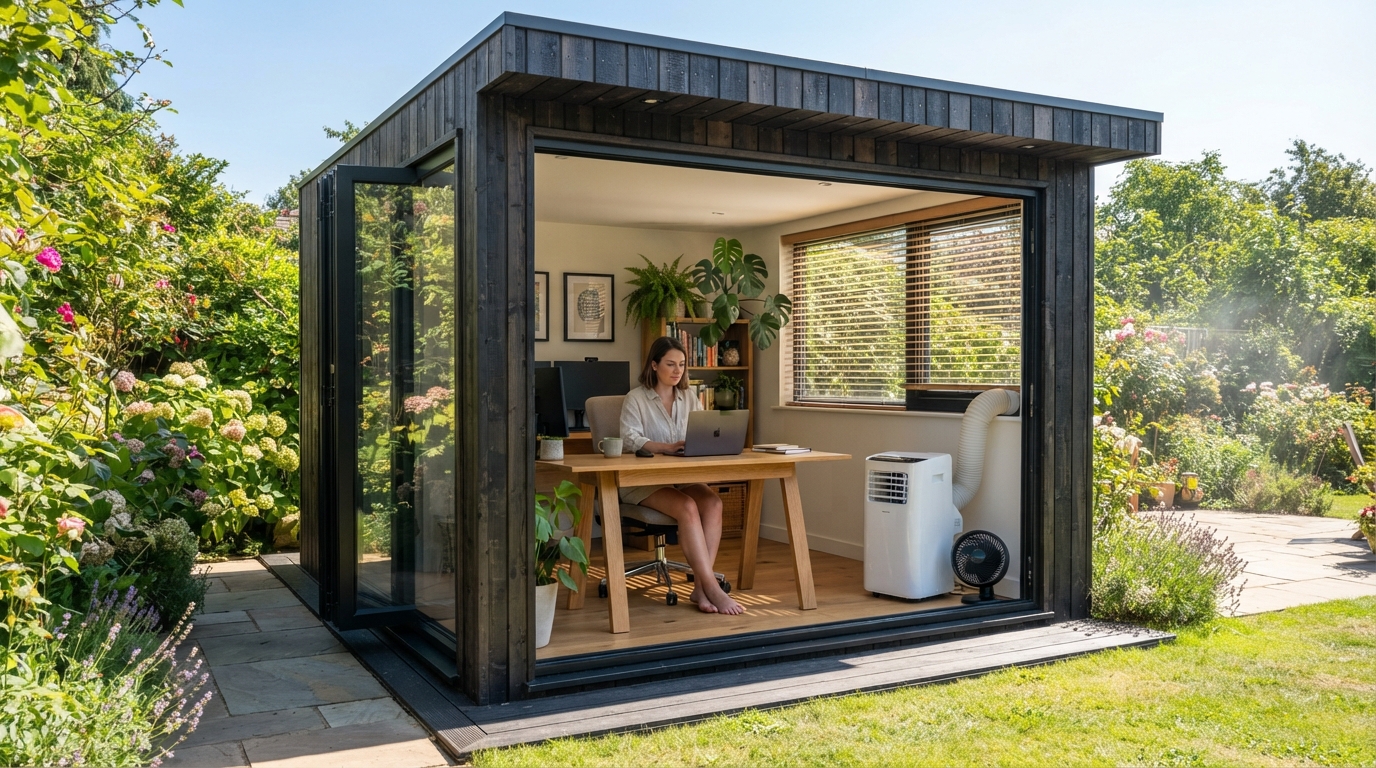
Garden rooms overheat far worse than houses, and it isn’t bad luck — they’re lightweight, heavily glazed, low on thermal mass and often under a dark flat roof, which is close to a recipe for a greenhouse. The fix follows a strict order: shade the glazing first (it’s the main heat source, and external shade beats anything internal), deal with the roof, then create real cross-ventilation — most garden rooms have a door and not much else, so there’s nowhere for hot air to escape. Only then think about cooling. The good news: a garden room is much easier to fit a permanent wall vent to than a house, so a portable air conditioner works genuinely well here, and a reverse-cycle unit heats it through the winter too.
If your garden office is unusable by two in the afternoon, you’re not alone — it’s the single most common complaint about them. Here’s why it happens and the order to fix it in.
Why they overheat so badly
A garden room concentrates almost every overheating risk factor into one small building:
- A lot of glass for the floor area. Most are sold on bifold or full-height glazed doors, frequently facing the best view or the sunniest aspect — which is usually south or west. That glazing ratio would be extreme in a house.
- Almost no thermal mass. A house has masonry, plaster and floors that absorb heat and flatten the daily temperature swing. A timber-framed garden room has very little, so it heats fast — and cools fast overnight, which is at least useful.
- A dark, flat or shallow-pitched roof in full sun all day, with the ceiling immediately beneath it and no ventilated loft void to buffer the heat.
- Insulation that varies enormously. Good builds are well insulated; cheaper “summerhouse” builds may have very little, and insulation thickness is limited by slim wall build-ups.
- Poor cross-ventilation. Often one set of doors and perhaps one small window — so even opening everything gives you no through-draught, just a stagnant warm box.
- Internal heat gains concentrated in a small space. A desktop PC, monitors, a heater or two people generate meaningful heat in 10–15m².
Step 1: shade the glazing (biggest win)
The glass is where most of the heat arrives, so this is where most of the benefit is — and external shade beats internal blinds decisively, because it stops the sunlight before it gets through the glass and becomes trapped heat.
- An awning or canopy over the glazed elevation, ideally retractable so you keep the light and warmth in winter — our external shading guide covers choosing one.
- A pergola, sail or freestanding parasol positioned to shade the doors through the hottest part of the day — no fixing to the building needed, covered in our garden and patio shade guide.
- Planting — a deciduous tree or tall shrub shades in summer and lets light through in winter.
- Internal blinds as a backup — better than nothing, and light-coloured or reflective-backed is far better than dark. Our window and shading guide explains the hierarchy.
- Solar-control film on the glazing — a reasonable option here, since a garden office is a working space where slightly reduced light matters less than in a living room. Our reflective film guide covers the trade-offs.
Step 2: deal with the roof
A dark flat roof in direct sun gets extremely hot, and in a garden room that heat is radiating down into the ceiling just above your head. Two practical options:
- A reflective (cool) roof coating. Garden rooms are close to the ideal candidate: small, accessible, flat or shallow-pitched, usually dark, and you don’t much care about losing a little passive solar gain in winter. Our cool roof coatings guide covers whether it’s worth it and the caveats.
- Check the roof insulation. On a cheaper build this is often the weakest element. Upgrading it — ideally with a denser material that delays heat transfer rather than just resisting it — makes a real difference, as our summer insulation guide explains.
- Shade the roof if a structure or planting can do it — rare, but very effective where possible.
Step 3: create genuine cross-ventilation
This is the cheap fix most garden rooms are missing. Hot air needs somewhere to go, and one open door isn’t a ventilation strategy — you need an opening at each end so air can travel through.
- Add an opening window opposite the doors. If you’re specifying a build, insist on this; if you have one already, retrofitting an opening light or vent on the opposite wall is often straightforward in a timber-framed structure.
- A high-level vent or roof vent lets the hottest air out at the top, where it collects.
- Purge overnight. Because garden rooms have little thermal mass, they cool quickly once you let the night air through — open up in the evening and shut it in the morning before the sun gets on the glass. A fan in an opening speeds it up, as our box-fan window guide explains.
- Add a fan for air movement while you’re working — it won’t lower the temperature but it makes a warm room far more bearable. Our fan types guide covers the choice, and a ceiling fan suits a garden room well since floor space is tight.
Step 4: cooling — and why portables suit garden rooms
Once you’ve done the above, a garden room is a small, well-defined space that’s easy to cool. And there’s a genuine advantage over a house:
- Portable unit with a wall vent — the pragmatic choice for most garden rooms. Size it to the room using our sizing guide, and remember a heavily glazed room needs more capacity than floor area alone suggests.
- A wall-mounted split system — quieter and more efficient, and the outdoor unit can sit discreetly beside the building. It needs a certified installer for the refrigerant work and an adequate electrical supply.
- A reverse-cycle unit either way is usually the smart buy: it heats the room efficiently in winter, which is when a garden office is otherwise cold and expensive to run. Our heat pump guide covers this.
The electrics matter more than you’d think
Planning, briefly
Garden rooms themselves are often built under permitted development as outbuildings, subject to conditions on size, height, siting and how the building is used — and those conditions are tighter in conservation areas and don’t apply in the usual way to listed buildings. Adding an external condenser unit is a separate question again. As with our air conditioning planning guide, we won’t quote thresholds here because they’re fact-specific and change — check the Planning Portal and your local planning authority. A portable unit venting through a wall you already own raises no planning question in itself.
If you’re still at the specifying stage
The cheapest cooling is the overheating you design out. If the garden room isn’t built yet:
- Think hard about orientation — a wall of glass facing due west will cook every summer evening.
- Specify opening windows on opposite walls for cross-ventilation, plus a roof vent.
- Ask about roof insulation specification, not just wall insulation.
- Choose a lighter roof colour or plan for a reflective coating.
- Include external shading (an integrated canopy or overhang) rather than retrofitting later.
- Size the electrical supply for what you’ll eventually want to run, including cooling.
Frequently asked questions
Why does my garden office get so much hotter than the house?
Lots of glass relative to floor area, very little thermal mass to absorb heat, a dark roof directly above the ceiling with no loft void, variable insulation, and usually no cross-ventilation. Those factors compound in a small building.
Is a portable air conditioner good enough for a garden room?
Often yes — and better here than in a house, because you can usually fit a permanent through-wall vent rather than blocking a window. Size it for a heavily glazed space, and choose reverse-cycle so it heats in winter too.
Do I need an electrician to add air conditioning?
For a split system, yes — and for any new or extended circuit to an outbuilding, which is notifiable work under Part P. Even for a plug-in portable, check the existing supply can carry it and don’t run it from a trailing extension lead.
What’s the single cheapest improvement?
Shading the glazing from outside, followed by adding an opening on the opposite wall so you get real cross-ventilation. Together they cost far less than cooling and reduce how much cooling you need.
Will a fan be enough?
A fan makes a warm room more bearable but doesn’t lower the temperature, and in a heavily glazed garden room on a hot afternoon it usually isn’t enough on its own. Shade and ventilate first; a fan then covers a lot of days, with cooling for the worst.
Sources
- Planning Portal — Outbuildings
- GOV.UK — Approved Document P: Electrical safety
- GOV.UK — Approved Document O: Overheating
- Energy Saving Trust — Keeping your home cool in summer
Related reading: our venting without a window guide and heat pump guide.
A portable unit vented through the wall suits a garden room well — and reverse-cycle heats it in winter. Compare current options at Amazon UK.