Best Dual Hose Portable Air Conditioners UK: What They Fix and What They Don’t
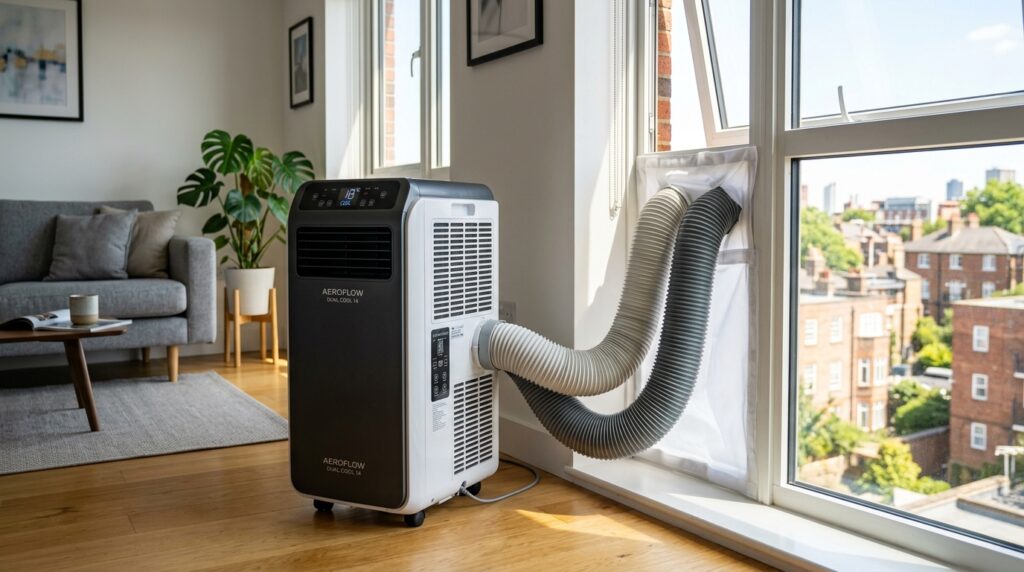
A dual-hose unit is genuinely more efficient in principle — it draws the air that cools its condenser from outside rather than from your room, so it doesn’t put the room under negative pressure and pull warm air back in through every gap. That’s a real advantage. But two honest caveats matter: dual-hose units are a smaller category in the UK and harder to vent (two hoses, more window kit), and a well-sealed single-hose unit closes a lot of the gap. Before you pay a premium for a second hose, seal the single-hose unit you’re comparing it to properly — for many rooms that’s the bigger win.
This is one of those spec-sheet features that sounds decisive and is often oversold. Here’s what the second hose actually does, and when it’s worth seeking out.
The problem a second hose solves
A single-hose unit does two jobs with one pipe. It pulls air from the room to cool its condenser, then blows that now-hot air outside through the hose. The catch: the air it expelled has to be replaced, and it’s replaced by warm air drawn in from outside through gaps around doors, windows and the vent kit. The room ends up under slight negative pressure, quietly sucking in the heat you’re trying to remove.
A dual-hose unit adds a second pipe that brings condenser air in from outside, uses it, and expels it again — a closed loop that never touches your cooled room air. No negative pressure, no warm air pulled in through the gaps. That’s the efficiency gain, and it’s real.
Why it’s not the whole story
Three things temper the advantage, and any honest guide has to say them:
- Sealing does most of the same job. The negative-pressure penalty of a single-hose unit depends heavily on how leaky the room is. Seal the window kit properly and close the door, and you cut the amount of warm air being drawn in — narrowing the gap to a dual-hose considerably. Our seal kits guide covers this, and it’s cheaper than upgrading the whole machine.
- Two hoses are harder to vent. You need a window kit that accommodates both, and that’s more fiddly on the awkward UK windows — casements, sashes, top lights — that already make venting a single hose a challenge.
- The category is smaller here. Dual-hose designs are less common in the UK market than single-hose, so choice is narrower and you can’t always find one with the other features (quiet operation, small size, good drainage) you want.
What to look for if you do want dual-hose
Since this is a smaller category and specifications vary, the useful thing is knowing what to check on any listing rather than trusting a badge:
- Confirm it’s genuinely dual-hose — two separate pipes, intake and exhaust — not a single-hose unit described loosely. The product photos and the window kit will show two openings.
- Check the room range and BTU against your room using our sizing guide — efficiency is wasted if the unit is the wrong size.
- Check the noise figure and the fan speed it refers to. A dual-hose unit still has its compressor in the room, so it’s no quieter for that — our quiet units guide covers reading the number properly.
- Check the window kit takes both hoses and will fit your window type before ordering.
- Look for the manufacturer’s own specification sheet — our brands guide covers why a documented model beats a marketplace listing with a bare BTU figure.
The picks
A dual-hose unit — chosen on documentation, not the badge
If efficiency is the priority
More efficient in principle
Check specs per model
If you run a unit hard — a home office all day, a long summer — the efficiency of a true dual-hose design can be worth seeking out. Because the category is small and specifications vary, buy on a documented specification sheet and a window kit that fits your window, rather than on the “dual hose” label alone. We’re pointing you at a search rather than naming a single model, because dual-hose availability shifts and we won’t quote figures for a unit we can’t verify.
Good for: heavy, all-day use; leakier rooms where negative pressure bites hardest; anyone who’ll genuinely run it enough for the efficiency to pay back.
Less good for: awkward windows (two hoses are harder to fit); anyone expecting it to be quieter (the compressor is still in the room); light users, for whom a sealed single-hose unit is simpler and cheaper and nearly as good.
A proper window seal kit for the single-hose unit you already have
The cheaper way to most of the gain
Fits UK casements
Fraction of the cost
The honest recommendation for a lot of people. Most of the dual-hose advantage comes from not pulling warm air in through gaps — and you can cut that dramatically by sealing a single-hose setup properly, for a fraction of the price of a new machine. If you’re weighing a dual-hose upgrade, try this first.
Good for: anyone with a single-hose unit and gaps around the window kit — which is most people; renters who can’t change much; a quick, cheap efficiency win.
Less good for: a badly sized or badly positioned unit, which sealing won’t fix. Measure your window frame profile before ordering, as sizing is the usual reason these get returned.
Frequently asked questions
Is a dual-hose really that much more efficient?
In principle yes — it avoids the negative-pressure penalty that pulls warm air into a single-hose setup. In practice the size of the gain depends on how leaky the room is; seal a single-hose unit well and the difference narrows.
Are dual-hose units quieter?
No — the compressor is still inside the room, so noise is comparable. Choose for quiet on the published decibel figure and fan speed, not on hose count.
Why are there so few dual-hose models in the UK?
Single-hose designs dominate the UK market, so the dual-hose category is smaller and choice is narrower. That’s a practical reason many people end up sealing a single-hose unit well instead.
Can I convert my single-hose unit to dual-hose?
No — it’s a different internal design, not an add-on. The productive move with a single-hose unit is to seal the room and window kit properly.
Sources
- Energy Saving Trust — Home appliances and energy use
- GOV.UK — Energy labelling of products
Related reading: our single vs dual hose comparison and seal kits guide.
If you run a unit hard, a documented dual-hose model can be worth it — but seal a single-hose setup first and compare. Browse current options at Amazon UK.