What Size Air Conditioner Do I Need? A BTU Sizing Guide
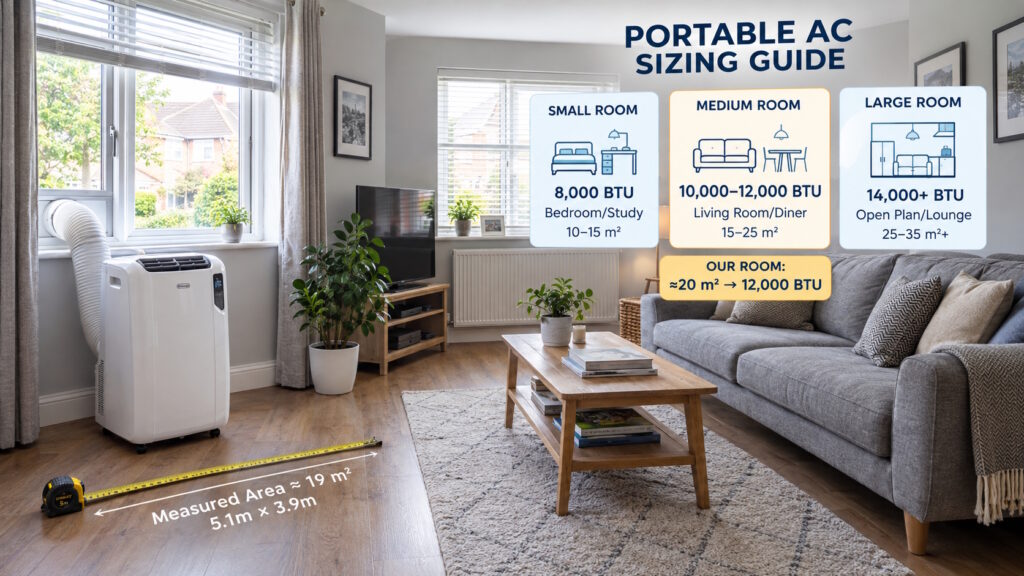
Start at roughly 500–600 BTU per square metre of floor area, then adjust — and the adjustments matter more than the starting figure. Add capacity for large or sun-facing glazing, a high ceiling, a room under an uninsulated roof, or heat-generating equipment. The mistake people expect to make is buying too small. The mistake they actually make just as often is buying too big: an oversized unit cools the air fast, satisfies its thermostat, and shuts off before it has run long enough to remove much moisture — leaving a room that’s cold and clammy, with a compressor cycling constantly.
Getting this right is the single most useful thing you can do before buying, and it takes about ten minutes.
Step 1: Measure the room
Length × width = floor area in square metres. Measure it rather than estimating — people are consistently wrong by a couple of metres, and that’s a whole capacity class.
Also measure the ceiling height. Standard guidance assumes roughly 2.4m. If yours is higher, you’ll need the adjustment in step 3.
Step 2: The starting figure
Multiply your floor area by 500–600 BTU per m².
| Floor area | Starting point | Common size |
|---|---|---|
| Up to 12m² | 6,000–7,200 BTU | 7,000 BTU |
| 12–16m² | 6,000–9,600 BTU | 7,000–9,000 BTU |
| 16–22m² | 8,000–13,200 BTU | 9,000–12,000 BTU |
| 22–30m² | 11,000–18,000 BTU | 12,000–14,000 BTU |
| Over 30m² | 15,000+ BTU | Consider two units or a fixed system |
This is a starting point, not an answer. Two rooms of identical floor area can have genuinely different requirements. Now adjust.
Step 3: The adjustments — the part that matters
Work through each. They stack.
Add capacity for:
- Large glazed areas — a bay window, bi-folds, floor-to-ceiling glazing, or a conservatory-style extension. Glass admits solar energy freely. Our bay window guide covers that case.
- South or west-facing aspect. West is the hardest — low evening sun comes in almost horizontally, and it arrives when you most want the room cool. Our west-facing guide covers it.
- A high or sloped ceiling. Size on volume, not floor area. A 3m ceiling means around 25% more air than a 2.4m one, plus more wall area gaining heat.
- A room under the roof — loft conversions and top-floor rooms take heat down from the roof all afternoon and usually have limited insulation depth between rafters.
- A room above a garage, or over an unheated space.
- A flat roof directly above.
- Heat-generating equipment — a desktop computer and monitors, a treadmill, kitchen appliances. A home office or gym has a continuous internal load most sizing guides ignore.
- More than two people regularly in the room.
- Poor insulation, single glazing, or an uninsulated extension.
You can size down for:
- North-facing rooms with little direct sun
- Ground floor rooms with a solid floor and thermal mass
- Well-shaded rooms — external shading genuinely reduces the load
- Rooms in the middle of a building, with neighbours either side moderating temperature
Why bigger isn’t better
The counterintuitive part, and the one worth understanding properly.
An air conditioner removes heat and moisture. Moisture removal happens because room air passes over a coil cold enough to condense water out of it — and that takes time running.
An oversized unit drops the air temperature quickly, hits its set point, and switches off. The air is cool but the moisture is still there. You get a room that’s cold and clammy, which feels worse than a slightly warmer room that’s properly dehumidified.
The other consequences:
- Short cycling. Repeated starting is harder on a compressor than steady running, and the clicking on and off is more disruptive to sleep than a constant hum. Our short cycling guide covers it.
- Higher cost. Startup draws more current than running.
- More noise. Bigger units are generally louder.
- More weight. A 14,000 BTU unit is a considerable thing to move and store.
Why undersizing is also a problem
An undersized unit runs continuously without reaching temperature. It never gets the satisfaction of switching off, so it uses more electricity overall than a correctly sized unit that cycles — and it still doesn’t make the room comfortable.
This is the most common complaint behind “my air conditioner isn’t working” — our troubleshooting guide covers the others.
Step 4: Reduce the load before you buy
Genuinely worth doing first, because it may drop you a capacity class — which means a cheaper, quieter, lighter unit.
- Shade the glass from mid-morning, before the room heats. The highest-value free action. External shading beats internal decisively. Our blinds guide covers what to look for.
- Check the loft insulation if the room is upstairs — our loft guide covers checking it with a ruler.
- Move heat sources out where you can.
- Seal and close the room — you’re cooling a defined volume, not a floor.
Step 5: Check the other numbers
Capacity isn’t the only spec that decides whether you’re happy with it.
- Noise, and the fan speed it was measured at. A decibel figure quoted without the fan speed tells you very little. For a bedroom this often matters more than capacity — our quiet units guide covers it.
- Energy rating. Determines running cost for the same cooling — our running cost guide covers the calculation.
- The manufacturer’s own stated room range. Useful as a cross-check against your calculation. If they disagree sharply, work out why.
- Minimum room size. Tied to the refrigerant charge — relevant for small rooms. Our R290 guide explains why that figure exists.
- Window kit compatibility. Work out where the hose is going before ordering. Our seal kits guide covers awkward openings.
- Weight, if you’ll move it seasonally — our moving guide covers doing that safely.
Worked examples
A 14m² north-facing bedroom, normal ceiling, one window, no equipment.
Starting figure: around 7,000–8,400 BTU. No significant additions; north-facing allows a reduction. 7,000 BTU is right. A 12,000 BTU unit here would short-cycle and leave the room clammy.
A 14m² loft office, west-facing roof window, desktop and two monitors.
Same floor area, completely different room. Roof above, upward-facing glazing, west aspect, continuous equipment load. Size up to 9,000–12,000 BTU, and shade the roof window externally first — our skylight guide covers that.
A 25m² open-plan living room with bi-folds, south-facing.
Starting figure around 12,500–15,000 BTU, pushed higher by the glazing and aspect. Realistically at or beyond what a portable unit manages. Shade heavily, consider cooling one zone rather than the whole space, or look at a fixed system.
Frequently asked questions
Can I use one unit for two rooms?
Not effectively. A portable unit cools one sealed room — open the door and you’re attempting the hallway too. Our two rooms guide covers the alternatives.
The manufacturer says 16–26m² — which end applies to me?
The lower end for a hot room, the upper end for a favourable one. A 26m² north-facing shaded room may be fine; a 20m² west-facing room with a bay may not.
What if I’m between two sizes?
Go up if the room has significant glazing or a roof above it. Go down if it’s shaded and north-facing. And shade the glass first — that may settle it.
Does BTU relate to running cost?
Indirectly. A larger unit draws more power, but an undersized one running flat out all evening can use more overall. The energy rating matters more than the BTU figure for cost — our units guide explains the difference between cooling output and electrical input, which people frequently confuse.
Sources
- GOV.UK — Approved Document O: Overheating (solar gain factors)
- Energy Saving Trust — Home appliances and energy use
- GOV.UK — Energy labelling of products
- Ofgem — Energy price cap
Related reading: our BTU vs kW explainer and main buying guide.
Once you have your figure, compare current specifications at Amazon UK — and check the manufacturer’s stated room range against your own calculation.