Can You Keep a Freezer in a Garage? UK Climate Class Explained
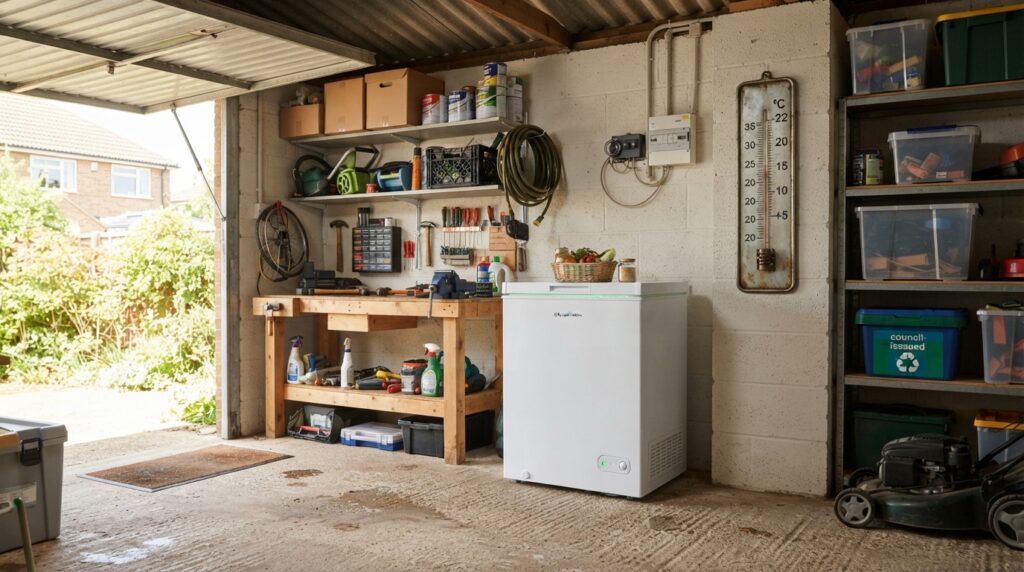
Only if the freezer’s climate class covers the temperatures your garage actually reaches. Every fridge and freezer is rated for a range of room temperatures, and most UK appliances are class SN, which means they’re designed to work between +10°C and +32°C. A typical UK garage spends part of the winter below 10°C and can climb past 32°C in a summer heatwave, so it falls outside that range at both ends. Too cold and the thermostat stops calling for cooling, so the freezer quietly thaws. Too hot and it runs almost constantly, uses more electricity and may not hold temperature at all. Check the climate class on the rating plate or in the manual before you trust a garage freezer with a month’s shopping.
Putting the old freezer in the garage is one of the most common bits of British household logic there is. It’s also the reason for a lot of ruined food. The problem isn’t the garage as such — it’s that appliances are rated for the temperature of the room around them, and most people have never had a reason to look that rating up.
What a climate class actually is
A climate class is the minimum and maximum room temperature a fridge or freezer is designed to work in. It’s printed on the rating plate inside the appliance, or listed in the manual and on the spec sheet. There are four standard classes:
- SN (extended temperate): +10°C to +32°C. The most common class for UK domestic appliances.
- N (temperate): +16°C to +32°C. Less common here.
- ST (subtropical): +16°C to +38°C.
- T (tropical): +16°C to +43°C.
Combined ratings exist too, and those are the useful ones. SN-ST covers +10°C to +38°C and SN-T covers +10°C to +43°C, giving you a wider working window at the hot end while keeping the lower 10°C limit.
The winter problem: a freezer that thaws because it’s too cold
That’s why an SN-rated appliance has a minimum of +10°C rather than “as cold as you like”. A standalone chest freezer is less vulnerable than a fridge-freezer because its thermostat is in the freezer itself, but it’s still only rated down to its stated minimum, and manufacturers are increasingly specific about this. If you want an appliance for an unheated space, look for one explicitly sold as garage-safe or garage-ready, which usually means a low-ambient rating or a small heater built in.
The summer problem: a freezer that can’t get rid of its heat
A freezer works by moving heat out of the cabinet and dumping it into the room, through the condenser coils at the back or underneath. If that room is already very hot, the condenser struggles to shed heat into it. The appliance then runs continuously, works harder, and may fail to reach its target temperature. Over time that means noticeably higher electricity use and a real risk of compressor failure.
A closed, south-facing, uninsulated garage with a thin metal up-and-over door is one of the hottest spaces on a UK property in a heatwave — the same reason a garage gym or workshop becomes unusable, which our garage and workshop cooling guide covers. If your freezer is in there and running flat out all August, that shows up on the bill, which is one of the things people miss when wondering why their electricity bill is high in summer.
What temperature should a freezer actually hold?
Government food safety guidance gives the figures: a fridge should be between 0°C and 5°C, and a freezer at around -18°C. The same guidance recommends checking with a thermometer once a week, because the dial on the front tells you what you asked for, not what you got. In a garage, that weekly check matters far more than it does in a kitchen, since the failure mode here is silent.
A fridge and freezer thermometer with an alarm
The cheapest way to find out before the food does
Alarm models warn you if it drifts
Wireless versions read from indoors
A plain dial thermometer is enough to do the weekly check the food safety guidance suggests. If the freezer is somewhere you don’t visit daily, an alarm model or a wireless one that displays in the house is worth the extra, because the whole risk with a garage freezer is that nothing looks wrong until you open it. Check the stated temperature range on the listing covers freezer temperatures, as some are sold for fridges only.
Good for: weekly temperature checks; catching a slow thaw in an outbuilding; confirming whether your garage is actually within the appliance’s rated range.
Less good for: fixing the underlying problem — it tells you there’s an issue, it doesn’t make an SN-rated freezer suitable for a 4°C garage. Wireless models also need the signal to reach the house.
If you’re keeping a freezer in the garage anyway
- Find the climate class first. Rating plate inside the appliance, or the manual. If it’s SN and your garage drops below 10°C in winter, you now know the risk you’re carrying.
- Measure the garage, not the forecast. A cheap thermometer left in there for a week in January and again in July tells you more than any general rule.
- Leave a decent air gap behind and around the appliance so the condenser can shed heat, and keep the coils free of dust.
- Keep it out of direct sun from any window or door, and away from the garage door itself, which is usually the hottest surface in there.
- Keep it full. A full freezer holds its temperature far longer than a half-empty one when the compressor isn’t running.
- Prefer a chest freezer to a fridge-freezer for an unheated space, and prefer one explicitly sold as garage-safe to either.
Frequently asked questions
Where do I find my freezer’s climate class?
On the rating plate, usually inside the appliance on a side wall, and in the manual or online spec sheet. It’s shown as SN, N, ST, T, or a combination such as SN-ST.
Why does my garage freezer defrost in winter?
On a fridge-freezer the thermostat is normally in the fridge section. If the garage is cold enough to keep that section cold, the compressor stops running — and since the same compressor cools the freezer, the freezer slowly thaws even though the appliance appears to be working.
Is a chest freezer better than a fridge-freezer for a garage?
Generally yes, because its thermostat sits in the freezer compartment itself rather than a fridge section. It’s still limited by its climate class, though, so check the rated minimum before assuming it will cope with an unheated garage.
What temperature should a freezer be?
Government food safety guidance says around -18°C, with fridges between 0°C and 5°C, and recommends checking with a thermometer weekly rather than relying on the dial.
Sources
- Whitegoods Help — UK climate classes for fridges and freezers
- GOV.UK / Food Standards Agency — How to chill, freeze and defrost food safely
Related reading: our food and medicine in a heatwave guide, garage and workshop cooling guide and room thermometer guide.
Compare current fridge and freezer alarm thermometers at Amazon UK.