Can One Portable Air Conditioner Cool Two Rooms?
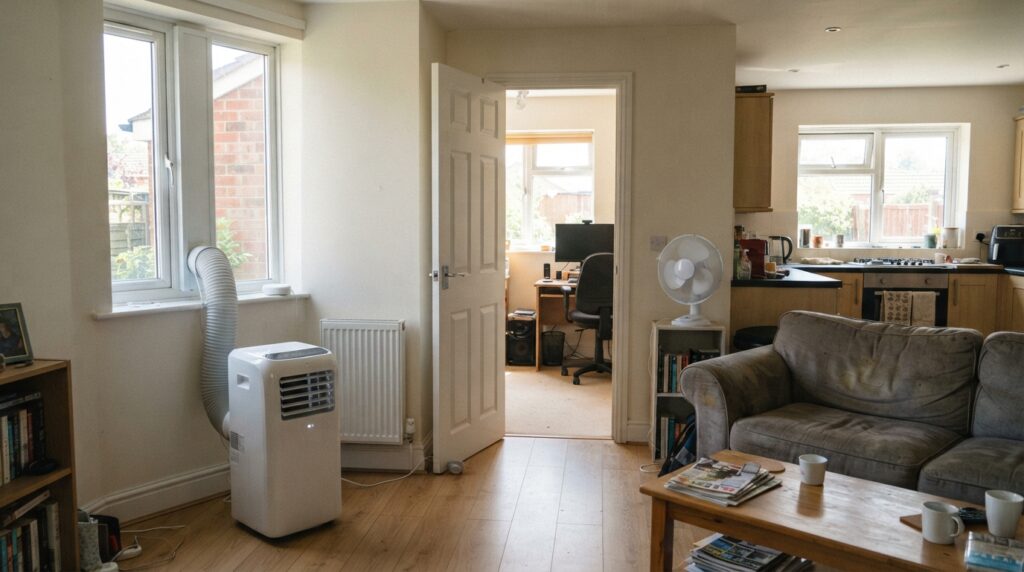
Usually not well, and the reason is arithmetic rather than opinion. A unit sized for one room is being asked to remove heat from roughly double the volume, with double the wall and window area gaining heat, and an open doorway between the two acting as a leak in both directions. The result is typically two rooms that are both slightly less unpleasant rather than one that’s genuinely comfortable. Where it can work: two small connected rooms, a properly oversized unit, and a fan to move air through the doorway. Where it can’t: two rooms on different floors, or anything separated by a hallway.
Reasonable question, usually asked by someone deciding whether to buy one unit or two. Here’s how to work out which side of the line you’re on.
Why it’s harder than it sounds
Three things compound.
Double the volume. Sizing guidance of roughly 500–600 BTU per square metre applies to the total space you’re conditioning. Two 15m² rooms is 30m², which needs meaningfully more capacity than 15m² — not a bit more.
Double the heat gain. More external wall, more glazing, more ceiling. Heat isn’t just present in a room, it’s continuously arriving, and you’ve doubled the arrival rate.
Air doesn’t move where you want it. This is the part people underestimate. Cold air is denser and sinks; warm air rises. Left to itself, cooled air pools near the unit and doesn’t travel far through a doorway. Meanwhile warm air from the second room flows back at ceiling level.
When it can work
- Two small rooms with a wide opening between them — a through-lounge, a bedroom with an en-suite, a kitchen-diner with a broad archway. Effectively one space with a pinch point.
- A unit deliberately sized for the combined area, not for one room. Size on the total.
- With a fan in the doorway to push air through. This is the single thing that makes it viable — without deliberate air movement, the second room gets very little.
- Where your expectations are modest — taking the edge off both rooms rather than making either genuinely cool.
- Rooms on the same floor and the same level.
When it won’t
- Rooms on different floors. Warm air rises up a staircase continuously, so you’d be cooling the ground floor and feeding the upstairs. Our stack effect guide covers why this is a losing battle.
- Rooms separated by a hallway. You’re now cooling three spaces, one of which connects to the whole house.
- Where one room has heavy solar gain. A south or west-facing room will keep gaining heat faster than the unit can move it, and the second room gets nothing.
- Where one room is a bedroom you need genuinely cool at night. Overnight cooling is where the health benefit sits, and splitting capacity undermines exactly that.
The honest recommendation
Cool one room properly rather than two rooms inadequately. Nearly always the better outcome from the same money.
Make it the room where it matters most, which for most households is the bedroom. Overnight heat carries the greatest health consequence — the body needs cooler night-time temperatures to recover, which is the concern behind the increase in tropical nights covered in our tropical nights guide.
Then use free measures on the second room: curtains closed from mid-morning, door closed during the day, purge ventilation at the right time, and a fan when you’re in there.
If you’re going to try it anyway
- Size for the combined area, using our BTU sizing guide. Under-sizing here produces the worst outcome of all: a unit running constantly and cooling neither room.
- Put the unit in the hotter room, not the middle. Cool the problem, let the second room benefit.
- Use a fan in the doorway, pointed from the cooled room toward the second one, low down where the cool air is.
- Close every other door so you’re conditioning two rooms, not the house.
- Seal the window kit properly. More important than ever when the unit is already working hard — our seal kits guide covers it.
- Expect a longer run time, and check the tank or set up continuous drainage, because it’ll produce more condensate. Our drainage guide covers the setup.
Two smaller units versus one larger one
Worth considering seriously if you genuinely need both rooms cool.
Two units: each cools its own sealed room properly. Independent control, so you can run only the one you’re using. Two exhaust hoses and two window kits to arrange, and two lots of noise. Note also that two high-wattage appliances on the same circuit can approach its limit — our electrical safety guide covers checking that.
One larger unit: one hose, one purchase, one thing to store over winter. But it only cools where it is, and moving a 25–35kg unit between rooms daily is not something most people keep up.
If both rooms genuinely need cooling every summer, two correctly sized units usually beat one large one. If it’s really one room plus occasional use of another, one unit and a fan is the sensible answer.
What about a fixed split system?
If you’re contemplating cooling multiple rooms every summer for years, a multi-split fixed system — one outdoor condenser serving several indoor units — is what that job actually calls for. It’s quieter indoors, more efficient, and properly controls each room.
It’s also a considerably bigger commitment: F-Gas certified installation is legally required for refrigerant work, and there may be planning, leasehold or conservation constraints. Our installation law guide, leasehold guide and listed buildings guide cover the constraints.
Frequently asked questions
Can I duct the cold air into the next room?
Some people try, and it works poorly — ducting cold air adds resistance the fan wasn’t designed for, and the duct itself gains heat along the way. A fan in the doorway achieves more for less effort.
Should I buy a bigger unit to cover both rooms?
Size for the combined area if you’re committed to the approach. But be aware that an oversized unit in a single room satisfies its thermostat quickly and cycles off before removing much moisture, leaving a room that’s cold but clammy. Sizing for two rooms and then using it in one has that downside.
Would moving the unit between rooms work?
In principle, but these units weigh 25–35kg and need the hose and window kit repositioning each time. Almost nobody sustains it beyond the first week.
What if the second room is just a hallway?
Then close the door to it. A hallway connects to the whole house, and cooling it is close to cooling nothing.
Sources
- Energy Saving Trust — Home appliances and energy use
- UKHSA — Adverse Weather and Health Plan
- Met Office — Tropical nights and their impact
- GOV.UK — Fluorinated gases (F-gases): rules
Related reading: our BTU sizing guide and open-plan cooling guide.
Compare current specifications and prices at Amazon UK. Check the stated room size range against the total area you’re trying to cool, not one room.