Air Cooler vs Air Conditioner: What’s the Difference?
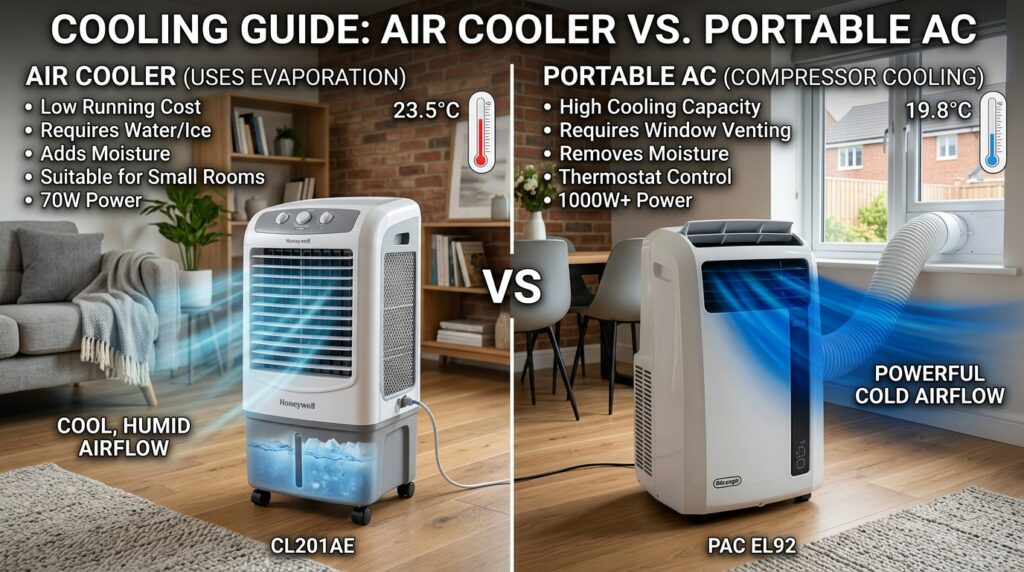
They are completely different machines, and the naming is doing a lot of work to obscure that. An air conditioner removes heat from the room and expels it outside through a hose — the room genuinely gets cooler and drier. An air cooler is a fan blowing air over a wet pad. It has no compressor, no refrigerant and no exhaust hose, and it removes no heat at all — it trades temperature for humidity. That works well in dry climates. In a muggy British summer, when humidity is already what’s making the heat unbearable, it frequently makes things feel worse.
Air coolers are among the most commonly mis-sold products in this category, and the confusion is understandable — the names are nearly identical and the marketing doesn’t clarify.
How each one works
Air conditioner
A refrigeration circuit. Room air passes over a cold evaporator coil, giving up heat and moisture; that heat is carried by refrigerant to a condenser and expelled outside through the exhaust hose.
Result: the room is cooler and drier. Heat has genuinely left the space.
Requires: an exhaust hose to somewhere outside, a compressor (so it’s noisier), and considerably more electricity.
Air cooler (evaporative cooler)
A fan and a wet pad. Air is drawn across water-saturated material, and evaporating that water absorbs heat from the passing air, which comes out cooler.
Result: the air leaving the machine is cooler — but the energy hasn’t left the room. It’s gone into turning liquid water into vapour, and that vapour is now in your room. You’ve made the air cooler and wetter simultaneously.
Requires: water topping up, and no hose at all.
Why that trade-off fails in Britain
Your body cools itself primarily by evaporating sweat. The more moisture already in the air, the harder that becomes.
So there’s a threshold: cool the air by a small amount while raising humidity, and you can feel hotter, because your own cooling system has been hampered more than the air temperature has fallen.
UK heatwaves are frequently muggy, and the worst nights — the tropical nights our tropical nights guide covers — often combine warmth with high humidity. That’s precisely when an air cooler performs worst and when people are most desperate to try one.
Our “feels like” guide covers why the same temperature feels so different on different days. Humidity is most of the answer.
Side by side
| Air conditioner | Air cooler | |
|---|---|---|
| Removes heat from room | Yes | No |
| Effect on humidity | Reduces | Increases |
| Exhaust hose needed | Yes | No |
| Electricity use | High | Low |
| Noise | Compressor + fan | Fan only |
| Works in humid weather | Yes | Poorly |
| Works in a sealed room | Yes | Poorly |
| Needs water refilling | No | Yes |
| Weight | 25–35kg | Light |
Where air coolers genuinely work
They aren’t useless — they’re specialised, and they’re sold as though they’re general-purpose.
- Well-ventilated spaces. A garage or workshop with the door open, where added moisture disperses rather than accumulating. This is the best domestic use case in the UK — our garage guide covers it.
- Outdoors or semi-outdoors — a marquee with the sides rolled up, a covered patio. Our marquee guide covers event use.
- Genuinely dry hot spells. The UK does get them, with easterly or continental air. Check a hygrometer — if indoor relative humidity is low, they work considerably better.
- Where you can’t vent a hose at all and a fan alone isn’t enough — though be realistic about what you’ll get.
- Where power draw matters — off-grid, a caravan, a leisure battery setup. Our caravan guide covers that.
Where they don’t
- A sealed bedroom overnight. The worst case — moisture accumulates in a closed room with a sleeping person already adding humidity.
- Any home with a damp or condensation problem. Adding moisture is the wrong direction, and damp and mould are a recognised health risk. Our damp guide covers it.
- Muggy heatwave nights — exactly when you’d most want it to work.
- Anywhere you’d expect air conditioner performance. It is not a cheaper air conditioner. It is a different machine.
The picks
MeacoCool MC Series 9000 (MC9000)
If you want the room cooler
16–26m²
A-rated
Dehumidify mode
Meaco publish 16–26m² and an A energy rating. If your goal is a room that’s genuinely cooler and less humid — a bedroom on a muggy night — this is the category that does that, and an air cooler is not a substitute at any price.
Good for: sealed rooms, humid nights, and anywhere you need the temperature to actually fall rather than the air to feel moved.
Less good for: anywhere you can’t vent a hose, which is the real constraint for a lot of people. It costs many times an air cooler to run, weighs 20kg-plus, and needs storing for eight months. If your windows won’t take a kit, this isn’t available to you regardless of how well it works.
A good fan
Usually beats an air cooler indoors
No water to refill
Pennies per night
Worth saying plainly: for most indoor UK situations, a plain fan does what an air cooler does without the humidity penalty. Both work by aiding evaporation from your skin — but a fan doesn’t add moisture to the room while doing it, and there’s no tank to fill or pad to replace.
Good for: moderate heat in any room, sealed or not; low running cost; nothing to maintain.
Less good for: genuinely hot or very humid conditions, where evaporation from skin can’t keep up. It doesn’t cool the air at all — our fan comparison covers where that limit sits.
Frequently asked questions
Is an air cooler cheaper to run?
Much — it’s essentially a fan and a pump. But it doesn’t do the same job, so it isn’t a saving, it’s a different purchase. Compare against a plain fan, not against an air conditioner.
Do they need ice?
Many have ice packs, which help briefly and marginally. The ice also cost energy to freeze, which your freezer dumped into your kitchen. Our ice and fans guide covers the arithmetic.
Can they cause damp?
Repeatedly raising indoor humidity in a home prone to condensation contributes to it. Occasional use in a ventilated room is fine; nightly use in a sealed bedroom isn’t.
Do they need cleaning?
Yes, and more than people expect. Standing water and a damp pad are a hygiene issue — empty the tank when not in use, and follow the manufacturer’s cleaning schedule.
Sources
- Met Office — Humidity
- Met Office — Tropical nights and their impact
- NHS — Heatwave: how to cope in hot weather
- GOV.UK — Damp and mould: health risks
- Citizens Advice — Consumer advice (misleading product descriptions)
Related reading: our fan comparison and wet towel guide.
Compare at Amazon UK. The test for any listing: if there’s no exhaust hose and no BTU rating, it isn’t removing heat from the room.