Turning the Spare Room into a Home Gym or Office: Heating and Cooling It Properly
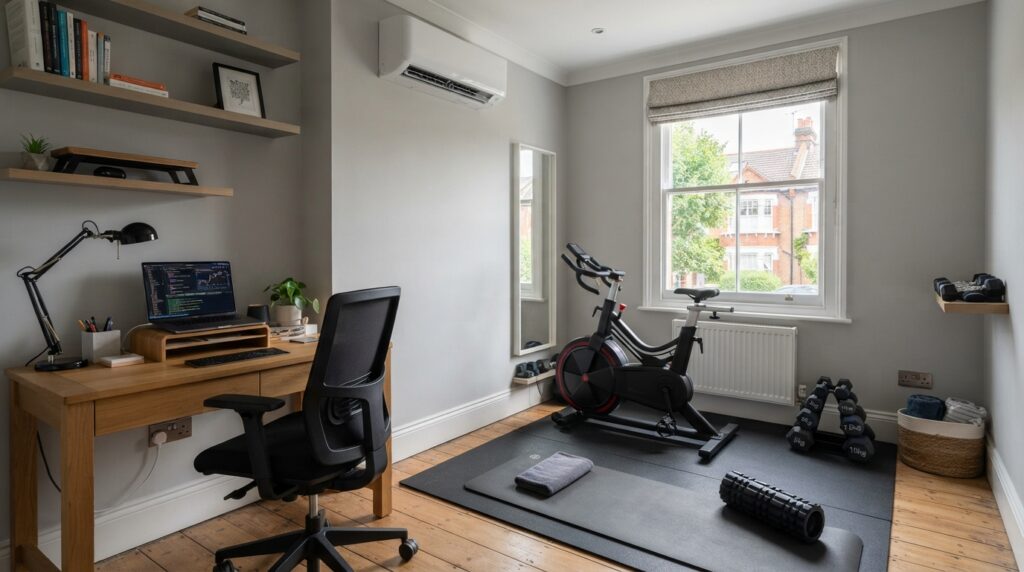
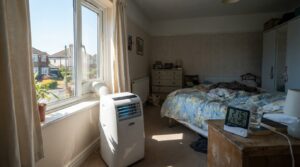
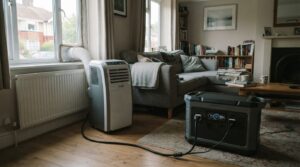
A spare room that’s been effectively unheated for years has a specific set of problems: it’s usually the coldest room in the house, often the dampest, and the radiator has frequently seized. Before buying any equipment, fix the radiator, deal with the damp, and check the floor loading if it’s a gym. Then note that a gym and an office want opposite things — a gym needs cooling far more than heating, an office needs both.
The spare room becoming a gym or office is one of the most common mid-life home changes in Britain, usually prompted by children leaving or by a permanent shift to working from home. It’s also a room that’s often been neglected for a decade, which brings its own list.
Start with why it’s cold
An unused spare room is almost always the coldest room in the house, and there’s usually a concrete reason rather than bad luck.
The radiator has probably seized. A TRV left in one position for years is very likely to have a stuck pin. Pull off the plastic head and check it moves freely — this alone fixes a surprising number of cold spare rooms, for free. Our cold room guide covers the full diagnostic sequence.
It may be sludged. Cold at the bottom, warm at the top means debris settled in the radiator, which needs an engineer rather than bleeding.
The system may never have been balanced for it. If it’s been turned down for years, nobody has noticed it doesn’t get proper flow.
It’s frequently the room with the most exposed surface — box rooms above a porch or passage, or corner rooms with two external walls.
Then deal with the damp, before it becomes a problem
This matters and it’s routinely skipped. An unheated room develops cold surfaces, and moisture migrating from the rest of the house condenses there. That’s why the spare room is so often the one with mould behind the wardrobe.
Now you’re about to start using it — and in a gym, adding significant moisture from breathing and sweating into a room that already had a condensation problem.
Before you move equipment in:
- Check behind furniture on external walls and in corners for existing mould.
- Deal with the cause, not just the surface. Our condensation and damp guide covers diagnosis.
- Check the extractor or trickle vents if there are any — a gym needs ventilation more than a bedroom did.
- Plan to keep it at a background temperature rather than switching it off between uses.
Gym and office want opposite things
Worth being clear, because it changes what you buy.
A home gym is mostly a cooling problem
Exercise generates substantial body heat and moisture. You warm up within minutes regardless of the starting temperature, so a gym typically wants a cool room — often cooler than you’d choose for anything else — plus good ventilation to shift humidity.
Heating matters only for the first few minutes and for stretching or recovery afterwards. Cooling matters throughout, and matters a lot in summer.
Humidity control matters more than people expect. A closed room with someone exercising in it becomes humid quickly, which makes it feel worse and, over time, contributes to the damp problem above.
A home office needs both
Sedentary work means you don’t generate much heat, so winter heating matters. But a small room containing a person, a computer and monitors — with the door closed — gets genuinely hot in summer, often before any other room. Our home office heating guide and quiet units guide cover both halves.
The floor, if it’s a gym
Beyond loading, there’s noise and vibration. Dropped weights or a treadmill transmit structurally through the floor to the room below, and in a terrace or semi, to neighbours. Rubber matting helps considerably and also protects the floor.
Ventilation matters more than in a bedroom
For a gym especially. You want to be able to shift humid air out, which in winter means short purge ventilation — five to ten minutes with the window wide open after a session — rather than leaving it ajar all day.
An extractor fan is worth considering if you’ll use the room daily. A dehumidifier is the alternative, and often the more practical one in a room without existing extraction — see our dehumidifiers guide.
The picks
Pro Breeze 7000 BTU
Best for a home gym
53 dB
~£296
~19p/hr
For a gym, cooling is what you actually need and heating largely isn’t — so the cheapest-to-run cooling-only unit makes more sense than paying for reverse-cycle capability you won’t use. Right for a typical box room or spare bedroom up to around 20m². It dehumidifies as part of cooling, which is a genuine bonus in a room where you’re generating moisture.
ElectriQ Eco Silent 12000
Best for an office
53 dB
A-rated
Heat pump
An office needs both, and this does both from one appliance with its own controls — heating in winter without firing the whole house system, cooling in summer when the computer equipment has made the room the hottest in the house. A-rated across both seasons. Suits rooms up to around 28m².
If it’s a dual-purpose room
Many spare rooms end up as office, gym and occasional guest room. That’s fine, but it does mean specifying for the most demanding use — which is generally the office, because it needs both heating and cooling and it’s used most hours.
Keep it usable as a guest room by choosing a unit that’s quiet enough to sleep next to. Both picks above run at 51–55 dB on lower settings.
The order to do it in
- Free: free the TRV, bleed the radiator, check for damp and mould, open the window and air it properly.
- Cheap: draught-proof the room — our guide covers it. Thermal curtains. A rug if the floor is cold.
- Structural check: floor loading, if heavy gym equipment is going upstairs.
- Then equipment: cooling for a gym, heating and cooling for an office.
- Ongoing: keep it at a background temperature between uses rather than off, to prevent the damp returning.
Frequently asked questions
Do I need building regulations approval to change a bedroom’s use?
Simply using an existing room differently generally doesn’t require approval. Structural work, new electrical circuits, or converting a loft or garage is a different matter — and electrical work is notifiable under Part P. Check with your local authority if the change involves more than furniture.
Will heavy gym equipment damage an upstairs floor?
Normal domestic floors handle normal loads, but concentrated heavy loads are worth checking rather than assuming — particularly loaded racks, multi-gyms and treadmills, and particularly in older properties. A structural engineer’s opinion is cheap relative to the alternative.
Should I heat a gym at all?
Enough to take the edge off before you start and for cooling down afterwards — exercising in a genuinely cold room raises injury risk during warm-up. Beyond that, you’ll be generating your own heat within minutes.
How do I stop it smelling?
Ventilation and humidity control, mostly. Purge ventilate after sessions, keep the room at a background temperature so surfaces aren’t cold, and consider a dehumidifier if it’s persistently humid. Damp is what makes a gym room smell, not the exercise itself.
Compare current prices, stock and reviews on portable air conditioners at Amazon UK.
Sources
- GOV.UK — Approved Document A: Structure (floor loading)
- GOV.UK — Approved Document F: Ventilation
- GOV.UK — Approved Document P: Electrical safety
- GOV.UK — Damp and mould: health risks
- Energy Saving Trust — Thermostats and heating controls
Related reading: our home office heating guide and condensation guide.