Does the Wet Towel Trick Actually Cool a Room?
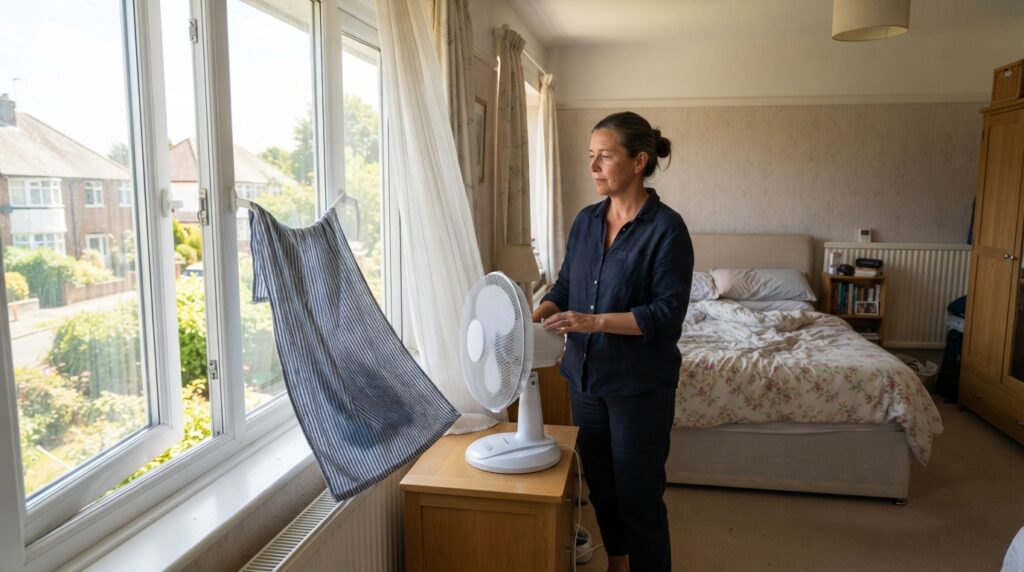
Partly, and with a catch that matters in Britain specifically. Hanging a damp sheet or towel in front of an open window or fan does cool the air passing through it — evaporation absorbs heat, which is real physics, not folklore. But that energy hasn’t left the room; it’s gone into turning water into vapour, and that vapour is now in your room. You’ve traded temperature for humidity. In a dry climate that’s a good trade. On a muggy British night, when humidity is already what’s making the heat unbearable, it frequently makes things feel worse rather than better.
This trick circulates every heatwave, usually presented as a free alternative to air conditioning. It’s worth understanding properly, because whether it helps depends entirely on conditions you can check.
The physics, briefly
Evaporating water takes energy. When water changes from liquid to vapour it absorbs heat from its surroundings — which is why sweating cools you, and why stepping out of a shower feels cold.
Hang a damp towel where air moves across it and the same thing happens: the air passing through gives up heat to evaporate the water, and comes out cooler.
So far so good. The catch is where that energy goes. It hasn’t been removed from the room — it’s now stored in the water vapour, which is in the air you’re breathing. Physicists call this latent heat. Practically, it means you’ve made the air cooler and wetter at the same time.
This is exactly how an evaporative air cooler works, which is why our air cooler comparison reaches the same conclusion about a machine that costs considerably more than a towel.
Why humidity is the problem in Britain
Your body cools itself primarily by evaporating sweat. The more moisture already in the air, the harder that gets.
So there’s a threshold. Cool the air by a small amount while raising humidity, and you can end up feeling hotter, because your own cooling system has been hampered more than the air temperature has fallen.
UK heatwaves are frequently muggy, and the worst nights — the tropical nights covered in our tropical nights guide — often combine warmth with high humidity. That’s precisely when this trick performs worst and when people are most desperate to try it.
Our “feels like” guide covers why the same temperature feels so different on different days. Humidity is most of the answer.
When it genuinely helps
It isn’t useless. It works when:
- The air is dry. The UK does get dry hot spells, particularly with easterly or continental air. Check a hygrometer or a weather app — if relative humidity is low, this works considerably better.
- The room is well ventilated. With air genuinely moving through and out, the added moisture leaves rather than accumulating. In a sealed room it just builds up.
- You use it on yourself rather than the room. This is the version that reliably works — see below.
The version that always works
Skip the room, and put the water on your skin.
A cool damp flannel on the wrists, neck, face and forearms cools you directly and efficiently, and adds a negligible amount of moisture to the room. NHS heatwave guidance recommends exactly this, and it’s what to reach for during a power cut when fans aren’t an option — our power cut guide covers that scenario.
A damp cloth on the back of the neck, refreshed every so often, does more for how you feel than a wet sheet across a window ever will.
The related tricks, assessed
Ice in front of a fan
Works briefly and marginally. A bowl of ice provides a small amount of cooling relative to the room’s heat load, and the ice cost energy to freeze in the first place — energy that your freezer dumped into your kitchen. Our ice and fans guide covers the arithmetic.
A bowl of water in the room
Adds humidity with no meaningful cooling, because nothing is moving air across it. Not worth doing.
Damp sheets on the bed
Sometimes called the Egyptian method. It does cool you as the water evaporates, but it dampens your bedding, adds humidity to a closed bedroom, and leaves you cold and damp when it works too well. A cool shower before bed achieves the same thing more pleasantly and without the laundry.
Freezing a hot water bottle
This one is genuinely reasonable — a sealed container of ice against your feet or behind your knees cools you directly, adds no humidity, and is reusable. Check the bottle is rated for freezing, and don’t apply ice directly to skin.
Cold shower before bed
Works, though not for the reason usually given. A warm rather than cold shower is often more effective, because it brings blood to the skin surface and helps the body shed heat afterwards. Our shower and sleep guide covers the evidence.
What actually beats all of this
Free, and reliably more effective:
- Shade the glass before the room heats — curtains and blinds closed from mid-morning on sun-facing windows. Stopping the energy entering beats trying to remove it.
- Purge ventilate at the right time — windows wide once outside is genuinely cooler than inside, shut in the morning. Most households get this backwards. Our window timing guide covers it.
- A fan pointed at you. Moving dry air across skin is the mechanism that works, and it doesn’t add humidity. Our fan explainer covers why aiming it at people rather than the room matters.
- Close doors to the room you’re trying to keep cool.
- Switch off electronics that are generating heat.
Frequently asked questions
So does it work or not?
It cools the air, genuinely. Whether it makes you feel cooler depends on humidity — in dry conditions with good ventilation, yes; on a muggy British night in a closed room, often not.
How do I know if it’s humid enough to be a problem?
A cheap hygrometer tells you. Above roughly 60% relative humidity indoors, adding more moisture is working against you. Our thermometers guide covers options.
Will it damage anything?
Repeatedly raising indoor humidity in a home prone to condensation contributes to damp and mould. Occasional use on a dry night is fine; making it a nightly habit in a poorly ventilated room isn’t.
Is an evaporative cooler the same thing?
Essentially yes, mechanised. Same physics, same limitation in humid weather. Our comparison covers where they do make sense — mostly ventilated garages, workshops and outdoor spaces.
Sources
- NHS — Heatwave: how to cope in hot weather
- Met Office — Humidity
- Met Office — Tropical nights and their impact
- GOV.UK — Damp and mould: health risks
- UKHSA — Adverse Weather and Health Plan
Related reading: our ice and fans guide and air cooler comparison.
Related guides



Compare current prices, stock and reviews on portable air conditioners at Amazon UK. Prices and stock move fast in a heatwave, so it is worth checking before you commit.
Browse air conditioners →