How to Keep Cool in a Power Cut During a Heatwave
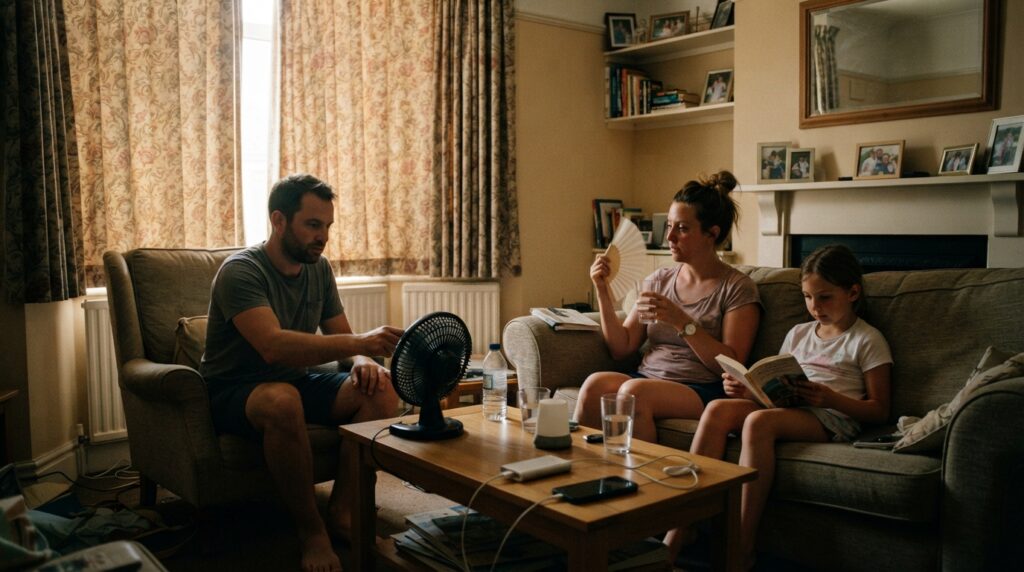
Without power you lose fans, air conditioning and often water pressure, so the strategy shifts entirely to the building and your body. Close everything on the sunny side, move to the coolest room — usually ground floor and north-facing — keep the fridge and freezer shut, and use water on your skin rather than trying to cool the air. The most important thing isn’t a gadget: it’s checking on anyone vulnerable, because a power cut in a heatwave is exactly the combination that turns hot weather into a health emergency for older neighbours.
Heatwaves and power cuts arrive together more often than people expect — demand peaks, equipment runs hot, and summer storms take out lines. This is what to do when both happen at once.
First ten minutes
- Check whether it’s just you. Look at your consumer unit for a tripped switch, then look at the street.
- Call 105 to report it and get an estimated restoration time. That number matters — it tells you whether this is twenty minutes or six hours, which changes what you do next.
- Close curtains and blinds on every sun-facing window immediately. This is now your main defence and every minute counts.
- Shut windows on the hot side if it’s hotter outside than in — which during a heatwave afternoon it usually is.
- Leave the fridge and freezer closed. A full freezer holds temperature for a surprisingly long time if left alone. Opening it repeatedly is what causes losses.
- Switch off and unplug the air conditioner and other appliances, so they don’t all restart simultaneously when supply returns.
Find the coolest room
With no cooling, the building’s own characteristics are all you have.
- Ground floor beats upstairs. Warm air rises, and upstairs also takes heat down from the roof — our stack effect guide covers why.
- North-facing beats south or west.
- A room with a solid floor — tile, stone, concrete — has thermal mass that stays cooler.
- Avoid conservatories, loft rooms and anything with a flat roof. These are the worst spaces in the house and become genuinely dangerous.
- A cellar or basement, if you have one, is often the coolest place in the building.
Move there, and close the doors between it and the rest of the house.
Cool yourself, not the air
Without a fan you can’t help evaporation along, so use water directly. NHS heatwave guidance covers this, and it’s more effective than people expect:
- Cool water on skin — wrists, neck, face, forearms and feet. A damp flannel or cloth works, refreshed regularly.
- A cool shower or bath if you still have water pressure. Note that if your supply is pumped, you may lose it in a power cut.
- A bowl of cool water for your feet.
- Drink water regularly, before you feel thirsty. Avoid excessive alcohol.
- Loose, light clothing.
- Rest. Physical activity generates heat you now have no way of shedding efficiently.
Check on people
The single most valuable thing you can do, and it costs nothing.
UKHSA’s heat mortality data consistently shows risk concentrated in the oldest age groups. A power cut removes fans and cooling from people who may already be struggling, may not have a mobile phone charged, and may not be able to get to a cooler place unaided.
- Knock on doors — older neighbours, anyone living alone, anyone unwell.
- Check they have water and know the supply is out.
- Offer to move them to a cooler room or a cooler house.
- Note that anyone relying on powered medical equipment needs urgent attention — see the Priority Services Register below.
Our elderly heatwave guide covers the warning signs and when to call NHS 111 or 999.
Register for the Priority Services Register — before you need it
Free, takes minutes, and it’s the thing to do today rather than during an outage.
Energy network operators and suppliers maintain a register for households needing extra support. You may be eligible if someone relies on electrical medical equipment, is of pensionable age, has a disability or long-term condition, has children under five, or is temporarily vulnerable.
It gets you advance notice of planned outages, priority updates during unplanned ones, and in some cases practical help. Register with both your network operator and your supplier — they’re separate lists. Our power cut kit guide covers this in full for the winter version of the problem, and everything there applies here too.
What not to do
- Don’t open the freezer to check on things.
- Don’t run a bath if you’re on a pumped supply and unsure how much water is left in the system.
- Don’t rely on your car for air conditioning for extended periods — never in a closed garage, and never leave anyone, particularly a child or animal, in a parked car.
- Don’t assume your solar panels will keep working. Most grid-tied systems shut down in a power cut for safety unless specifically fitted with backup capability. Our solar guide covers this.
Is a battery worth it for this?
Honestly, for cooling specifically, usually not.
Air conditioners are among the most power-hungry appliances in a home. A portable power station large enough to run one for a meaningful period costs considerably more than the air conditioner did, and UK outages are usually short. Our battery guide covers the arithmetic.
A fan is a different matter. A modest power station will run a fan for many hours, and a fan plus water on skin is genuinely effective. If you want backup for heat, that’s the sensible scale — not enough to run a compressor, enough to keep air moving.
The same station charges phones, which matters more than people expect during an outage.
When power returns
- Turn things back on gradually rather than all at once.
- Check the freezer contents. Food that has fully thawed shouldn’t be refrozen — the Food Standards Agency has guidance.
- Let the air conditioner stand a few minutes before restarting, and check the manual, as some units require a delay before the compressor restarts.
- Purge ventilate as soon as outside is cooler than inside, to shed the heat the house gained.
- Compensation may apply for long outages under the guaranteed standards of performance — your network operator can advise.
Frequently asked questions
Should I open windows during a daytime power cut?
Only if it’s genuinely cooler outside than inside, which during a heatwave afternoon it usually isn’t. Opening up at the wrong time fills the house with hot air. Wait until evening, then open wide.
Will my food be safe?
A closed fridge and freezer hold temperature for a considerable time. Keep them shut, and check FSA guidance on what’s safe when power returns. Don’t refreeze anything that has fully thawed.
What if I’m on a pumped water supply?
You’ll lose water pressure too. Keep some bottled water as standing preparation — it’s the item people wish they’d had.
Can I use a car to charge things?
Yes, with a USB adaptor, and it’s a useful way to keep phones alive. Never run the engine in a closed or partly closed garage.
Sources
- Energy Networks Association — Power Cut 105
- Ofgem — Priority Services Register
- NHS — Heatwave: how to cope in hot weather
- NHS — Heat exhaustion and heatstroke
- UKHSA — Adverse Weather and Health Plan
- HSE — Carbon monoxide in the home
- Food Standards Agency — Chilling and freezing
Related reading: our power cut kit guide and heat health alerts guide.
Related guides



Compare current prices, stock and reviews on portable air conditioners at Amazon UK. Prices and stock move fast in a heatwave, so it is worth checking before you commit.
Browse air conditioners →