Running Air Conditioning on a Cheap-Rate or Time-of-Use Tariff
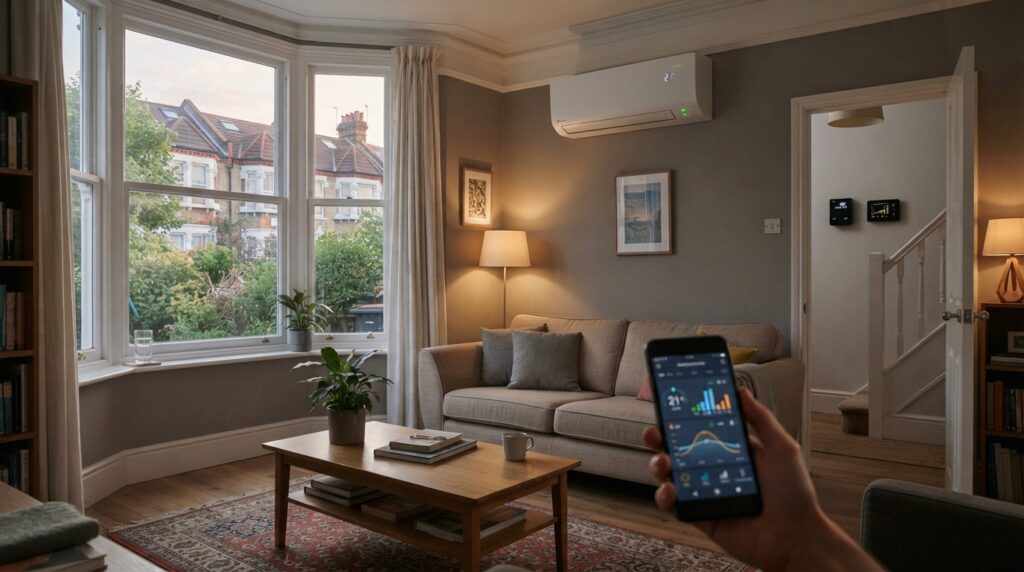
There’s a genuine opportunity here and a genuine trap. The opportunity: pre-cooling during cheap-rate hours and letting the room coast works, because a well-sealed room holds its temperature for hours. The trap: most cheap-rate periods are overnight, which is when you’d be running the unit anyway for sleep — so the saving is smaller than it first appears, and the expensive daytime peak is exactly when a hot room most needs cooling. Whether it stacks up depends far more on your household’s total usage pattern than on the air conditioner.
The tariff types, briefly
- Standard single rate — one price per unit, all day. Most households.
- Economy 7 and similar — a cheaper rate for a set overnight block, a higher rate the rest of the time. Designed originally for storage heating.
- Half-hourly and dynamic tariffs — prices vary through the day, often tracking wholesale costs, with cheap and expensive windows that move. Require a smart meter operating in half-hourly mode.
- Export and battery tariffs — relevant if you have solar or a home battery.
Ofgem publishes guidance on how these work and what to check before switching, linked below.
Where the saving actually is
Pre-cooling is the mechanism
A sealed, shaded room doesn’t warm up instantly once the unit stops. It coasts. That’s the whole basis of tariff-shifting for cooling: put the energy in when it’s cheap, take the comfort out later.
Practically: run the unit hard during the cheap window, get the room and its contents genuinely cool — walls, floor and furniture, not just the air — then let it drift through the expensive period with the unit off or on a low setting.
How long it holds depends on how well sealed and shaded the room is, which is why the free measures matter more here, not less. An unshaded west-facing room won’t coast at all — it’ll be gaining heat continuously. Our west-facing room guide covers that case.
The honest limitation
Most cheap windows on Economy 7-style tariffs are overnight. But overnight is when you’d want the unit running for sleep anyway, so you’re not shifting anything — you’re just paying less for what you were already doing. That’s a real saving, but it’s not the clever load-shifting the idea implies.
The expensive period is typically late afternoon and early evening, which is exactly when a west-facing room peaks and when people get home to a hot house. So the tariff structure and the cooling need are somewhat in opposition.
Dynamic tariffs are more interesting, because cheap windows can fall in the middle of the day — often when solar generation is high — which is genuinely useful for pre-cooling before the evening peak.
Working out whether it’s worth it
Do this rather than assuming:
- Find your unit’s power consumption in watts, from the rating plate or manual.
- Estimate hours of use across a summer, honestly. Most people overestimate — UK cooling seasons are short.
- Multiply to get kWh, then apply the rate difference between peak and off-peak to the hours you could realistically shift.
- Compare that against what the tariff change does to everything else — your kettle, oven, washing machine, and crucially your heating if it’s electric.
Step four is the one people skip, and it’s the one that decides it. A tariff with cheap nights and expensive days can cost a household more overall if most of their usage is in the day. Our running cost guide covers the calculation for the appliance itself.
Making it work in practice
- Use a timer or smart plug to run during the cheap window without staying up for it. Check the plug’s load rating against the appliance — many are rated well below what a portable air conditioner draws, and that’s a fire risk rather than a minor mismatch. Our electrical safety guide covers it, and our smart plugs guide covers the options.
- Use a unit with a built-in timer or app, which avoids the plug rating question entirely.
- Seal and shade properly first. A room that leaks won’t hold its temperature through the expensive window, and the whole strategy collapses. Free, and it’s the precondition.
- Cool the fabric, not just the air. Run long enough during the cheap period that the walls and furniture cool too — that’s what gives you the coasting.
- Watch your actual usage on a smart meter display or app for a couple of weeks before deciding whether the pattern is working.
Solar and batteries change the picture
If you have solar panels, the arithmetic is different and better. Cooling demand peaks when generation peaks — sunny afternoons — which is the best natural match of any household load.
Pre-cooling during the middle of the day on your own generation, rather than exporting it, is one of the more sensible uses of solar in a UK home. Our solar guide covers whether it genuinely adds up.
With a battery, you can also charge on a cheap rate overnight and discharge during the expensive evening period — though the losses at each conversion mean it’s rarely worth buying a battery for cooling alone. Our battery guide covers portable power stations specifically.
Don’t forget the free version
Worth stating, because it beats any tariff optimisation:
- Shading before the room heats reduces the load the unit has to handle at all, at zero running cost.
- Purge ventilation at the right time cools the house on free outside air.
- Sealing the window kit means every unit of electricity does more work.
- Right-sizing means the unit cycles rather than running flat out.
Reducing consumption beats paying less per unit, and it works whatever tariff you’re on.
Frequently asked questions
Will Economy 7 save me money on air conditioning?
On the cooling itself, potentially — if your use is overnight, which for bedroom cooling it often is. But you’d be paying a higher daytime rate for everything else, so the whole-household picture decides it, not the appliance.
How long does a cooled room stay cool?
Enormously variable. A well-insulated, shaded, sealed north-facing room can coast for hours. An unshaded room with large west-facing glazing starts warming as soon as the unit stops. Shading and sealing are what buy you the coasting.
Do I need a smart meter?
For dynamic and half-hourly tariffs, yes — they need half-hourly data. Economy 7 traditionally used a two-rate meter. Your supplier can tell you what your meter supports.
Is it worth switching tariff just for this?
Rarely, given how short UK cooling seasons are. It becomes worth considering when combined with an EV, electric heating, a heat pump or a battery — loads that run for far more of the year.
Sources
- Ofgem — Getting a cheaper energy deal
- Ofgem — Energy price cap
- Ofgem — Smart meters
- Energy Saving Trust — Home appliances and energy use
- Energy Saving Trust — Solar panels
- Citizens Advice — Energy supply advice
Related reading: our running cost guide and solar guide.
Related guides
Compare current prices, stock and reviews on portable air conditioners at Amazon UK. Prices and stock move fast in a heatwave, so it is worth checking before you commit.
Browse air conditioners →