Sleeping During the Day: Cooling a Bedroom for Night-Shift Workers
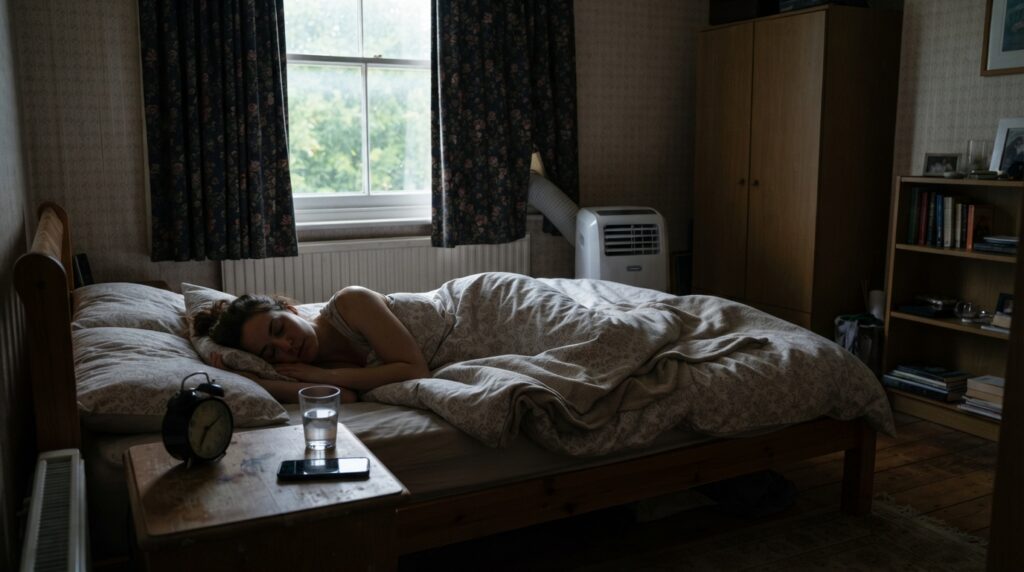
Night-shift workers get the worst version of this problem, and it’s rarely acknowledged. You need the room cool during the hottest hours of the day, when everyone else’s advice — “open the windows, it’s cooler outside” — is exactly wrong. You also can’t use the one free tool that works for everyone else, which is overnight purge ventilation, because you’re at work then. The practical answer is pre-cool before you get home, seal and shade the room completely, and treat noise as seriously as temperature, because daytime brings traffic, deliveries and neighbours that night doesn’t.
If you work nights, most summer sleep advice is written for someone else’s schedule. This is the version for yours.
Why your problem is harder
Three things stack against you.
You need it cool at the peak. A room is at its hottest in the afternoon, and for a night worker that’s the middle of the sleep period. Everyone else’s bedroom problem is the residual heat at 11pm; yours is the full solar load at 3pm.
You can’t purge ventilate. The most effective free measure — windows wide once outside is cooler than inside, usually late evening or overnight — happens while you’re at work. Nobody’s there to open them, and leaving windows open in an empty house has its own problems.
Light and heat arrive together. Blocking daylight is already essential for daytime sleep, and the coverings that do it best are frequently the ones that trap heat rather than reflect it.
The routine that works
1. Shade before you leave for work
Close blinds and curtains on sun-facing windows before you go, not when you get back. Once solar energy has entered, it’s in the room and stored in the walls and furniture.
Crucially for you: the outward-facing side of the covering should be light or reflective. A blackout blind with a dark backing absorbs energy and re-radiates it into the room. One with a white or metallised outward face sends some back through the glass. Our blackout blinds guide covers the distinction, which matters more for you than for anyone else because your blinds are closed at peak sun.
External shading is substantially better, because it stops the energy outside the glass entirely. An external blind, shutter or awning on the bedroom window is the single most effective thing available — see our shading guide, and note that fitting anything externally may need permission in a leasehold flat.
2. Pre-cool on a timer
The highest-value habit if you have an air conditioner. Set it to run for a period before you get home, so you arrive at a cool room rather than starting the machine from a baked one and waiting two hours to sleep.
A basic plug-in timer does it, or a unit with app control. Check the timer or smart plug’s load rating against the appliance first — our electrical safety guide covers why that matters with a high-wattage unit.
Our cooling times guide covers why starting from cold is the hardest task you can give a unit.
3. Seal the room
Door closed, window kit properly sealed, and every other door in the house closed too if you can. You’re cooling one room against the whole building’s heat, in the hottest part of the day. Our windows guide covers why a gap costs more than intuition suggests.
4. Purge when you can
You can still do it — just at a different point in your cycle. When you wake in the early evening and before you leave for work, open up if outside is genuinely cooler than inside. That sheds stored heat before the next day starts.
A cheap thermometer showing both indoor and outdoor readings takes the guesswork out. Our thermometers guide covers options.
Noise: the part that’s specific to you
Daytime is loud in a way night isn’t. Traffic, deliveries, bin lorries, school runs, neighbours, gardening.
Which creates a real tension: the fan or air conditioner keeping you cool also makes noise, and the window you’d open for air lets noise in.
What helps:
- Check the published noise figure before buying, and check the fan speed it was measured at. A figure quoted without a fan speed tells you little, and units are considerably louder at full speed. Some manufacturers publish a specific quiet-mode figure — that’s the number that matters for you.
- Compressor cycling is the intrusive part, more than steady fan noise. A unit that clicks in and out repeatedly is more disruptive than a slightly louder one running continuously.
- Steady noise can help. Many shift workers find a fan’s constant sound masks intermittent outside noise better than silence does. Our quiet operation guide covers what to look for.
- Sealing for cooling also seals for sound. Draught-proofing the door and sealing the window kit properly reduces both.
The rest of the household
Worth saying, because it’s usually the real obstacle.
Cooling one room properly is far easier than cooling a house, and it’s cheaper. But it needs the household to keep that door closed, keep the blinds shut in that room, and not open windows “to let some air in” while you’re asleep.
A note on the door helps more than you’d think. So does agreeing which room is yours for the summer — if there’s a north-facing room, it’s the right one, whatever the usual arrangement.
If you can’t cool the room
Practical fallbacks:
- Sleep in the coolest room in the house, even if it isn’t the usual bedroom. Ground floor and north-facing beats upstairs — our stack effect guide explains why.
- A fan pointed at you, not at the room. It doesn’t cool the air but it increases evaporation from skin, which is what actually makes you feel cooler.
- A cool shower before sleeping.
- Lighter bedding, and natural fibres over synthetics.
- Split your sleep if your schedule allows — a shorter block during the hottest hours and a second later, when the room has cooled.
Frequently asked questions
Should I leave the air conditioning running while I’m at work?
Cooling an empty room all night is waste. A timer that starts it an hour or two before you get home gives you the benefit without the cost — that’s the whole argument for pre-cooling.
Is a blackout blind enough on its own?
It helps considerably with light, which you need regardless, and moderately with heat if it has a reflective outward face. On a south or west-facing room in July it won’t be enough on its own — external shading or cooling will be needed too.
What temperature should I aim for?
Cooler than a living room. Sleep guidance generally points to a cool bedroom, and consistency matters as much as the number — our night waking guide covers why temperature swings wake people.
Can I ask my employer for help?
Worth asking. Employers have duties around shift work and fatigue, and some have policies covering it. Our workplace temperature guide covers the legal position on heat at work.
Sources
- NHS — Sleep and tiredness
- NHS — Heatwave: how to cope in hot weather
- HSE — Fatigue and shift work
- Met Office — Tropical nights and their impact
- UKHSA — Adverse Weather and Health Plan
Related reading: our night waking guide and blackout blinds guide.
Compare portable air conditioners at Amazon UK. For daytime sleep, check the published noise figure and the fan speed it was measured at, and look for a timer or app control so you can pre-cool.