Can Solar Panels Run My Air Conditioning for Free?
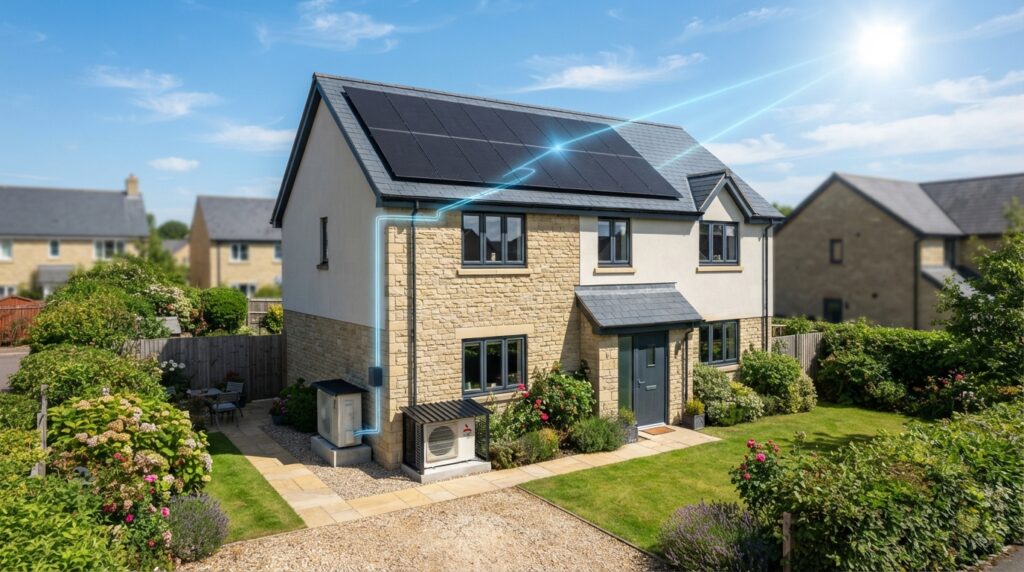
Partly, and the timing is unusually favourable — cooling demand peaks on hot sunny afternoons, which is exactly when solar output is highest. That’s a much better match than heating, whose peak falls on cold dark winter evenings when panels produce nothing. In practice a typical domestic array can cover much or all of a portable unit’s daytime draw. The catch is overnight, which is when bedroom cooling matters most and when your panels produce nothing at all — that’s where a battery, or a cheap night tariff, comes in.
This is one of the better questions in domestic energy, because the answer is genuinely encouraging in a way most efficiency questions aren’t.
Why the timing works so well
Solar output and cooling demand are driven by the same thing: sunshine.
A hot, clear afternoon is when your panels are producing most and when your house most needs cooling. The two curves broadly track each other, which is unusual — most household loads don’t align with generation at all.
Contrast this with heating. Peak heating demand in the UK falls on cold, dark, still winter evenings, when a solar array produces essentially nothing. That mismatch is why solar does relatively little for heating bills and comparatively more for cooling.
It’s also why the wider grid picture is less alarming than people assume as cooling becomes more common — our grid guide covers that.
The arithmetic
Rough figures, and you should check yours against your own system and bill.
What a portable air conditioner draws: typically 750W to 1,400W depending on capacity, and it cycles rather than running flat out, so average consumption is usually below the rated figure.
What a typical domestic array produces: a common UK residential system is somewhere in the region of 3–4kWp. On a clear summer afternoon, output can approach a substantial fraction of that peak rating.
So on a genuinely sunny afternoon, a domestic array is often producing more than a single portable unit consumes — meaning the unit can run on solar with capacity to spare, provided nothing else large is running.
The caveats that matter:
- Cloud. Output drops sharply. A muggy overcast day can still be uncomfortably warm — and those are exactly the days generation disappoints.
- Other loads. Your solar is feeding the fridge, freezer, router and everything else first, in the sense that all household demand draws from the same pool.
- Orientation and shading. A south-facing unshaded array performs very differently from an east-west split or one shaded by a tree.
- Time of day. Output peaks around the middle of the day; the hottest part of a UK afternoon often runs later, into declining generation.
The overnight problem
This is the honest limitation, and it’s the important one.
Overnight is when cooling matters most for health, because the body relies on cooler night-time temperatures to recover — the reason tropical nights are so consequential, covered in our tropical nights guide.
It’s also when your panels produce nothing. So the bedroom cooling that matters most is entirely grid-supplied.
Three ways round it:
- A home battery. Stores surplus daytime generation for overnight use. This is the proper fix, and it transforms the economics of overnight cooling — at meaningful upfront cost.
- Pre-cool the bedroom in the afternoon on free solar, then run the unit minimally overnight. Thermal inertia works in your favour — a room cooled hard at 4pm starts the night much cooler. This is free and genuinely effective.
- A time-of-use tariff. Cheap overnight rates make grid-supplied night cooling considerably less painful, with or without solar.
Making the most of it without a battery
Practical, free, and worth doing whether or not you ever buy storage:
- Run cooling during peak generation — roughly late morning through mid-afternoon — rather than only when you feel hot in the evening.
- Pre-cool rather than chase. Cooling a room hard while the sun’s out and coasting through the evening uses free electricity for the expensive part of the job.
- Use a timer or smart plug to run it while you’re out, so the house is cool when you get back and the generation isn’t wasted. Our smart plugs guide covers the options.
- Check your generation monitoring. Most systems have an app showing live output. Running the air conditioner when you can see surplus is the whole trick.
- Don’t oversize the unit. A bigger unit draws more and is more likely to exceed available generation — our BTU guide covers correct sizing.
Does using it yourself beat exporting?
Generally yes. Under the Smart Export Guarantee, licensed suppliers must offer a tariff paying for exported electricity — but export rates are typically well below what you pay to import. So consuming your own generation is usually worth more than exporting it.
That makes running the air conditioner on surplus solar a genuinely sensible use of it, rather than a guilty pleasure.
Do panels make the house hotter?
A common worry, and the answer is reassuring. Panels sit above the roof surface with an air gap, absorbing solar energy that would otherwise land on the tiles. Research generally finds a modest cooling effect on the roof beneath rather than a heating one.
Our solar panels and house heat guide covers this properly.
The picks
Pro Breeze 7000 BTU
Lowest draw
53 dB
~£296
~19p/hr
The lowest power draw of our picks, which is exactly the specification that matters when you’re trying to stay within available generation. Right for a bedroom or home office up to around 20m². If your array is modest or partly shaded, this is the sensible choice.
ElectriQ Eco Silent 12000
A-rated, year-round
53 dB
A-rated
Heat pump
Higher draw but A-rated efficiency, so more cooling per unit of electricity — which matters when the electricity is finite. The reverse-cycle heating is worth noting too: heat pump heating is far more efficient than resistive, so on a bright winter day your panels contribute more usefully to heating than they would with any electric heater.
Cheaper than any of it: reduce the demand
Worth ending here. The cleanest kilowatt-hour is the one you don’t need.
External shading, closing blinds before the room heats, and proper ventilation timing all reduce how long the unit runs — which stretches your solar further than any equipment choice. Our shading guide and window timing guide cover both.
Frequently asked questions
Do I need a battery to make this worthwhile?
No — daytime cooling on surplus solar works without one. A battery is what extends the benefit to overnight, which is where cooling matters most. Whether it pays back depends on your consumption pattern and tariff.
Will my air conditioner run during a power cut if I have solar?
Generally no. Most grid-tied solar systems shut down in a power cut for safety, unless specifically fitted with backup capability. Don’t assume you have it — check your system. Our power cut guide covers alternatives.
Is it cheaper to export and buy back?
Almost never. Export rates under the Smart Export Guarantee are typically well below import rates, so self-consumption is usually the better value.
How do I know if I’m running on solar or grid?
Your inverter or system app shows live generation and, on most modern setups, live household consumption. If generation exceeds consumption, you’re running on solar and exporting the rest.
Compare current prices, stock and reviews on portable air conditioners at Amazon UK.
Sources
- Energy Saving Trust — Solar panels (typical system sizes, output, self-consumption)
- Ofgem — Smart Export Guarantee (export tariff obligations)
- Energy Saving Trust — Home energy storage
- Ofgem — Energy price cap (import unit rates)
- Met Office — Understanding tropical nights
Related reading: our running cost guide and solar panels and house heat guide.