Why Is My Conservatory Too Cold to Use in Winter?
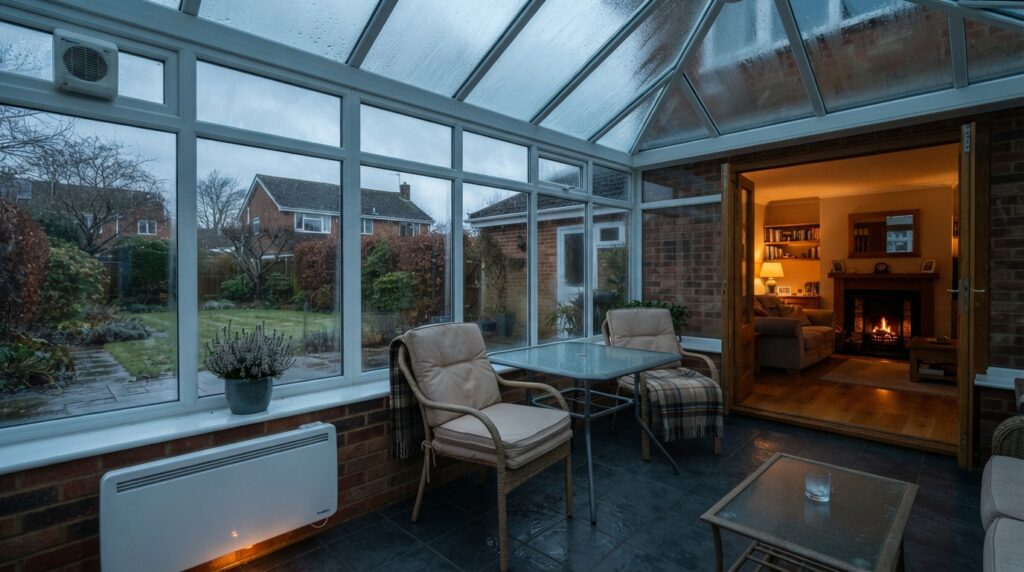
Because a conservatory is essentially a glass box, and glass is by far the worst-performing part of any building envelope. Most UK conservatories are also exempt from the insulation requirements that apply to the rest of the house, which is precisely why they were cheap to build and why they’re unusable for four months a year. The fixes that actually work, in order: roof first, then glazing, then heating — heating a conservatory without addressing the roof is pouring money through the ceiling.
Roughly the same households that ask us how to cool a conservatory in July ask how to heat one in January. It’s the same underlying problem — an envelope with almost no thermal resistance — expressed in opposite directions.
Why they perform so badly
Glass is a poor insulator. Even good double glazing performs far worse than an insulated wall. A room that’s mostly glass, including the roof, has very little resistance to heat loss.
The roof is usually the worst element. Polycarbonate roofing — standard on a great many UK conservatories — is thin, lightweight and thermally poor. Heat rises, so the worst-performing surface sits exactly where the heat is trying to escape.
Almost no thermal mass. There’s nothing to hold warmth. Switch off the heat and the room drops to near outdoor temperature quickly.
Air leakage. Conservatories are often built with less attention to sealing than the main house, and the junction between the conservatory and the original external wall is a common leak path.
Regulatory exemption. This is the structural reason. Conservatories meeting certain conditions — broadly, ground level, under 30 square metres, separated from the house by external-quality doors, with an independent heating system having its own controls, and glazing meeting safety requirements — are generally exempt from building regulations approval. That exemption is why they could be built quickly and cheaply. It’s also why they were never required to meet the insulation standards the rest of your house meets.
Fix the roof first
If you do one thing, do this. Roughly speaking, more heat escapes through a poor conservatory roof than through any other single element.
Insulated roof panels replacing polycarbonate transform winter usability more than any other intervention. They’re a proper job with proper cost, but the difference is genuinely night and day — and they help just as much in summer, when the same roof is the main reason the room becomes unusable in July.
Thermal roof blinds are the cheaper middle ground. Considerably less effective than replacing the roof, but they reduce heat loss and cost a fraction as much.
Internal insulated ceilings — a solid insulated ceiling built beneath the existing roof — are increasingly common. Worth checking whether the work affects your exemption status; a supplier should be able to advise, and building control will confirm.
Then the glazing
- Thermal or heavy lined curtains and blinds. The cheapest meaningful improvement. Closed at dusk, they add a layer of still air against the glass.
- Secondary glazing film — clear film shrunk taut with a hairdryer. Cheap, removable in spring, and genuinely effective on older single or poor double glazing.
- Check and renew the seals where the frames meet the base wall and where the conservatory meets the house. Perished mastic is common on conservatories over ten years old, and this junction is a frequent source of both draughts and water ingress — see our draught-proofing guide.
- Insulate the dwarf wall if there is one — often overlooked, and easier than the glazing.
Only then, heating
Heating an uninsulated conservatory is expensive and largely futile. Once the roof and glazing are improved, heating becomes viable.
Note the regulatory point above: the exemption generally requires the conservatory’s heating to have its own controls, separate from the house system. In practice that usually means an independent appliance rather than extending your central heating into it — and extending radiators into a conservatory is a common way people unknowingly change their regulatory position.
Among independent options, a reverse-cycle heat pump unit is the standout, for two reasons: it’s the only electric option that beats the 100% efficiency ceiling every resistive heater hits, and it cools the same room in summer — which, for a conservatory, is arguably the more valuable half. Our running costs comparison covers the physics.
The picks
ElectriQ Eco Silent 12000
Best conservatory buy
53 dB
A-rated
Heat pump
The obvious answer for a conservatory specifically: heats it in winter, cools it in summer, and runs on its own controls independent of the house system. Highest capacity in our range, which matters in a room with this much heat loss. Suits spaces up to around 28m², though be realistic — in an uninsulated glass box on a January night, no portable unit will keep up. Do the roof first.
MeacoCool MC Series 9000
Smaller conservatories
51–55 dB
~£349
App control
Suitable for a smaller conservatory or a well-insulated one where the roof has already been upgraded. App control is genuinely useful here — bringing the room up to temperature from indoors before you go and sit in it, rather than sitting in the cold while it catches up.
Be realistic about what’s achievable
Worth saying honestly. An unimproved conservatory with a polycarbonate roof will not become a comfortable January living room, whatever you plug into it. The heat loss is simply too high.
What’s achievable with heating alone is extending usable season — comfortable in autumn and spring, usable for a couple of hours on a mild winter afternoon. Achieving genuine year-round use requires the fabric work.
The good news: every improvement helps in both directions. An insulated roof that keeps heat in during January keeps solar heat out in July, which is the problem covered in our conservatory cooling guide.
Condensation: the winter side-effect
Cold glass plus warm moist air produces condensation reliably. In a conservatory it can be substantial, and it pools on frames and sills, eventually causing damage.
Keep some ventilation — trickle vents open, roof vents functional — even in winter, and consider a dehumidifier if you’re using the space regularly. Our condensation guide covers the balance between ventilation and heat loss.
Frequently asked questions
Can I just put a radiator in from my central heating?
Technically possible, but it may change your conservatory’s building regulations exemption, which generally requires independent heating controls. It’s also expensive to run given the heat loss. Check with building control before extending the system, and consider an independent appliance instead.
Is replacing the roof worth the cost?
For a conservatory you actually want to use year-round, it’s the single highest-impact change available — and it improves summer usability equally. Get quotes for both insulated panels and a solid insulated ceiling, and ask each supplier about building regulations implications.
Why is my conservatory unusable in both summer and winter?
Same cause, opposite direction. Glass conducts heat readily in both directions and there’s no thermal mass to buffer the swing, so it overheats in July and freezes in January. Anything that improves the fabric helps both problems.
Would a dehumidifier help with the cold as well?
Not directly, though drier air does feel slightly warmer at the same temperature and dry surfaces conduct less heat away than damp ones. Its real value is preventing the condensation and mould that cold glazing produces.
Compare current prices, stock and reviews on heat pump air conditioners at Amazon UK.
Sources
- GOV.UK Planning Portal — Conservatories: building regulations (exemption conditions: ground level, under 30m², external-quality separating doors, independent heating controls, safety glazing)
- GOV.UK — Approved Document L (conservation of fuel and power)
- Energy Saving Trust — Windows and doors (glazing performance)
- Energy Saving Trust — Draught-proofing
Related reading: our conservatory cooling guide and running costs comparison.