Best Air Conditioner for a Narrowboat or Houseboat (UK)
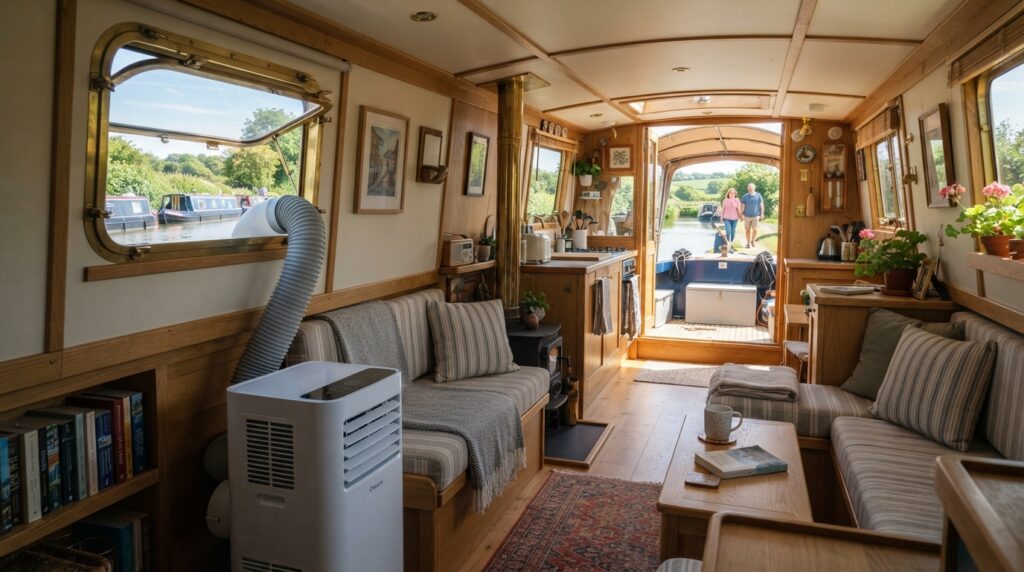
A compact, single-hose portable air conditioner suits a narrowboat or houseboat’s tight space best, but the bigger question is almost always power, not size. If you’re moored with a shore power hookup, a standard portable unit works exactly as it would in a flat. If you’re cruising or off-grid much of the time, running one from batteries alone is a genuine challenge — most boaters in that situation either accept air conditioning as a marina-only comfort, or run a small generator (the same starting-surge and headroom principles from our generator power guide apply here too). Whichever route, you’ll also need a proper plan for venting the hose through a porthole rather than a standard window, and for where the condensate water actually goes.
A narrowboat or houseboat cabin has a few genuinely different constraints from a flat or house — here’s how to think through them before buying.
Power: the question that decides everything else
This is worth getting straight before anything else. A portable air conditioner’s compressor draws meaningful, sustained power while running — considerably more than lighting, a laptop charger, or most of what typically runs off a boat’s leisure batteries. Running one from batteries through an inverter is possible in principle, but batteries drain quickly under that kind of sustained load, and recharging them (via engine, solar, or shore power) has to keep pace. For most boaters, the realistic options are:
- Shore power at a marina — by far the simplest, and the situation a standard mains portable air conditioner is actually designed for.
- A generator — sized with genuine headroom for the compressor’s starting surge, following the same principles as our generator power requirements guide, and run outdoors only, away from windows and vents, because of carbon monoxide.
- Accepting it as a marina-only comfort — many boaters simply run air conditioning only when hooked up, and rely on fans, ventilation and shading the rest of the time while cruising.
If you want to run one from batteries alone while off-grid, that’s a genuine electrical engineering question specific to your boat’s battery bank, inverter capacity and charging setup — get that properly assessed by a qualified marine electrician rather than guessing.
Choosing the unit itself
A compact, single-hose portable air conditioner
Fits the space and the power budget
Lower running power than dual-hose models
Simplest venting requirement
Cabin space on a narrowboat or houseboat is tight, so the smallest, simplest style of portable air conditioner — a single-hose unit — generally makes the most sense, both for physical space and because it’s typically the lower-power option within the portable category. It won’t match a dual-hose unit’s efficiency in the very hottest conditions, but for a compact cabin that’s rarely the limiting factor.
Good for: tight cabin spaces; the lowest power draw within the portable category; simplest single-hose venting.
Less good for: very hot, humid conditions where maximum efficiency matters most; and it still needs mains power (shore hookup or generator) to run properly.
Venting: a porthole isn’t a standard window
Standard window kits are designed to fit a domestic sliding sash or casement window, and a boat’s portholes or small windows generally don’t match that shape or opening mechanism. You’ll typically need to improvise or source a boat-specific venting solution — some boaters have a hatch or a custom-cut board fitted to take the hose, rather than relying on an off-the-shelf kit. Measure your specific window or hatch opening carefully before buying a hose kit, and be prepared that some adaptation is likely, rather than assuming a standard kit will simply fit.
Condensate water: plan where it actually goes
Why boats often need more cooling than you’d expect
A metal-hulled narrowboat or houseboat typically has far less insulation than a house — a thin steel or fibreglass hull conducts heat readily, meaning the cabin can heat up faster and more directly from sun on the hull than an equivalent-sized room in a well-insulated building. Combined with being moored on or near water, where humidity is often higher than inland, a boat cabin can present a genuinely tougher cooling challenge than its small size might suggest. If damp and condensation are as much an issue as heat, our air conditioner vs dehumidifier guide covers whether you need one appliance or both.
Frequently asked questions
Can I run a portable air conditioner off my boat’s leisure batteries?
Technically with a large enough inverter and battery bank, but it draws batteries down fast and needs proper sizing by a qualified marine electrician. Most boaters find it far more practical as a shore-power appliance, used while hooked up at a marina.
Will a standard window kit fit a porthole?
Usually not directly — portholes and boat windows differ in shape and opening mechanism from domestic windows. Expect to need a boat-specific or adapted venting solution, and measure your specific opening carefully before buying a kit.
Do narrowboats need more cooling than a similarly sized room in a house?
Often yes — a metal hull conducts heat readily and typically has far less insulation than a house wall, and higher ambient humidity near water can add to the challenge. Don’t assume the small cabin size alone makes cooling easy.
Sources
- Health and Safety Executive — Carbon monoxide dangers from generators and engines
- Energy Saving Trust — Keeping your home cool in summer
Related reading: our generator power requirements guide and air conditioner vs dehumidifier guide.
Compare current compact, single-hose options at Amazon UK.