Air Conditioner vs Household Appliances: Running Cost Compared (UK)
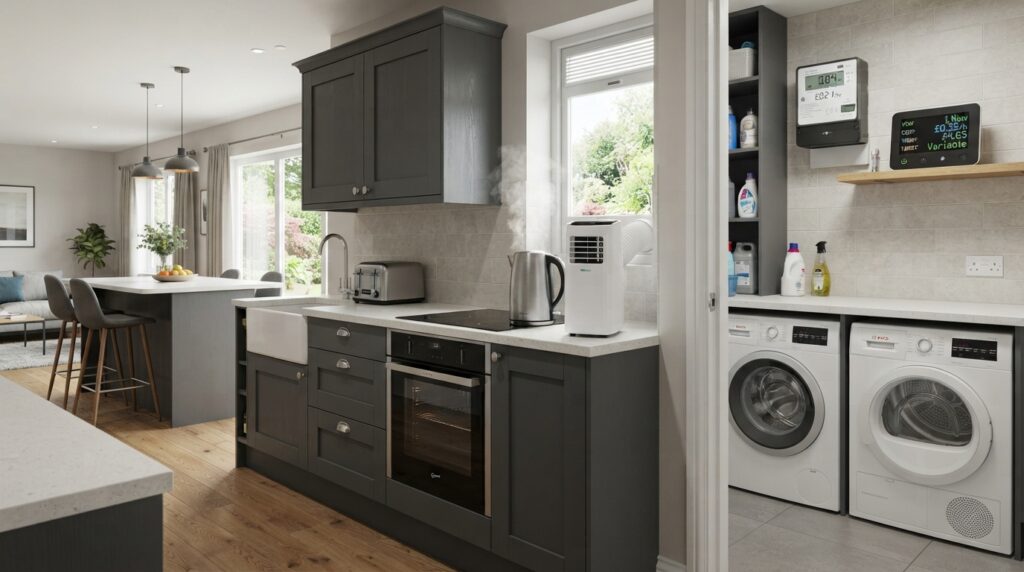
There’s no single “air conditioner cost” to compare against a kettle or a tumble dryer, because it depends entirely on the wattage of your specific unit and how many hours it actually runs — and we won’t invent a figure here, because it would be misleading for your model and your tariff. What’s genuinely useful to know: a portable air conditioner typically draws less power at any given moment than a big single-use appliance like a kettle, oven or tumble dryer, but it often runs for hours at a stretch rather than minutes, and once the room reaches your set temperature the compressor cycles off and on rather than drawing full power continuously. The honest way to work out your own cost is wattage x hours run x your own tariff rate — and the tools below help you do that with real numbers.
“Is running the air conditioner going to wreck my bill?” is a fair question, and it deserves a proper answer rather than a made-up number. Here’s how to actually work it out.
What actually determines the cost — and it isn’t the appliance category
Every electrical appliance’s running cost comes down to the same simple formula: wattage x hours used x your electricity price per unit. That means “how much does an air conditioner cost to run” is really the wrong question — the right one is “how much does my air conditioner, run for the hours I actually use it, cost on my tariff.” Two different portable units of similar cooling capacity can draw meaningfully different amounts of power, so the specific model matters more than the category.
How it compares to appliances you already have a feel for
Without inventing specific wattage figures for appliances we haven’t tested, here’s the honest, qualitative picture that’s widely understood about how appliances differ:
- Short, high-power bursts — a kettle, a toaster, or an oven at full heat draw a lot of power, but only for a few minutes at a time. Their total cost per use is often modest simply because the duration is so short.
- Long, lower-power runs — an air conditioner, a fridge-freezer, or a tumble dryer draw less power at any given moment than a kettle, but run for a long stretch (or continuously, in a fridge-freezer’s case), so the total energy used adds up differently. A unit that draws a moderate wattage but runs for six hours on a hot afternoon can use more total energy than a kettle boiled ten times that day.
- Cycling loads — a fridge-freezer’s compressor, and an air conditioner’s compressor once the room reaches temperature, switch off and on rather than running flat out the whole time. This is a genuine saving compared to running at full power continuously, and it’s one reason “leave it on all day” isn’t automatically the expensive option — see our leave-on vs turn-off guide for that specific question.
The upshot: it’s genuinely hard to say an air conditioner is “cheaper” or “more expensive” than a named household appliance in the abstract, because both the wattage and — crucially — the hours used vary so much. A unit run for two hours on a mild evening costs a fraction of the same unit run for eight hours on a heatwave day.
Why the energy label doesn’t tell you the whole story either
An air conditioner’s energy efficiency rating (A+++ through to less efficient grades) tells you how efficiently it converts electricity into cooling — a more efficient unit uses less energy to deliver the same cooling effect. It’s a genuinely useful figure when comparing two models, but on its own it doesn’t tell you what running your unit, in your room, for your hours, actually costs — that still needs the wattage-and-hours calculation. Our energy efficiency ratings guide explains what the label does and doesn’t tell you.
Working out your own real number
- Find the wattage on your unit’s rating plate or spec sheet.
- Estimate realistic hours — not the whole day if you’re mostly out, and remember the compressor cycles off once the room’s cool rather than running the full wattage the entire time.
- Check your actual tariff — your energy supplier’s app, a recent bill, or the current Ofgem price cap figure for a rough reference point.
- Use a proper calculator — the Energy Saving Trust publishes tools and guidance for working out appliance running costs accurately, using your own numbers rather than a generic estimate.
If you want to actually see what a unit is costing you in practice rather than estimating, a smart plug with energy monitoring — our smart plugs guide covers this — gives you real, measured figures for your specific unit rather than a calculation.
Ways to bring the real cost down, whatever it turns out to be
- Size the unit properly — an undersized unit runs constantly trying to reach temperature and never gets there; an oversized one cycles more than needed. Either wastes energy.
- Shade the room before switching on — closing curtains or blinds against direct sun cuts the heat load the unit has to fight, so it reaches temperature faster and cycles off sooner.
- Use a timer or smart plug so it isn’t running in an empty room.
- Keep the filter clean — a clogged filter makes the unit work harder for the same cooling, which costs more for no benefit.
Frequently asked questions
Is air conditioning more expensive to run than a tumble dryer?
It depends on the specific models and how long each runs — there’s no fixed answer. Both draw meaningful power, but over very different timescales, so check each appliance’s own wattage and your actual hours of use rather than assuming one is always cheaper.
Does an air conditioner use full power the whole time it’s on?
No — once the room reaches your set temperature, the compressor cycles off and on to maintain it rather than running continuously at full power. This means the average power draw over a session is usually lower than the peak figure on the rating plate.
How can I find out exactly what my unit costs to run?
Check its rating plate for the wattage, use your actual tariff rate, and ideally use a smart plug with energy monitoring to measure real usage rather than estimating. The Energy Saving Trust also publishes calculators for this.
Sources
- Energy Saving Trust — Keeping your home cool in summer
- Ofgem — Energy price cap
Related reading: our energy efficiency ratings guide and leave-on vs turn-off guide.
A smart plug with energy monitoring shows exactly what your unit uses. Compare current options at Amazon UK.