Best Air Conditioner for a Kitchen Extension With Bifold Doors (UK)
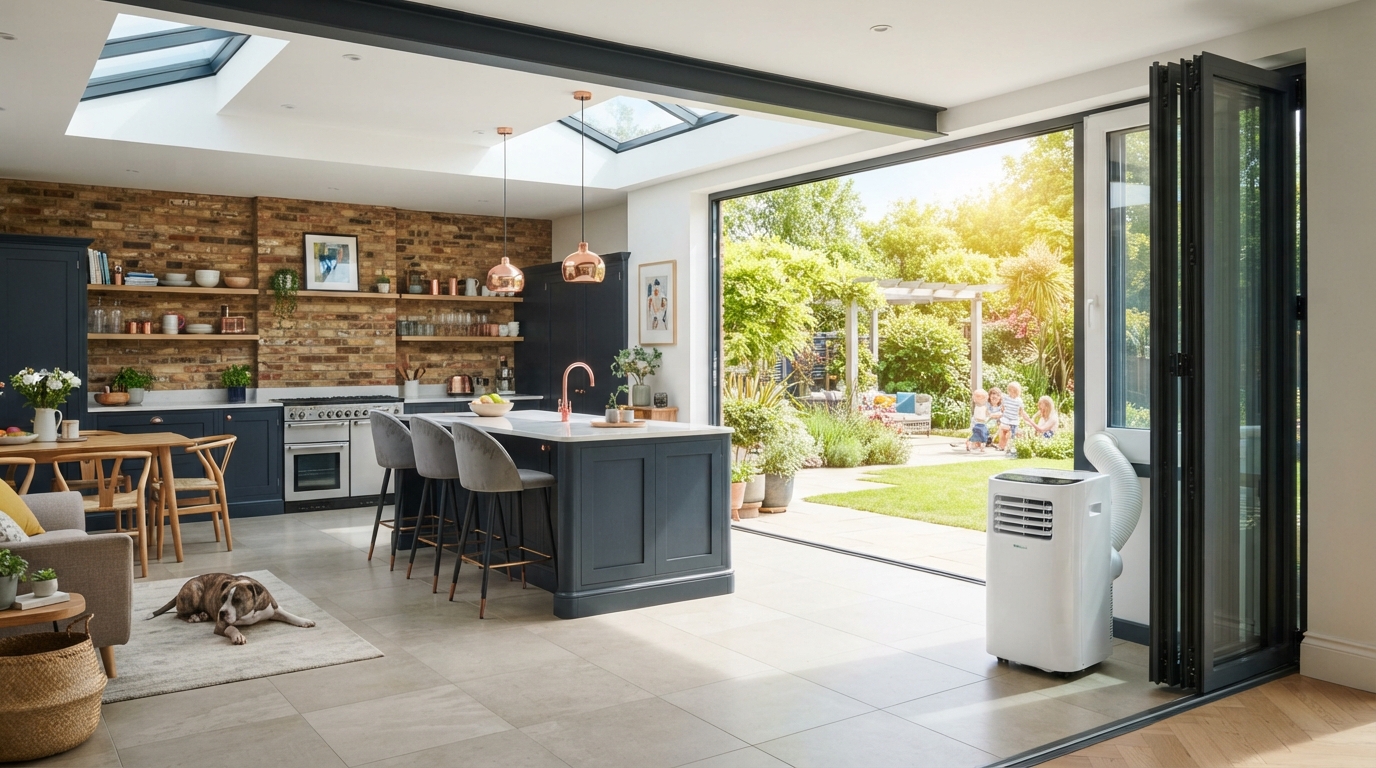
A glazed kitchen extension is the hardest room in the house to cool, and it’s worth being honest about that up front. A wall of bifold doors, often a glazed roof lantern, an open-plan layout you can’t shut off, and cooking heat on top — it’s a greenhouse with a hob in it. So the order matters: shade the glazing first (it’s the main heat source and no unit will keep up if you skip this), then choose cooling that’s sized for the volume, not the floor area. A portable unit can work but is often undersized for the glass and the open space; for a big glazed extension a fixed split system is frequently the honest answer. One genuine advantage: unlike most rooms, an extension usually lets you fit a permanent wall vent for a portable’s hose. And choose reverse-cycle whatever you pick, because these rooms are cold in winter too.
These extensions are wonderful to live in and brutal to cool. Here’s why, and how to actually get on top of it — starting with the part that does most of the work.
Why a glazed extension overheats so badly
It stacks up nearly every overheating factor at once:
- A wall of glass. Bifold and sliding doors are usually the whole rear elevation, and that elevation often faces the garden — frequently the sunniest, south or west aspect. That’s an enormous area of solar gain.
- A glazed roof lantern or rooflights. Many extensions have a lantern or flat rooflights letting in strong, high-angle overhead sun — heat coming straight down, with the ceiling right below it and no loft to buffer.
- Open-plan. The extension usually flows into the rest of the house with no door to close, so you can’t isolate and seal a small space to cool — you’re cooling a large connected volume.
- Cooking and appliance heat. It’s a kitchen. Ovens, hobs, the fridge and dishwasher all add heat exactly where people gather.
- Often single-aspect. If the only openings are the bifolds on one wall, there’s no cross-ventilation path — opening them gives you air in and out of the same face, which barely moves air through.
Step 1: shade the glass — nothing works without this
- External shading — a retractable awning over the bifolds, external blinds, or a brise soleil. Most effective by far, because it stops the sun before the glass. Our external shading guide covers it.
- Solar-control film on the glass — a strong option here, because a kitchen is a working space where slightly reduced light matters less than in a living room, and it treats the glass directly. Our reflective film guide covers the trade-offs.
- Shade the roof lantern — specific lantern and rooflight blinds exist, and this is often the most neglected and most valuable single measure, because overhead sun is intense.
- Internal blinds on the bifolds — better than nothing, and light-coloured or reflective-backed, but working on heat that’s already through the glass.
This is the same hierarchy as our window and shading guide, and it applies double here because the glazed area is so large. Approved Document O, the building regulations overheating guidance, is largely about limiting exactly this kind of solar gain in new work.
Step 2: use the bifolds for a night purge (and add cross-flow)
The huge doors are a liability by day but an asset at night: thrown open once it’s cooler outside, they flush an enormous amount of hot air out of the space. To make it work as ventilation rather than just an opening:
- Open the bifolds at night when it’s cooler outside than in, per our window timing guide, and shut them before the sun gets on them in the morning.
- Create a cross-flow by opening a window or door on the opposite side of the open-plan space — a window in the original part of the house — so air travels through rather than in and out of the same wall.
- Check whether the roof lantern opens. If it has an opening vent, it’s a superb exhaust — hot air rises and escapes through the top while cooler air comes in low through the bifolds. A fixed lantern can’t do this, which is worth knowing if you’re still specifying the extension.
- Mind security and insects with big doors open — and a fan can force the flush faster.
Step 3: choosing the cooling — and sizing it honestly
Portable unit
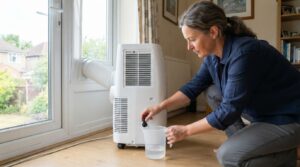
Good for: a smaller extension, or spot-cooling the area people actually sit in rather than the whole open-plan space; renting; no planning question. A real bonus in an extension is that you can usually fit a neat permanent wall vent for the hose, as our venting guide covers — no blocked door, tidy and out of the way.
Less good for: cooling a large, glazed, open-plan space to a comfortable temperature — a single portable is often simply not powerful enough, and cranking a too-small unit just runs up the bill without winning. Size generously and be realistic about what one can do.
Fixed split system — often the honest answer
Good for: genuinely cooling a large glazed extension. A wall-mounted split delivers far more cooling, more efficiently, mounts high to throw air across the open space, is much quieter (compressor outside), and doesn’t block a door or need a hose. For a big open-plan kitchen-diner, it’s frequently the only thing that will actually keep the room comfortable on a hot day. Choose reverse-cycle so it heats the extension in winter too — these glazed spaces are cold and expensive to heat, so that’s a major bonus, as our heat pump guide explains.
Less good for: budget and simplicity — it costs more, needs a certified installer for the refrigerant work, and an outdoor condenser unit that raises the planning and (if leasehold) freeholder-consent questions in our planning guide. Our portable vs split guide covers the full trade-off.
The kitchen factor
It’s still a kitchen, so a few things compound the heat and are worth managing:
- Use an extractor when cooking — it removes heat and moisture from the hob, not just smells.
- Cook cooler in a heatwave — the oven is a powerful heat source in a glazed room; our hot kitchen guide covers reducing appliance heat.
- Site the cooling away from the cooking heat so it isn’t fighting the hob directly.
If you’re still building it
The cheapest cooling is designed in. If the extension isn’t finished:
- Specify an opening roof lantern or vents for the stack-effect exhaust.
- Plan external shading (an integrated awning or brise soleil) rather than retrofitting.
- Consider solar-control glazing in the bifolds and lantern from the start.
- Provide an opening on another aspect for cross-ventilation.
- Run the electrical supply and, if going for a split, the pipework routes while walls are open — far cheaper than later.
- Think about orientation — a fully-glazed west-facing rear will cook every summer evening.
Frequently asked questions
Will a portable air conditioner cool my bifold kitchen extension?
A generously sized one can help, and you can usually fit a tidy wall vent for it — but a single portable is often underpowered for a large, glazed, open-plan space. Shade the glass first, size on volume not floor area, and for a big extension a fixed split system is frequently the realistic answer.
Why does my glazed extension get so hot?
A wall of glass (often facing the sun), usually a glazed roof lantern, an open-plan layout you can’t seal, and cooking heat — all at once. Solar gain through the glazing is the biggest factor, which is why shading it is the essential first step.
What size air conditioner do I need?
Bigger than a floor-area rule of thumb suggests. The extensive glazing and open-plan volume mean far more heat to remove, so size on the volume and the glass, not the floor area, or the unit will be undersized. Our sizing guide covers the calculation.
Is a split system worth it for an extension?
Often yes, for a large glazed one — it delivers the cooling a portable can’t, runs quieter and more efficiently, and a reverse-cycle model heats the extension in winter, when these rooms are cold. The costs are a certified install, an outdoor unit and possible planning considerations.
What’s the single most important thing?
Shading the glass. No unit of any size will keep the room comfortable with sun pouring through the bifolds and lantern unshaded — and shading it directly reduces how big and costly a cooling unit you need.
Sources
- GOV.UK — Approved Document O: Overheating
- Energy Saving Trust — Keeping your home cool in summer
- GOV.UK — Fluorinated gases (F-gases): rules (certified installers)
- Planning Portal — Do you need permission?
Related reading: our hot kitchen guide and portable vs split guide.
Shade the glass first, then size generously — a fixed split often suits a big open-plan space best. Compare current options at Amazon UK.