Best Type of Fan for UK Homes: Pedestal, Tower, Desk or Ceiling?
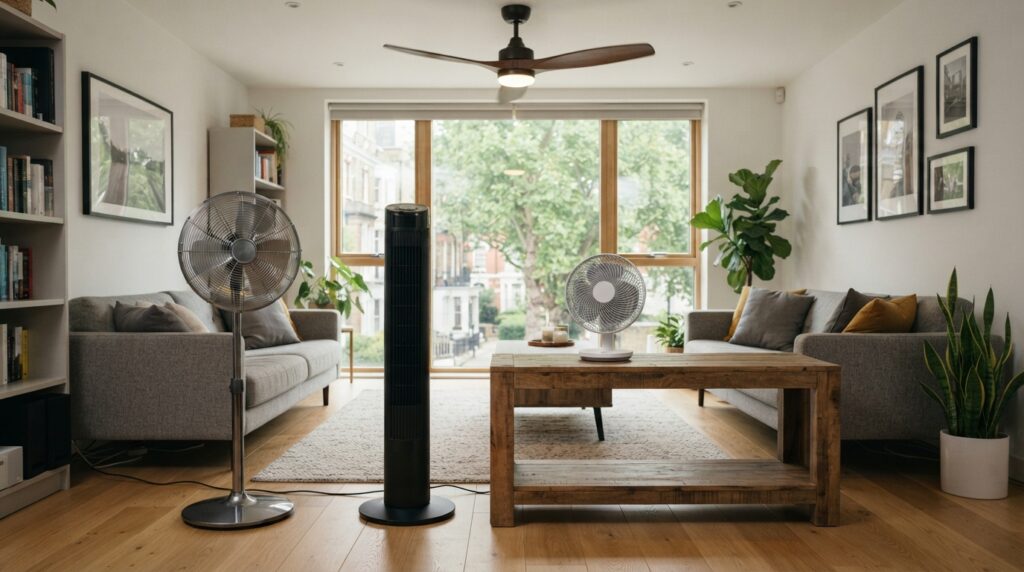
First, the thing to understand: a fan doesn’t cool the air, it cools you — by moving air across your skin so sweat evaporates. So a fan in an empty room does nothing useful; point it at people, and switch it off when you leave. With that in mind: a pedestal fan moves the most air and is the best all-rounder for a living room or bedroom; a tower fan is slimmer and often quieter for tight spaces; a desk fan is for personal cooling at a workspace; and a ceiling fan is the most effective and cheapest-to-run for a whole room, but it needs installing. Most homes are best served by a pedestal or tower fan, with a ceiling fan the upgrade if you’ll fit one.
Fans are the cheapest cooling most people will buy. Here’s which type suits which situation — and the one physical fact that decides how to use any of them.
The rule that applies to every fan
A fan creates airflow; airflow speeds evaporation of sweat and carries warm air away from your skin. That’s how it makes you feel cooler. It does not lower the room’s temperature — if anything the motor adds a trace of heat. Two practical consequences:
- Aim it at people, not the room. A fan cooling an empty room is wasted.
- Turn it off when you leave. There’s no benefit to it running with nobody there.
Where a fan genuinely moves cooler air into the home — a fan in a window at night — that’s a different, powerful trick, covered in our box-fan window guide.
Pedestal fan
The height-adjustable, oscillating all-rounder — a large blade on a stand.
Good for: living rooms and bedrooms; moving the most air of the freestanding types; reaching seated or standing height; covering a whole room with oscillation.
Less good for: tight spaces (it has a footprint and a wide head); quiet bedrooms at full speed, where a big blade can be noisy — though many run quietly on low; and it’s the least tidy to store.
Tower fan
A tall, slim column that takes little floor space.
Good for: tight spaces and flats; a tidier look; often quieter than a pedestal at comparable settings; frequently comes with a timer and remote.
Less good for: raw airflow — a tower generally moves less air than a good pedestal, so in a large or very hot room it can feel gentler. Check it has the fan speeds and reach you need before assuming it matches a pedestal.
Desk fan
A small fan for personal cooling close up.
Good for: a desk or bedside; cooling one person directly for very little electricity and space; a home office (our work-from-home cooling guide covers noise on calls).
Less good for: cooling more than the person right in front of it — it won’t do a room. Buy it as personal cooling, not a room solution.
Ceiling fan
A fixed fan that moves air across a whole room from above — the most effective and cheapest-to-run option, and a year-round fixture.
Good for: whole-room airflow without taking floor space; very low running cost; a permanent fixture that’s always there; many can run in reverse in winter to push warm air down from the ceiling.
Less good for: anyone who can’t install one — it needs an electrician and a suitable ceiling, so it’s off the table for many renters and awkward for low ceilings. It’s also not portable, so it only cools the room it’s in.
How to choose
- One room, best all-round airflow, movable → pedestal fan.
- Tight space, tidier, quieter → tower fan.
- Just cooling yourself at a desk or bedside → desk fan.
- A room you own and use a lot, want it permanent and cheapest to run → ceiling fan (if you can install one).
- Flushing the whole home’s heat at night → a box or window fan, per our window-trick guide.
A safety note for extreme heat
When a fan isn’t enough
A fan makes you feel cooler; it can’t lower the temperature or cut humidity. On the hottest, most humid nights that isn’t enough, and that’s the point at which cooling — a portable air conditioner — earns its cost. Our fan vs air conditioner guide covers exactly where that line sits.
Frequently asked questions
Do fans actually cool a room?
No — they cool you, by moving air across your skin. The room’s temperature doesn’t drop, so point a fan at people and switch it off when you leave.
Is a tower fan better than a pedestal fan?
Tidier and often quieter, but usually moves less air. For raw airflow in a larger or hotter room, a pedestal wins; for a tight, quiet space, a tower.
Is a ceiling fan worth installing?
If you own the room and use it a lot, yes — whole-room airflow, very cheap to run, out of the way, and reversible for winter. The catch is it needs an electrician and a suitable ceiling.
Which fan is quietest for a bedroom?
Often a tower fan or a ceiling fan on low, but it varies by model — check the noise on the lowest useful speed. Our quiet bedrooms guide covers sleeping with airflow.
Sources
- Energy Saving Trust — Keeping your home cool in summer
- NHS — Heat exhaustion and heatstroke
- Met Office — Heat-health advice
Related reading: our fan vs air conditioner guide and box-fan window guide.
For most rooms a pedestal or tower fan is the sensible buy. Compare current options at Amazon UK.