Is It Cheaper to Run Several Fans or One Air Conditioner?
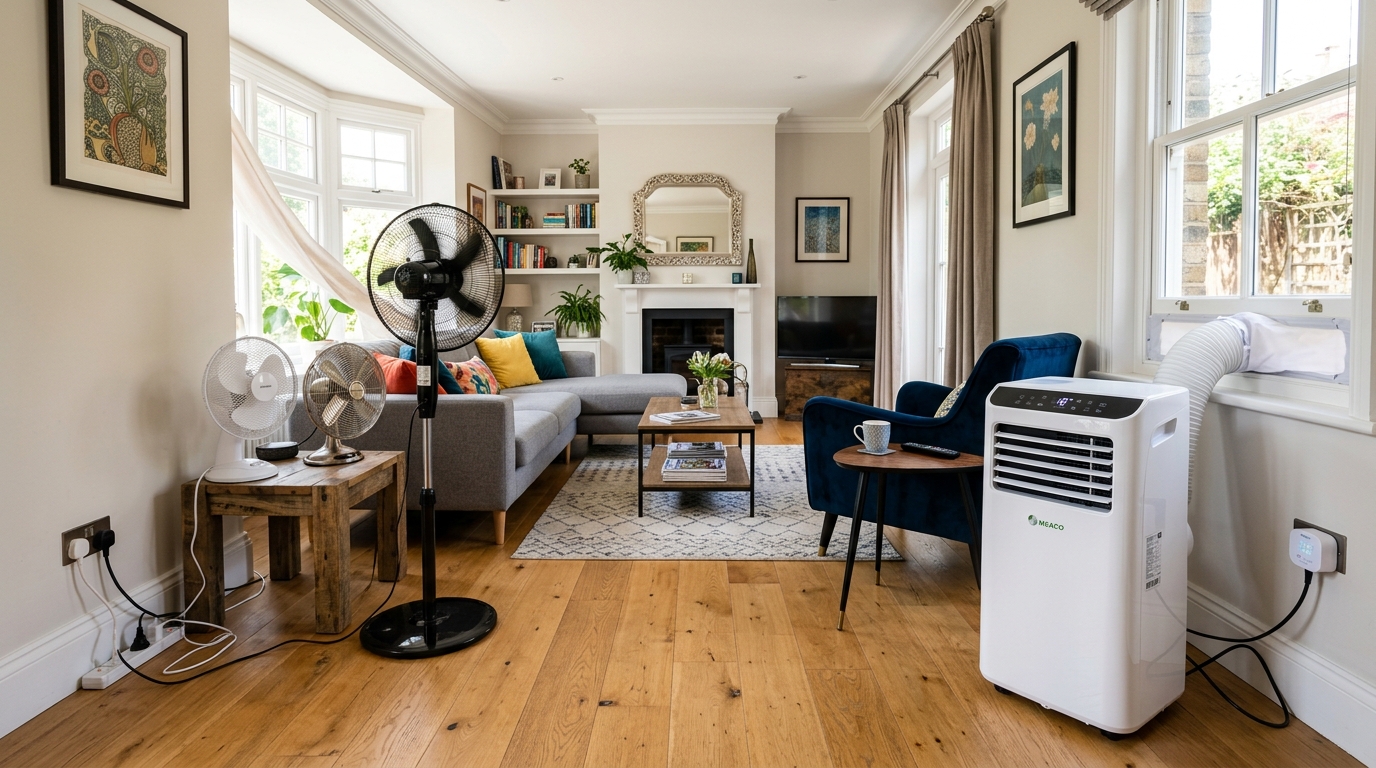
Fans win on cost, and not narrowly. A typical pedestal fan draws tens of watts; a portable air conditioner typically draws somewhere in the region of 0.8 to 1.4 kW. You could run a houseful of fans for less than one air conditioner. But the comparison has a catch that the arithmetic hides: they don’t do the same thing. Fans make people feel cooler by moving air across skin; an air conditioner actually removes heat from the room. On a night when the air is too warm for evaporation to help, no number of fans substitutes for one air conditioner.
Here’s how to work it out for your own house rather than relying on someone else’s figures.
Do the calculation yourself
We don’t quote running costs on this site, because unit rates move and a figure published today is wrong within months. The method doesn’t change, though, and it takes two minutes.
- Find the wattage on each appliance’s rating plate or in the manual.
- Divide by 1,000 to get kilowatts.
- Multiply by hours used.
- Multiply by your electricity unit rate in pence per kWh — it’s on your bill, and Ofgem publishes current price cap rates.
Do this for one air conditioner and for however many fans you’d actually run. The gap will be large enough that precision doesn’t matter much.
Two adjustments worth making:
- An air conditioner cycles. A thermostat means it isn’t drawing full power continuously once the room reaches temperature, so real cost is below the flat calculation — how far below depends on how well sealed and shaded the room is.
- A fan usually runs flat out for the whole period, so its figure is closer to the real thing.
Our running cost guide works through the method in more detail.
Why the comparison isn’t like for like
The important part, and the reason a pure cost answer misleads.
A fan adds no cooling to the room. It moves air, which increases evaporation from your skin, so you feel cooler while the room temperature stays the same — in fact the motor adds a small amount of heat. Point it at an empty room and it achieves nothing at all.
An air conditioner removes heat from the room and expels it outside through the hose. The room genuinely gets cooler, and drier too, since moisture condenses out at the coil.
So the honest framing isn’t “which is cheaper per hour” — it’s “which one solves my problem.”
When several fans genuinely is the better answer
- Several rooms occupied at once. One air conditioner cools one sealed room. Four fans cover four rooms for a fraction of the cost.
- Moderate heat. Below the point where evaporation stops keeping up, a fan is enough for most people.
- Everyone’s in a different place. Fans work on people, so put them where the people are.
- You can’t vent a hose. Restricted windows, a rented flat, an awkward opening — a fan needs none of that.
- Short bursts of hot weather. For a handful of uncomfortable days a year, the capital cost of an air conditioner is hard to justify.
- You move around the house. A fan you can carry beats a 30kg appliance you can’t.
When one air conditioner wins despite the cost
- Tropical nights, where the temperature doesn’t drop below 20°C and there’s no cooler outside air to bring in. Our tropical nights guide covers the trend — these are becoming more common.
- High humidity. This is the one that decides it. When the air is already moist, evaporation from your skin is hampered and a fan is moving warm damp air around. An air conditioner reduces humidity as well as temperature, which is why it works when fans have stopped helping.
- One room that has to be cool — a bedroom where someone isn’t sleeping, a home office, a room where someone at higher risk in heat spends their time.
- A room gaining heat continuously — west-facing, loft conversion, conservatory, above a garage. A fan doesn’t touch the underlying problem.
- You need it cool before you arrive. A fan can’t pre-cool; an air conditioner on a timer can.
The combination most households end up with
Worth saying, because it’s usually the right answer and nobody frames it this way.
Fans for the house, one air conditioner for the bedroom.
Fans handle the living areas during the day at negligible cost. The air conditioner handles the room where heat does the most damage — sleep loss compounds everything else.
And running a fan alongside the air conditioner is efficient rather than wasteful. Circulating the cooled air means you can set the unit a degree or two higher for the same comfort, which reduces the compressor’s running time. The fan costs pennies; the saving is on the expensive appliance.
The free things beat both
Whatever you run, these reduce how much you need it:
- Shade sun-facing windows from mid-morning, before the room heats. Free, and it beats both machines. Our blinds guide covers what to look for.
- Purge ventilate once outside is genuinely cooler than inside, then shut up in the morning. Most households get this backwards by hours — our timing guide covers judging it.
- Close internal doors to the room you’re cooling.
- Switch off electronics generating heat — our standby guide covers how much they contribute.
- Seal the window kit properly if you do run an air conditioner. With a single-hose unit a gap is a suction point, not a passive leak.
The picks
Two or three pedestal or tower fans
Best cost per room
No venting
Move between rooms
For covering several rooms in moderate heat, this is the sensible spend. Look for a remote if one will be used overnight, a timer, a stable base, and oscillation for shared rooms. Buying two decent fans usually beats one expensive one, because coverage matters more than airflow at a single point.
Good for: multiple occupied rooms, low running cost, renters and awkward windows, and running alongside an air conditioner to let you set it higher.
Less good for: humid or genuinely hot nights, where evaporation from skin can’t keep up. Fans also add noise in every room rather than one, and they can’t pre-cool or reduce humidity. In very high temperatures a fan pointed at someone vulnerable isn’t doing what it appears to — see the NHS guidance linked below.
MeacoCool MC Series 9000 (MC9000)
For the one room that matters
16–26m²
A-rated
Dehumidify mode
Meaco publish 16–26m² and an A energy rating. The efficiency class is the number that matters for this comparison — it determines how much electricity the unit uses for the same cooling, and over a hot fortnight the gap between classes is real money.
Good for: the single room where being cool genuinely matters; humid nights where fans have stopped helping; pre-cooling on a timer.
Less good for: covering a house — it cools one sealed room and no more. It costs many times a fan to run, weighs 20kg-plus, needs venting through a window, and needs storing for eight months of the year. If you get four uncomfortable nights a year, fans and shading are the better answer.
Frequently asked questions
How many fans equal one air conditioner?
None, in cooling terms — they do different things. On running cost, you could run a great many fans for what one air conditioner draws. On effect, one air conditioner in a sealed room beats any number of fans on a humid night.
Is it wasteful to run a fan and the air conditioner together?
No — it’s efficient. Circulating the cooled air lets you set the unit a degree or two higher for the same comfort, and the fan’s consumption is trivial next to the compressor’s.
Do ceiling fans cost less than portable ones?
Generally more efficient for the air they move, and they free up floor space. They need fixed electrical work, which is notifiable under Part P. Our ceiling fans guide covers the constraints.
Should I leave a fan on in an empty room?
No. A fan works on people, not on air temperature — an empty room gains a little heat from the motor and nothing else. Switch it off when you leave.
Sources
- Ofgem — Energy price cap (current unit rates)
- Energy Saving Trust — Home appliances and energy use
- NHS — Heatwave: how to cope in hot weather
- UKHSA — Adverse Weather and Health Plan
- Met Office — Tropical nights and their impact
- Meaco Dehumidifiers — MeacoCool MC9000 specifications
Related reading: our fan vs air conditioner guide and running cost guide.
Compare both at Amazon UK. For most households, fans for the living areas and one air conditioner for the bedroom is the arrangement that works.