Keeping Dogs and Cats Cool When They’re Home Alone
Signs: heavy or frantic panting, drooling, bright red or very pale gums, lethargy or collapse, unsteadiness, vomiting or diarrhoea, confusion, seizures.
While you get help: move them somewhere cool and shaded, offer small amounts of water, and start cooling — current veterinary advice supports pouring cool (not ice-cold) water over them and keeping air moving. Do not use ice-cold water or ice baths, which can cause the surface blood vessels to constrict and slow cooling. Ring the vet on the way so they’re ready — dogs can deteriorate rapidly, and internal damage can occur even after they appear to recover. Out of hours, call your practice’s emergency number.
The most important point isn’t about equipment: never rely on a machine to keep an animal alive. A portable air conditioner shuts itself off when the condensate tank fills — silently, with nobody there — and a power cut or a tripped breaker does the same. If a pet is left alone in weather that would be dangerous without cooling, the answer is changing the arrangement, not trusting a compressor. What works reliably: a cool room with shade, a solid floor, multiple water sources, free movement between rooms, and someone checking in.
This is the part of heat planning people think about last, and for dogs specifically it’s the part where things go wrong fastest.
Why home alone is the risky bit
An animal alone can’t tell you it’s struggling, can’t move to a cooler room if the door’s shut, can’t refill a water bowl it’s knocked over, and can’t switch off a machine that’s failed. Every problem compounds because nobody’s watching.
Dogs are at particular risk because they don’t sweat the way we do — they cool mainly by panting, which becomes less effective as air temperature and humidity rise. Cats generally cope better and are good at seeking out cool spots, but they can still overheat.
Animals at higher risk
Worth knowing which category yours falls into, because it changes how cautious to be:
- Flat-faced breeds — bulldogs, French bulldogs, pugs, boxers, Persian cats. Their airway structure makes panting far less effective, and they are substantially more vulnerable to heat.
- Older animals, and very young ones
- Overweight animals
- Thick or double-coated breeds
- Animals with heart or respiratory conditions, or any ongoing illness
- Black or dark-coated animals, which absorb more heat in sun
If yours is in any of these groups, be considerably more conservative about leaving them during hot weather, and talk to your vet about what’s appropriate for them specifically.
Setting up the room
All of this works whether or not you have cooling, and it works when the electricity doesn’t.
- Pick the coolest room. Ground floor, north-facing, ideally with a tiled, stone or solid floor — animals lie on cool surfaces deliberately, and a solid floor is genuinely useful.
- Close blinds and curtains before you leave, not when you get back. The energy arrives all day.
- Leave internal doors open so they can move between rooms and find their own cool spot. A cat shut in a sunny conservatory has no options.
- Avoid conservatories, loft rooms and flat-roofed spaces entirely. These become genuinely dangerous, and a cat flap into a hot conservatory is a trap.
- Multiple water bowls, in different rooms, heavy enough not to tip. One knocked-over bowl shouldn’t leave an animal without water for eight hours.
- Add ice cubes to water before you go — they melt slowly and keep it cooler.
- A damp towel to lie on, laid somewhere they can choose to use or not. Never wrap or confine an animal in wet fabric.
- A cooling mat — the pressure-activated gel type needs no power, so it can’t fail.
- Check the garden if they have access — shade that exists at 9am may be gone by 2pm, and a water bowl in sun heats up.
Where a machine fits — and where it doesn’t
Being straight about this matters more than selling anything.
A portable air conditioner is not a life-support system. Specifically:
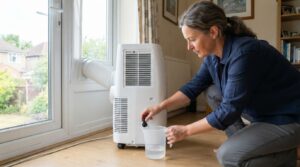
- It stops when the condensate tank fills, typically after hours of running, and nothing tells you. This is the failure mode most likely to catch you out on a hot day, because humid weather fills tanks faster.
- A tripped breaker or power cut stops it and nothing switches it back on.
- It cools one sealed room — but you want doors open so the animal can move, which works against it.
- The hose and cable are things to chew or trip over.
If you use one for this:
- Set up continuous drainage so the tank never fills. Non-negotiable for unattended running — our drainage guide covers it.
- Fit a temperature monitor with phone alerts. Cheap, and it turns a silent failure into a notification you can act on.
- Secure the cable and hose out of reach.
- Never point the airflow directly at a bed the animal can’t move away from.
- Treat it as a bonus, not a plan. The room should be survivable without it.
The better answer on a genuinely hot day
Change the arrangement rather than trusting a machine:
- Come home at lunchtime, or ask someone to check in
- A neighbour, friend or pet sitter looking in during the hottest hours
- Doggy daycare on the worst days
- Take them with you where that’s practical — never leaving them in a parked car
- Work from home if you can during an amber or red heat alert
Walks and exercise
Related, and the commonest cause of heatstroke in dogs in the UK.
- Walk early morning or late evening, avoiding the middle of the day entirely in hot weather
- Check the pavement with the back of your hand. If you can’t hold it there comfortably for several seconds, it’s too hot for paws
- Shorten walks, and skip them on the worst days — a missed walk is better than a vet emergency
- Carry water
- Exercise-related heatstroke is a bigger risk than lying in a warm room, particularly for flat-faced and older dogs
The picks
A pressure-activated cooling mat
Can’t fail
Self-recharging
Animal chooses to use it
The item we’d buy first for this, precisely because there’s nothing to go wrong. Gel mats activate under the animal’s weight and recharge when not in use, so no electricity, no cable, no failure mode. Place it somewhere the animal can choose to lie on it or move off — that choice matters, because an animal will regulate itself given options.
Good for: unattended use; households where power reliability is a concern; animals that already seek out cool floors.
Less good for: chewers. A punctured gel mat is a mess and a potential ingestion risk, so don’t leave one with a dog that destroys things unsupervised. It also cools by contact only — it does nothing for air temperature, so it supplements a cool room rather than creating one.
A temperature monitor with phone alerts
Tells you before it’s late
Logs the day
Inexpensive
The one piece of technology genuinely worth having here. It tells you what the room actually did while you were out, which is information you can act on — and if the cooling fails or the room climbs, you get a notification rather than finding out when you walk in. Logging also tells you whether the room is a problem at all, which sometimes saves you the cost of cooling entirely.
Good for: knowing rather than guessing; catching a failed air conditioner or a room that heats more than you assumed.
Less good for: doing anything about it from a distance. It depends on your Wi-Fi and power staying up — which is exactly what may fail — and an alert is no use if you’re two hours away. It informs the arrangement; it doesn’t replace one.
Frequently asked questions
What temperature is too hot for a dog indoors?
There’s no single figure — it depends on breed, age, weight, coat, health and humidity. A flat-faced dog can struggle at a temperature a lean whippet manages easily. Watch the animal rather than the thermometer, and ask your vet what’s appropriate for yours.
Should I shave my dog in summer?
Ask your vet or a professional groomer first. For some double-coated breeds the coat provides insulation against heat as well as cold, and clipping can make things worse and risk sunburn. It isn’t a universal answer.
Is a fan enough for a pet?
Less useful than for people. Fans work by aiding evaporation from skin, and dogs don’t sweat that way. Moving air helps a little, but shade, a cool floor and water matter more. Keep any fan out of reach and secure the cable.
Can I leave the air conditioning on all day for them?
Only with continuous drainage set up, and even then treat it as a bonus rather than the plan. The room needs to be safe if the machine stops, because it can and nobody will be there.
Sources
- RSPCA — Hot weather advice for pets
- Blue Cross — Heatstroke in dogs
- PDSA — Heatstroke in dogs
- British Veterinary Association — British Veterinary Association
- Cats Protection — Cat care advice
- Met Office — Heat-Health Alerts
Related reading: our pets and filters guide and heatwave power cut guide.
Compare options at Amazon UK. For an unattended pet, a cooling mat and a temperature monitor are more dependable than a machine that can switch itself off.