Best Air Conditioner for a Baby’s Nursery: Safe Setup Guide
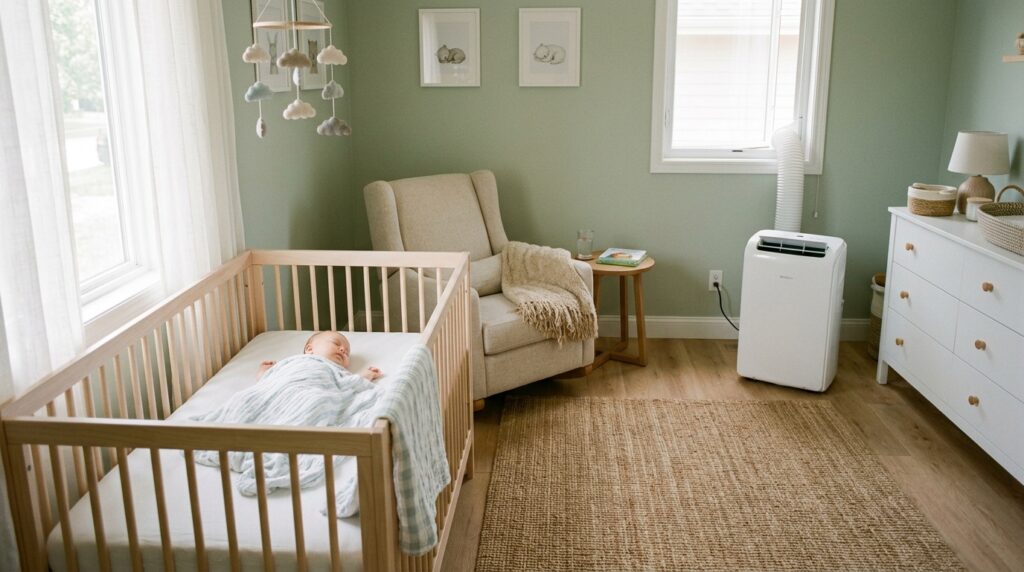
The Lullaby Trust recommends a room temperature of 16–20°C for safer sleep, with around 18°C often cited as comfortable — cooler than most parents expect, and the reason overheating rather than cold is the concern. For equipment: noise and airflow direction matter more than capacity. Never point the airflow at the cot, position the unit so the hose and cable are nowhere near it, and — critically — keep blind and curtain cords well away from the cot, because looped cords are a strangulation risk and people rearrange nurseries when they add shading for heat.
Nurseries get hot for the same reasons any bedroom does, but the margins matter more and the equipment choices are narrower.
The temperature target
The Lullaby Trust’s safer sleep guidance gives 16–20°C as the room temperature range, and this is the figure to work to rather than general comfort advice written for adults.
That’s cooler than most centrally heated homes run, and the emphasis is deliberate: overheating is a recognised risk factor for sudden infant death, which is why the guidance leans cool rather than warm.
Use a room thermometer. Not a guess, not how the room feels to you — many baby monitors include one, and standalone ones are inexpensive. Our thermometers guide covers options, and one that records overnight minimum and maximum is more useful than a spot reading.
To check whether your baby is too warm, Lullaby Trust guidance is to feel their chest or the back of their neck — hands and feet normally feel cooler and aren’t a reliable guide.
Safety first, equipment second
- Never point the airflow at the cot. Cool the room, not the baby. Angle the louvres away and use oscillation if available.
- Position the unit away from the cot — out of reach as the baby becomes mobile, and far enough that the hose and cable can’t be reached.
- Route the cable safely. Not across the floor where you’ll walk at night carrying a baby, and not where it can be pulled.
- Plug directly into a wall socket, never an extension lead or coiled reel. Our electrical guide covers why.
- Keep the window kit secure. A panel that can be pushed out is a hazard as well as a security issue.
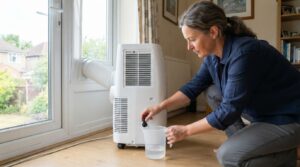
- Clean the filter religiously. A neglected filter blowing dust and mould into a nursery is worse than a slightly warm room. Fortnightly minimum during use — our maintenance guide covers it.
- Check the smoke alarm while you’re rearranging the room.
Noise
The buying criterion that decides whether the unit gets used. A machine that wakes the baby will be switched off, and then it isn’t cooling anything.
- Check the published decibel figure and the fan speed it was measured at. A figure without that is close to meaningless.
- Compressor cycling is the intrusive part — clicking in and out disturbs sleep more than steady running. Correct sizing reduces it.
- Independent measurements can differ from published ones. Trusted Reviews measured 58.5 dB fan-only on the Meaco Pro 9000 against a published 52 dB low-fan figure.
- Some parents find steady noise helps, masking household sounds. Others find any noise wakes the baby. You’ll know which yours is.
- Pre-cool instead. Often the best answer: run the unit before bedtime, switch it off, and let a well-sealed, shaded room coast. Our cooling times guide covers why pre-cooling beats chasing.
Do the free things first
These reduce how much the unit needs to run, which helps with noise as well as cost.
- Shade the window from mid-morning, before the room heats. Closing curtains at bedtime achieves very little — the energy has been arriving all day. A reflective outward face matters more than opacity. Our blinds guide covers it — and mind the cord safety point above.
- Purge ventilate once outside is genuinely cooler than inside, then shut up in the morning. Our timing guide covers judging it.
- Consider a cooler room. Ground floor and north-facing beats upstairs — our stack effect guide covers why. Note that Lullaby Trust guidance recommends babies sleep in the same room as their parents for the first six months, so this may be a whole-family decision.
- Remove heat sources. Night lights, monitors and chargers all contribute in a small sealed room.
- Adjust bedding rather than the thermostat where you can — lighter sleepwear and fewer layers, following Lullaby Trust guidance on appropriate bedding for the temperature.
The picks
MeacoCool MC Series 7000
Right size for a nursery
Small rooms
Simple controls
UK support
Meaco describe this as the smallest model in their range, for small home and office spaces — and a nursery is usually a small room. Right-sizing matters here specifically: an oversized unit cools fast, hits temperature and cycles off, and that repeated clicking is more disruptive to a sleeping baby than a smaller unit running steadily.
Good for: a typical box-room or small nursery; parents who want documented specifications and UK warranty support.
Less good for: a large nursery or a loft room, where it will run continuously without catching up. It’s still an audible appliance — no portable unit is silent, and if your baby wakes at any noise, pre-cooling and switching off is the better strategy than any model choice. Check Meaco’s current published room-size range before buying.
A room thermometer
Buy this first
Records overnight
Inexpensive
The item we’d buy before any cooling. The Lullaby Trust range of 16–20°C is a number, and you can’t judge it by feel — a room that feels fine to a fully dressed adult standing up may be several degrees off. A model that records overnight minimum and maximum tells you what the room actually did while everyone was asleep, which is the information you want.
Good for: knowing whether you have a problem at all; many parents find the room is already in range and no cooling is needed.
Less good for: doing anything about it. It measures, it doesn’t cool. Place it at cot height rather than on a shelf near the ceiling, since temperature varies by height in a room.
What about a fan?
Often sufficient, and simpler. A fan removes no heat but moving air increases evaporation from skin, so it helps at moderate temperatures.
Same rules apply: never point it at the cot, and position it where it can’t be reached or pulled over. A floor-standing fan near a cot is a hazard as the baby becomes mobile — wall-mounted or well out of reach is better.
Frequently asked questions
Is air conditioning safe for a baby?
A domestic unit cools and dehumidifies room air — there’s nothing specific to babies about that. The practical points are airflow direction, filter cleanliness, cable and cord safety, and not over-cooling. For anything about your baby’s health, ask your health visitor or GP.
What if the room won’t get below 20°C?
Shade the window from mid-morning, purge ventilate overnight, remove heat sources, and consider a cooler room. If it’s still above range during a heatwave, follow Lullaby Trust guidance on hot weather and speak to your health visitor if you’re worried.
Should I use dry mode?
It removes moisture, which can help comfort in muggy weather. Watch that it doesn’t over-dry the room, and don’t direct airflow at the cot. Our dry mode guide covers when it earns its place.
Can I use it while my baby is in the room?
Yes, with airflow directed away and the unit positioned out of reach. Many parents prefer to pre-cool and switch off for the night, which avoids the noise question entirely.
Sources
- The Lullaby Trust — Room temperature
- The Lullaby Trust — Safer sleep advice
- NHS — Reduce the risk of sudden infant death syndrome
- NHS — Heatwave: how to cope in hot weather
- RoSPA — Blind cord safety
- Electrical Safety First — Electrical safety around the home
- Trusted Reviews — MeacoCool MC Series Pro 9000 review (independent noise measurement)
Related reading: our night waking guide and blackout blinds guide.
Compare options at Amazon UK. For a nursery, buy the thermometer first — you may find the room is already in the recommended range.