Easiest Portable Air Conditioners for Older Adults (UK)
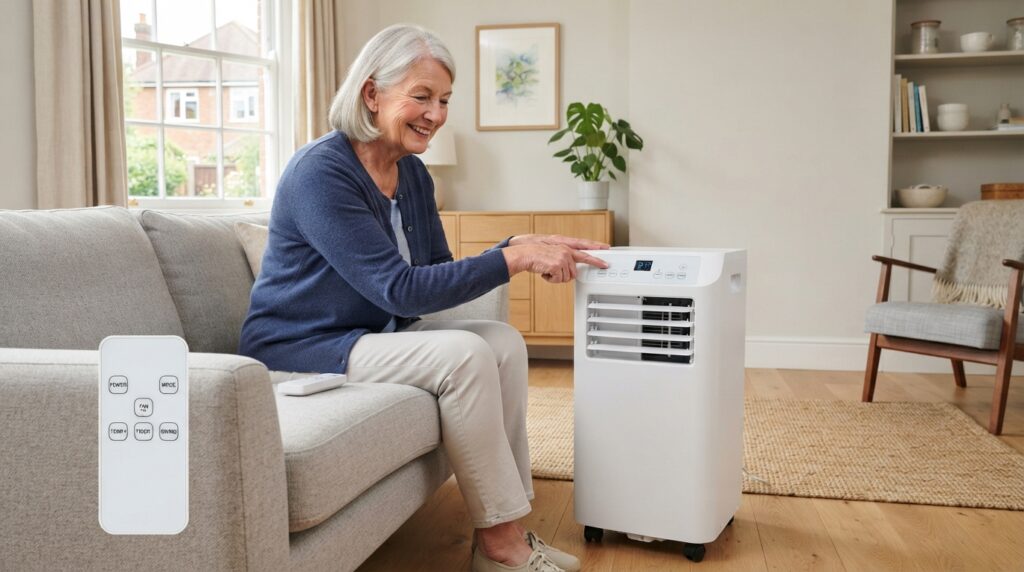
The most important feature for ease of use isn’t a technical spec at all — it’s a simple physical remote or control panel with clear, large buttons, rather than a unit that expects you to use a smartphone app to do anything basic. Beyond that, look for castors for easy moving, a filter that’s simple to reach and clean, and a straightforward cool-only mode rather than a confusing array of settings you’ll never use. The best approach for most households is to set the unit up properly once — hose fitted, settings sorted — and leave it largely alone, rather than something that needs adjusting or fiddling with every day.
This is a different question from “which air conditioner is most accessible” — see our cooling and mobility guide for that broader picture. This one is specifically about simplicity: a unit that’s genuinely easy to understand and operate day to day, whoever’s using it.
What actually makes a unit easy to use
Physical controls you can see and press
Many modern appliances push people toward a smartphone app for full control, and while that suits some, it’s an unnecessary extra step for a lot of people — and a genuine barrier for anyone less confident with a phone, or without one to hand. Look for a unit with a clear physical remote and an on-unit control panel that covers everything you actually need (power, temperature, fan speed, timer) without requiring an app for basic operation. Large, clearly labelled buttons and a bright, easy-to-read display matter more here than any amount of “smart” functionality.
Set it up once, not every day
The best approach for ease of use is usually to fit the hose and window kit properly once at the start of the season and leave it in place, rather than a unit that needs setting up and packing away repeatedly. If the initial setup is fiddly, it’s worth asking a family member or friend to help get it installed correctly the first time — after that, day-to-day operation should just mean pressing power and adjusting the temperature.
Simple, not “smart,” modes
Many units offer a long list of modes — dehumidify, sleep, eco, auto, fan-only, various swing and timer combinations. For everyday ease of use, a straightforward cool mode with a clear temperature dial or buttons is genuinely more useful than a unit that buries the basic function under menus. If a unit does have extra modes, that’s fine — the key is that the simple, most-used function is quick and obvious to reach.
The pick
A single-hose unit with a physical remote and simple controls
Straightforward, day to day
Castors for easy moving
Simple cool-only operation
A single-hose portable unit is generally lighter and simpler to live with than a dual-hose model, and pairing that with a clear physical remote and control panel — rather than app-dependent controls — covers most of what makes a unit genuinely easy to use day to day. Castors make it easy to reposition without lifting, and a washable filter that’s simple to access means maintenance doesn’t become a barrier either.
Good for: straightforward day-to-day use; anyone who’d rather not rely on a smartphone app; a unit that’s simple to reposition; setting up once and leaving it.
Less good for: anyone wanting the more sophisticated modes and app scheduling some pricier units offer — simplicity here is a deliberate trade-off, not a limitation to work around.
Other things worth checking
- Noise level — a quieter unit matters for anyone who’s a lighter sleeper, and it’s worth checking reviews specifically for bedroom noise. Our quiet bedroom units guide covers this in depth.
- Auto shut-off and safety features — a unit that shuts off safely if the tank is full, or if it’s tipped, is a genuinely useful feature rather than an extra.
- Weight and castors — even if it’s set up once and left, being able to move it between rooms without help is worth having.
- Where the manual is kept — keeping the paper manual somewhere obvious (or taking a photo of the key settings page) saves confusion later, especially if someone else needs to help troubleshoot.
Getting the setup right the first time
A properly fitted window kit and a sensibly positioned unit make the biggest difference to how easy a unit is to live with — far more than any control panel. If a family member is helping set it up, it’s worth them also showing whoever will use it day to day exactly which buttons matter (power, temperature up/down) and pointing out the tank-empty indicator, so it’s not a mystery if the unit stops and displays something unexpected.
Frequently asked questions
Should I avoid units that need a smartphone app?
Not necessarily avoid entirely, but check the unit has full physical controls for the basics (power, temperature, fan speed) so an app isn’t required for everyday use. Some units use an app only for extra features, which is fine as long as the physical remote covers the essentials.
Is a single-hose or dual-hose unit easier to live with?
Single-hose units are generally lighter, simpler to set up, and adequate for most rooms — making them the easier day-to-day choice, even though dual-hose units are marginally more efficient in very hot conditions.
What’s the single most useful feature for ease of use?
A clear physical remote or control panel with large, obvious buttons for the functions used every day — power, temperature and fan speed — rather than relying on a screen menu or an app.
Sources
- NHS — Heat exhaustion and heatstroke
- Age UK — Staying cool in a heatwave
Related reading: our cooling and mobility guide and quiet bedroom units guide.
Compare current simple-control, single-hose options at Amazon UK.