How to Cool a Room With High Ceilings
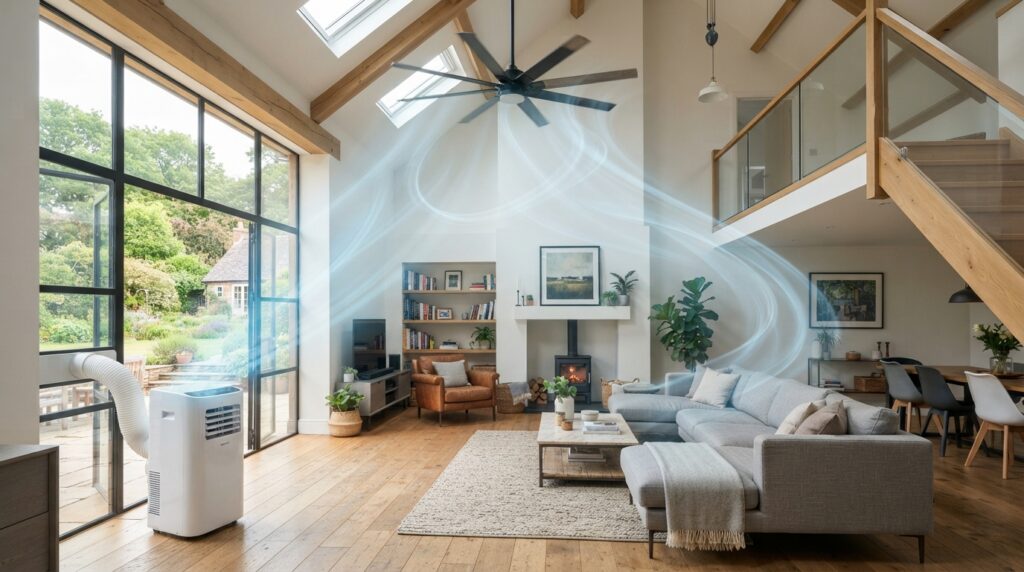
High-ceilinged rooms — Victorian and Georgian rooms, barn conversions, galleried landings, glazed extensions with lanterns — behave differently from ordinary rooms because of one thing: warm air rises and pools in the space above your head. That’s partly good news (the air you actually occupy can be cooler than the room average) and partly the problem (a tall room holds and radiates a lot of heat). The tactics that exploit this: ventilate high to let the hot top layer escape (open a high window or roof light so hot air exhausts and cool air is drawn in low — the “stack effect”, and it’s genuinely powerful in tall rooms); a ceiling fan on a drop rod to bring air movement down to where you are; and, if you’re buying cooling, size it on the room’s volume, not its floor area — the single most common mistake, which leaves tall rooms with an air conditioner that’s far too small.
A high ceiling is lovely to live in and awkward to cool, but the same physics that makes it awkward also gives you levers an ordinary room doesn’t have. Here’s how to use them.
Stratification: the thing that changes everything
Warm air is less dense than cool air, so it rises. In a room with a standard 2.4m ceiling there isn’t far for it to go, so the air stays fairly mixed. In a room with a 3m, 4m or double-height ceiling, the warm air climbs and forms a distinct hot layer up high, leaving cooler air lower down. This is called stratification, and understanding it explains every recommendation below.
There are two consequences, pulling in opposite directions:
- The helpful side: the air at head height — where you sit and sleep — can be noticeably cooler than the room’s average, because the worst heat is stacked above you.
- The unhelpful side: the room contains a large volume of hot air and a lot of warm surface area radiating heat, so it holds heat stubbornly and a small cooling device gets lost in the volume.
Lever 1: ventilate high to exhaust the hot layer
This is the tall room’s superpower, and most people don’t use it. Because hot air collects at the top, an opening high in the room lets that hot layer escape, while cooler air is drawn in through openings lower down — a natural convection current called the stack effect. The taller the room, the stronger it is.
- Open high windows, clerestory windows or roof lights to let the hot top layer out. If your tall room has windows up high that you never open, they’re your best cooling tool.
- Open low windows or doors on the shaded side to draw cool air in at the bottom.
- A galleried landing or stairwell acts as a chimney for the whole house — open a high landing window and hot air rises out of it, pulling cool air in through lower windows across the house.
- Do it at the right time — when it’s cooler outside than in, as our window timing guide explains. The stack effect works day or night, but you only want to bring outside air in when it’s cooler than inside.
Lever 2: a ceiling fan (on a drop rod)
Tall rooms are where ceiling fans earn their keep most, for two reasons:
- In summer, a ceiling fan blowing downwards brings air movement down from the high ceiling to where you are, so you feel a cooling breeze — and it gently mixes the cooler lower air. In a very tall room, mount it on a drop rod so it hangs at an effective height rather than being marooned near the ceiling doing little at floor level.
- In winter, the reverse (updraught) setting genuinely helps here — unlike in a standard room, a tall room has a substantial warm layer at the ceiling to push back down, so destratifying it can make the room more comfortable and let you heat a little less. Our ceiling fan direction guide covers switching between the two.
Fitting a ceiling fan is fixed electrical work — a qualified electrician, a fixing that can carry a moving load, and notifiable under Part P if it involves new wiring. Our fan types guide covers the alternatives if fitting one isn’t practical.
Lever 3: size cooling on volume, not floor area
Lever 4: put the thermostat where you are
A subtle one specific to tall rooms. If your cooling (or heating) is controlled by a sensor high on the wall or built into a unit up high, it’s reading the hot upper layer, not the cooler air you occupy — so it may over-cool, or behave oddly. Where you can, position or set the controlling thermostat at occupied height, and be aware that a portable unit’s own sensor sits at the unit, low down, which is usually fine. It’s a reason a wall thermostat for a fixed system should be sensibly placed, not stuck up near the ceiling.
Lever 5: shade the (often large) windows
High-ceilinged rooms tend to come with tall, large windows — and in period properties, single glazing — so solar gain through the glass is often the biggest heat source, just as in any room. Everything in our window and shading guide applies, with the practical wrinkle that tall windows need tall shading: full-drop thermal curtains, long blinds, or external shading, and often a ladder or professional fit. Don’t forget the high windows — a small clerestory or gable window in full sun can dump a surprising amount of heat.
Then cool what’s left
Once you’ve ventilated high, added air movement and shaded the glass, a correctly sized cooling unit finishes the job. For a tall room:
- A generously sized portable unit can work — but size it up for the volume, and vent it well. Because tall period rooms often have deep window reveals or sash windows, check the seal kit will fit.
- A fixed split system is often the better answer for a large tall room, because it delivers more cooling more efficiently and mounts high on the wall where it can throw air across the volume — our portable vs split guide covers the trade-off, and in a listed or period property the installation questions in our listed buildings guide may apply.
Note the contrast with the opposite problem — a low-ceilinged garden room, covered in our garden room guide — where there’s no tall volume to work with and the roof is the main issue.
Frequently asked questions
Are high ceilings cooler or hotter?
Both, in a sense. The air you occupy lower down can be cooler because the hottest air rises above your head — but the room as a whole holds and radiates a lot of heat and is harder to cool with a small unit. The trick is to exhaust the hot upper layer and bring air movement down to your level.
What’s the stack effect?
Warm air rising and escaping through a high opening, which draws cooler air in through lower openings — a natural convection current. In a tall room it’s a genuinely powerful, free cooling method: open high to let heat out, low to let cool in, when it’s cooler outside than in.
Why isn’t my air conditioner coping in a tall room?
Almost certainly because it was sized on floor area, which assumes a normal ceiling. A tall room has much more air volume, so a floor-area-sized unit is undersized. Size on volume, or scale the floor-area figure up for the extra height.
Do ceiling fans work in high-ceilinged rooms?
Very well — better than in standard rooms. Mount one on a drop rod so it hangs at an effective height, use the downdraught in summer, and the reverse setting in winter genuinely helps here because there’s a real warm layer at the ceiling to push down.
Should I shade the high windows too?
Yes — a small window high up in full sun can add a lot of heat, and tall rooms often have large or single-glazed windows that are the main heat source. Shade the glass, ideally externally, using full-drop curtains or blinds for the tall ones.
Sources
- Energy Saving Trust — Keeping your home cool in summer
- GOV.UK — Approved Document F: Ventilation
- GOV.UK — Approved Document P: Electrical safety
Related reading: our sizing guide and ceiling fan direction guide.
A ceiling fan on a drop rod moves air where you actually are in a tall room. Compare current options at Amazon UK.