How Long Should It Take to Cool a Room?
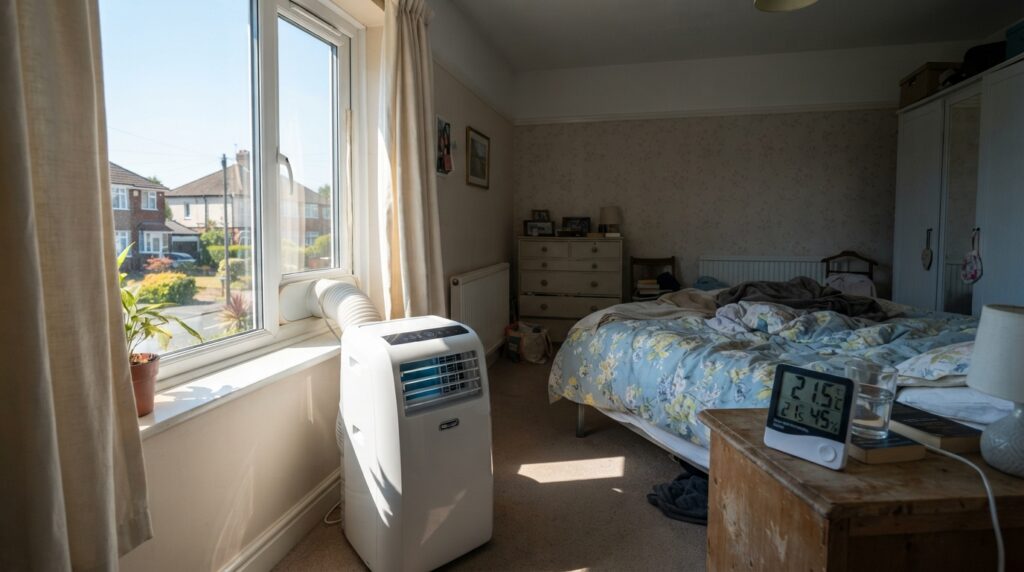
A correctly sized portable unit in a sealed room typically brings the temperature down noticeably within the first twenty to thirty minutes, and reaches a comfortable steady state somewhere between one and three hours depending on how hot the room started and how much heat is still arriving. If yours is running for hours with little to show for it, the cause is almost always one of four things: a poorly sealed window kit, an open door, ongoing solar gain, or a unit undersized for the room. All four are diagnosable in ten minutes.
There’s no single correct figure, because “how long” depends on a room’s heat load rather than on the machine alone. But there is a way to tell whether yours is behaving normally.
The test that tells you if the unit is working
Before assuming anything is wrong, do this — it takes two minutes and separates “the unit is faulty” from “the room is fighting it”.
- Run the unit on cooling for at least ten minutes.
- Hold your hand at the air outlet. The air should feel distinctly cold, not merely moving.
- If you have a thermometer, measure the outlet air and the room air. A working unit produces a clear difference between the two.
Cold air out but the room isn’t cooling means the unit is fine and heat is arriving as fast as it’s being removed. That’s a room problem, and everything below applies.
Air that isn’t cold is a unit problem — our troubleshooting guide works through the causes, starting with a clogged filter and an iced coil.
What actually determines the time
Starting temperature
A room at 30°C has far more heat to remove than one at 25°C, and the further from your target it starts, the longer it takes. This is why pre-cooling beats chasing: starting the unit mid-afternoon, before the room peaks, means it never has to catch up from a deficit. Starting at 10pm in a room that’s baked all day is the hardest possible task.
How much heat is still arriving
This is the one people underestimate. Cooling isn’t a one-off job — it’s a race against heat still entering. Sources include:
- Sunlight through glass, which is usually the largest single source in a UK room
- A hot loft above, radiating down through the ceiling all evening
- Warm air leaking in around the window kit and under the door
- Electronics — a desktop, monitors and a console generate real wattage
- People. Each person in a room is a continuous heat source
Thermal mass
The air in a room cools quickly. The walls, floor, furniture and ceiling take far longer, and they radiate heat back at you while they do. That’s why a room can read a comfortable temperature on a thermometer and still feel warm — and why our companion piece on radiant temperature applies in reverse in summer.
It’s also why the second hour matters. The first thirty minutes cools the air; the next couple of hours cool the room.
Sizing
An undersized unit removes heat more slowly than the room gains it on the hottest afternoons. It never reaches target, runs continuously, and costs more to run than a correctly sized one would. Our BTU sizing guide covers the calculation.
The four fixes, in order
1. Seal the window kit properly
The biggest and cheapest win. Supplied kits fit approximately, and every gap lets hot air straight back in. With a single-hose unit the room sits under slight negative pressure, so it’s actively drawing outside air in through every gap you leave — our hose comparison explains the mechanism.
Foam tape or draught-excluder strip costs very little. Our seal kits guide covers better options for awkward windows.
2. Close the door
An open door means you’re cooling the hallway, the stairs and everything connected to them. Free, and it changes the arithmetic completely.
3. Block the sun before the room heats
Curtains and blinds closed from mid-morning, on sun-facing windows, before the room warms up. Closing them at 6pm when the room is already hot achieves very little.
External shading is considerably more effective than internal, because it stops the energy before it passes through the glass — our shading guide covers the difference, and our blackout blinds piece covers what internal coverings can and can’t do.
4. Shorten and straighten the hose
The exhaust hose gets hot, and every metre inside your room radiates heat back into the space you’re cooling. Kinks restrict flow and make the compressor work harder for the same result.
Realistic expectations by room
Assuming a correctly sized unit, sealed kit and closed door:
- Small, shaded, north-facing bedroom: noticeably cooler within twenty minutes, comfortable within an hour.
- Standard double bedroom after a hot day: an hour or two to comfortable, longer if the loft above is uninsulated.
- Room with large south or west-facing glazing, mid-afternoon: potentially never, while the sun is on it. Shade first, then cool.
- Loft conversion: longest of all, for the reasons in our loft conversion guide.
- Open-plan space with one portable unit: expect to cool the zone around the unit rather than the whole area.
Don’t set it colder to make it faster
A persistent misconception worth killing. Setting 16°C when you want 22°C doesn’t cool the room any faster — the compressor runs at its rate regardless. All you achieve is a longer run time, a colder room than you wanted, and a higher bill.
Set your actual target. Our temperature guide covers sensible settings, and the same principle applies to heating, as our thermostat guide explains.
Pre-cooling: the habit that solves most of this
If there’s one change worth making, it’s timing.
Run the unit in the late afternoon, before the room reaches its peak, rather than starting when you go to bed. The room never gets as hot in the first place, the unit never has to recover from a deficit, and it spends the evening maintaining rather than chasing.
A basic plug-in timer automates this for a few pounds. Check the plug’s load rating against the appliance first — our electrical safety guide covers why that matters with a high-wattage unit. If you have solar panels, pre-cooling also means running on your own generation, as covered in our solar guide.
Frequently asked questions
Is it normal for it to run continuously?
On the hottest afternoons, yes. A unit that never cycles off even overnight in mild conditions is either undersized, fighting a leak, or has a restricted filter.
Should I run it all day or only when I’m in the room?
Neither extreme. Pre-cool for a period before you need the room, then maintain. Cooling an empty house all day is waste; starting from cold at bedtime is the hardest task you can give it.
Why does it cool faster some days than others?
Humidity. Removing moisture takes energy, so on a muggy day more of the unit’s capacity goes into dehumidifying and less into lowering temperature. Our “feels like” guide covers why that also makes the same temperature feel worse.
My unit cools the air but the room still feels hot. Why?
Thermal mass. The walls, floor and furniture are still warm and radiating at you. Give it another hour, and address what’s heating those surfaces in the first place — usually sunlight through glass, or a hot loft above.
Sources
- Energy Saving Trust — Home appliances and energy use
- UKHSA — Adverse Weather and Health Plan (keeping homes cool)
- Met Office — Humidity
Related reading: our ten things that improve performance and BTU sizing guide.
If the diagnosis points to an undersized unit, compare current specifications and prices at Amazon UK — check the stated room size range against your room.