Why Is Upstairs Always Hotter Than Downstairs?
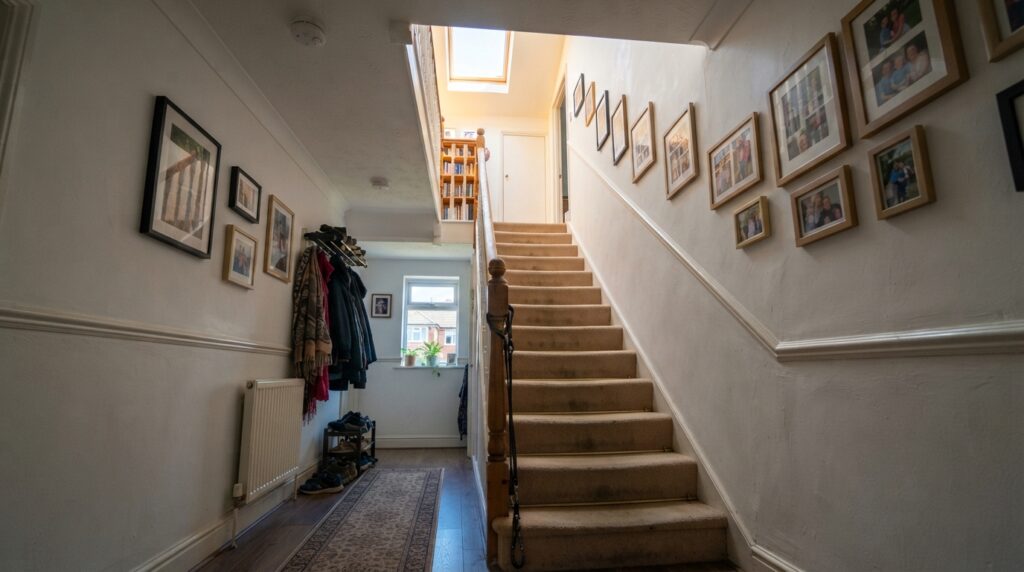
Three things stack up, and the last one surprises people. Warm air rises, so your staircase acts as a chimney feeding heat upstairs all day. The roof takes the most solar load of any surface on your house, and that heat comes down through the ceiling. And upstairs has no thermal mass beneath it — downstairs sits on a cool solid floor that absorbs heat, while your bedroom ceiling sits under a loft that can reach well over 40°C on a hot afternoon and then radiates it back into the room all evening, long after sunset.
Almost every UK house does this, and it’s why bedrooms are the hardest rooms to sleep in during a heatwave — precisely when sleep matters most.
Cause 1: The stack effect
Warm air is less dense than cool air, so it rises. In a house with an open staircase, that creates a continuous convection loop: warm air rises up the stairwell, cooler air is drawn along the ground floor to replace it, and the cycle repeats all day.
The result is that heat generated anywhere downstairs — cooking, appliances, sunlight through a south-facing window — ends up upstairs.
You can’t switch physics off, but you can interrupt the path. A door at the bottom of the stairs is one of the highest-value doors in a UK house, in both seasons. Our closing doors guide covers the winter side; in summer it works the same way in reverse.
Cause 2: The roof
Your roof receives more solar energy across a day than any wall, because it faces upward and is exposed from sunrise to sunset regardless of orientation.
Dark tiles or slate absorb a great deal of that, and a poorly insulated loft passes it down through the ceiling into the bedrooms below.
This is the one most worth fixing, because the fix works in both directions. Loft insulation to current Building Regulations guidance — around 270mm of mineral wool — slows heat transfer downward in summer and upward in winter. Many UK homes have considerably less than that, having been insulated to older standards decades ago.
Our loft insulation guide covers how to check what you’ve actually got with a ruler. It’s the rare improvement that pays back twice a year.
Cause 3: Thermal mass, and why evenings are worst
This is the part that explains the timing.
Downstairs typically sits on a solid ground floor — concrete, screed, or a substantial timber structure over a cool void. That mass absorbs heat through the day and releases it slowly, which moderates the swings. It’s why a ground-floor room stays relatively steady.
Upstairs has none of that. Above you is a lightweight plasterboard ceiling and a loft that heats rapidly. Below is a timber floor already at room temperature. There’s nothing to absorb the heat.
Worse, the loft acts as a heat store on a delay. It’s still radiating downward at 10pm, hours after the sun has gone. That’s why the bedroom is often at its worst exactly when you’re trying to sleep — the phenomenon behind the tropical nights covered in our tropical nights guide.
The other contributors
- Smaller windows upstairs in many houses, giving less capacity to purge heat overnight.
- Security concerns mean ground-floor windows often stay shut overnight while upstairs ones are opened — but the stack effect means upstairs windows draw warm air up from the house rather than pulling cool air in.
- Loft conversions are a special case and worse again, because insulation between rafters is constrained by rafter depth. Our loft conversion guide covers this.
- Heating imbalance in winter. The same house often has the opposite problem in January, where upstairs radiators are starved. That’s usually a balancing or TRV issue — our cold bedroom guide covers it.
- Hot water tanks and airing cupboards upstairs contribute year-round if poorly insulated.
What actually helps — in order
Free
- Close curtains and blinds upstairs from mid-morning, before the rooms heat. Stopping solar gain entering beats removing it later.
- Close the door at the bottom of the stairs to interrupt the stack effect.
- Close bedroom doors during the day, and open them at night once outside is cooler than inside.
- Purge ventilate properly. Once outside temperature drops below inside — often not until quite late in a heatwave — open windows wide across the house to get a through-draught, then shut everything in the morning. A thermometer tells you when that crossover happens; guessing usually gets it wrong. Our thermometers guide covers options.
- Close the loft hatch and check it’s draught-sealed. An open or leaky hatch is a direct route from a 40°C loft into your landing.
- Move heat-generating electronics out of bedrooms where you can.
Cheap
- Blackout or thermal-lined curtains on sun-facing upstairs windows. Dual-purpose — they work in winter too.
- A fan, pointed at people rather than the room. Our fan explainer covers why that distinction matters.
- Draught-seal and insulate the loft hatch itself.
Worth the money
- Loft insulation to 270mm. The single highest-value fix here, and it helps in January too.
- External shading — awnings, shutters or external blinds. Considerably more effective than anything fitted inside the glass, because it stops the energy before it enters. Our shading guide covers it.
- A portable air conditioner in the bedroom. Cool one room properly rather than attempting the house — that’s the realistic use case, and overnight is when it matters most for health.
Why cooling the bedroom is the right priority
If you’re only going to address one room, make it where you sleep.
The body needs cooler night-time temperatures to recover, and sustained warm nights are associated with the health effects that make heatwaves dangerous rather than merely unpleasant. UKHSA’s heat mortality data consistently shows the risk concentrated among older people — which is why our elderly parents guide treats bedroom temperature as the priority too.
MeacoCool MC Series 9000
Bedroom-sized
51–55 dB
~£349
App control
Sized for most UK bedrooms up to around 25m² and quiet enough to sleep next to, which matters more than raw output in an upstairs room. App scheduling lets you pre-cool in the late afternoon rather than starting from a baked room at bedtime.
Frequently asked questions
Should I open the loft hatch to let heat escape?
No — that’s backwards in summer. The loft is hotter than the house, so opening the hatch lets heat in. In winter it’s occasionally suggested during a hard freeze to protect pipes, which is a different situation entirely.
Does a light-coloured roof help?
In principle yes, since it reflects more solar radiation. In practice, re-roofing for that reason alone doesn’t stack up financially in the UK, and planning or conservation rules may restrict materials. Insulation is the better spend.
Why is my house cold upstairs in winter but hot upstairs in summer?
Not a contradiction — they have different causes. Summer heat comes down from the roof; winter cold usually reflects a heating distribution problem, most often a seized TRV or a radiator needing bleeding. Our bleeding guide covers the fix.
Will a loft fan or roof vent help?
Ventilating a loft properly does help it shed heat, and adequate eaves ventilation matters year-round for keeping the loft dry. But insulation between the loft and your ceiling does more for the room below. Do the insulation first.
Compare current prices, stock and reviews on portable air conditioners at Amazon UK. Buying outside a heatwave means normal prices and actual availability.
Sources
- Energy Saving Trust — Roof and loft insulation
- GOV.UK — Approved Document L (insulation standards)
- UKHSA — Adverse Weather and Health Plan
- Met Office — Tropical nights and their impact
- NHS — Heatwave: how to cope in hot weather
Related reading: our why UK homes trap heat and loft insulation guide.