Best Air Conditioner for a Baby’s Nursery UK (Safe Setup Guide)
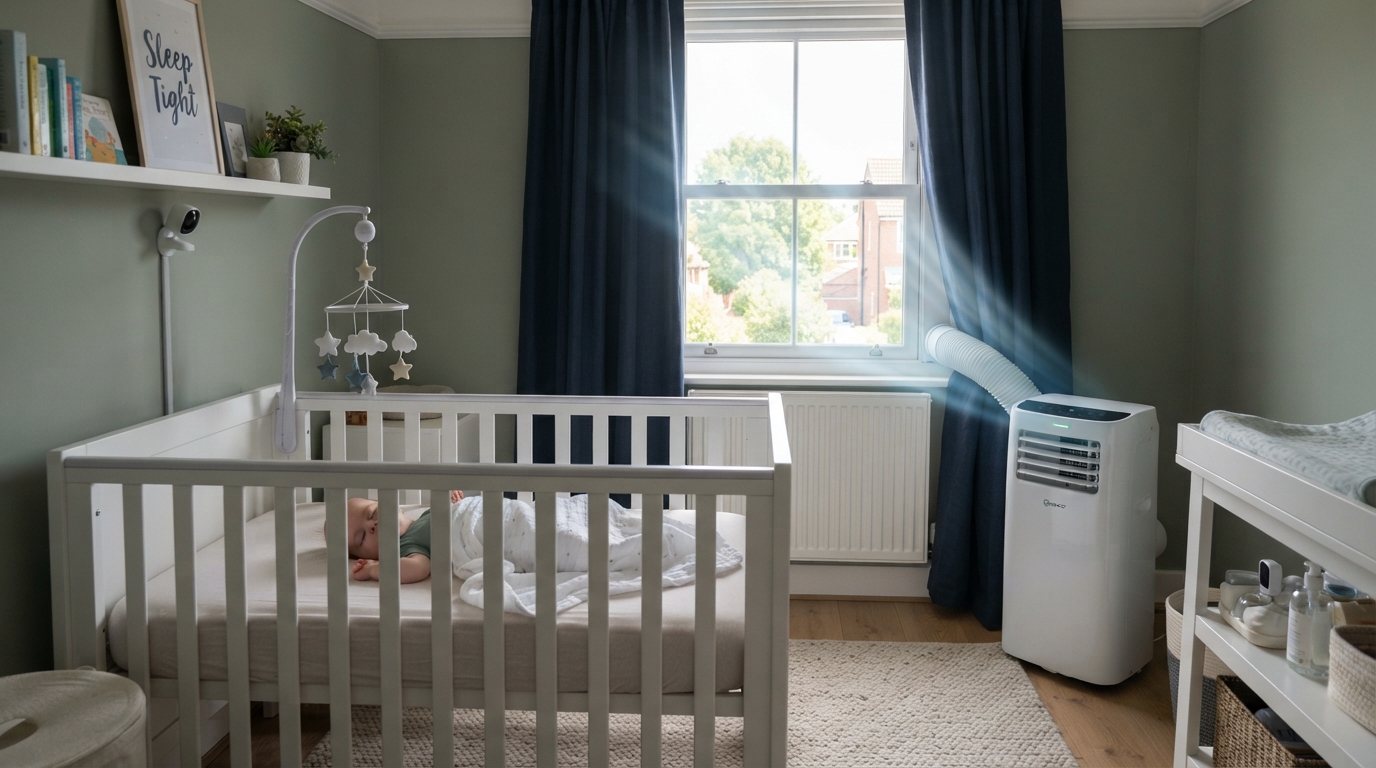
Buy a room thermometer first, because you can’t aim for 16–20°C without one. If the nursery regularly runs above 20°C on summer nights despite curtains and ventilation, a quiet portable air conditioner is a sensible fix — as long as it’s set up safely. Put it well away from the cot, with the airflow never aimed at your baby (the Lullaby Trust gives the same advice for fans). Keep cables and the hose out of reach, set the unit to hold the room within range rather than as cold as possible, and check your baby by feeling their tummy, as the NHS suggests. For a typical nursery, a unit around 7,000–9,000 BTU with a genuinely usable sleep mode is the right size.
Nurseries are often the smallest bedroom in the house, and in many British homes that means a box room at the front or back that bakes in the afternoon sun. A hot nursery is more than uncomfortable: overheating is a recognised SIDS risk factor. This guide focuses on setting up cooling safely. If you’re still weighing up whether to buy at all, our nursery air conditioner buying guide covers the wider question.
The temperature the guidance actually specifies
The Lullaby Trust recommends a room temperature of 16–20°C for babies, saying that keeping it within this range, where possible, helps lower the risk of SIDS. The NHS describes 16 to 20°C as comfortable and safe for sleeping babies. In hot weather the NHS adds that a single layer of lightweight cotton is enough, and that if your baby is sweating or their tummy feels hot, you should take off some clothing or bedding.
Notice what that range doesn’t say. It doesn’t say “as cool as possible”. A nursery at 14°C isn’t safer than one at 18°C. The aim is to bring an overheating room back into range and keep it there.
Buy a room thermometer first
Before anything else, put a thermometer in the nursery at roughly cot height, away from the window and the unit itself. It’s the only way to know whether the room is in range, and it often reveals that the problem is concentrated in a few hours in the late afternoon and evening. Our room thermometer guide covers what to look for; many also show humidity, which matters below.
Safe positioning: the rules that matter
- Never point the airflow at the cot. The Lullaby Trust says a fan in a baby’s room shouldn’t be aimed directly at the baby, and the same logic applies to cold air from an air conditioner. Angle the louvres towards the ceiling or the far side of the room.
- Keep the unit well away from the cot, on the other side of the room if you can, so there’s no cold draught and nothing within a curious toddler’s reach later.
- Cables and hoses out of reach. Run the power lead along the wall, plug it directly into a wall socket rather than an extension lead, and make sure the exhaust hose can’t be pulled.
- Secure the window. The exhaust hose has to go out of a window, which means a window left partly open. Use a proper window seal kit and a restrictor, as our window restrictor guide explains.
- Nothing on or over the unit: no blankets, clothes or toys drying on it, and nothing blocking the vents.
Don’t forget humidity
Air conditioners dry the air as they cool. That’s usually helpful in a muggy British summer, but you don’t want to overdo it. The Health and Safety Executive says relative humidity between 40% and 70% doesn’t have a major impact on thermal comfort, and Allergy UK suggests keeping indoor humidity under 50% but above 30% to discourage house dust mites. A thermometer that also shows humidity lets you check you’re in a sensible band rather than guessing.
Noise: the specification that decides it
Every compressor-based portable unit makes some noise. For a nursery, the figure that matters is the noise on the lowest or sleep setting, and whether the manufacturer actually states which setting its figure applies to. Some babies sleep better with steady background noise; others wake at every change in compressor sound. Our quiet bedroom air conditioner guide covers noise in more depth.
The picks
MeacoCool MC Series Pro 9000
Quieter on paper, with app control
52–54 dB
16–26 m²
A-rated, R290
Based on Meaco’s specifications, this is a 9,000 BTU single-duct unit rated for rooms of 16–26 m², with a stated noise level of 52–54 dB, a sleep mode, a 1–24 hour timer and app control. The app is genuinely useful in a nursery: you can check or adjust it without walking into the room and waking your baby. It uses R290 refrigerant and has an A energy rating. Meaco sells it in a cooling-only version and a CH version that also heats. Its rated power is 1,005W, so at 26.32p per kWh it costs at most about 26.5p an hour, and less once the room reaches temperature and the compressor cycles.
Good for: checking and adjusting remotely via the app; a slightly larger nursery; parents who want heat as well with the CH version.
Less good for: small box rooms, where 9,000 BTU is more than needed. Meaco doesn’t say which setting the 52–54 dB figure applies to, and it’s a single-duct design.
Pro Breeze 7000 BTU 3-in-1
Right-sized for a small nursery
54 dB low / 65 dB high
10–20 m²
Class A, R290
Pro Breeze lists this as a 7,000 BTU, Class A unit with cooling, dehumidifying and fan modes, a sleep mode, a timer and a remote control. Its manual gives a rated cooling input of 750W, noise of 54 dB on low and 65 dB on high, R290 refrigerant, and an applicable area of 10–20 m² — a good match for the small bedrooms nurseries usually are. At 26.32p per kWh, 750W works out at about 19.7p an hour at most.
Good for: small and box-room nurseries; a lower rated power draw; simple remote-control operation.
Less good for: running on high overnight — 65 dB is loud for a sleeping baby, so plan to cool the room before bedtime and use low or sleep mode overnight. No app and no heat mode.
A routine that works
- Close the curtains on the sunny side during the day. Blackout thermal curtains help most — see our thermal curtain guide.
- Cool the room before bedtime, using a higher setting while your baby isn’t in there.
- Switch to sleep or low mode once the room is in range, and set it to hold around the middle of the 16–20°C band.
- Check the thermometer before you go to bed and if you get up in the night.
- Check your baby: the NHS suggests feeling their tummy, and removing a layer if they’re sweating or feel hot.
Cleaning and hygiene
A unit running in a nursery should be kept clean. Clean or replace the filters as often as the manual says, empty any water tank regularly, and don’t let the unit sit damp between uses. If it ever smells musty, stop and clean it before using it again — our guide to why an air conditioner smells explains the causes, and our maintenance guide covers routine care.
Frequently asked questions
Is it safe to use an air conditioner in a baby’s room?
It can be, if it’s used to keep the room within the recommended 16–20°C rather than making it cold, the airflow isn’t aimed at the cot, and cables and hoses are out of reach. The Lullaby Trust gives the same “don’t aim it at the baby” advice for fans.
What temperature should a nursery be?
The Lullaby Trust and the NHS both recommend 16–20°C. Use a room thermometer to check, rather than going by how the room feels to you.
How do I know if my baby is too hot?
The NHS says that if your baby is sweating or their tummy feels hot to the touch, take off some of their clothing or bedding. In hot weather a single layer of lightweight cotton is enough.
What size air conditioner does a nursery need?
Most nurseries are small bedrooms, where a 7,000 BTU unit rated for around 10–20 m² is usually enough. A larger or very sunny room may suit a 9,000 BTU unit. Our BTU calculator explains how to size one properly.
Sources
- The Lullaby Trust — Room temperature
- NHS — How to dress a newborn baby
- Health and Safety Executive — Thermal comfort factors
- Allergy UK — House dust mite allergy factsheet
- Meaco — MeacoCool MC Series Pro 9000
- Pro Breeze — 7000 BTU 3-in-1 portable air conditioner
Related reading: our nursery air conditioner buying guide, keeping a baby cool in a pram or buggy and quiet bedroom air conditioner guide.
Compare the MeacoCool MC Series Pro 9000 at Amazon UK.