Portable Air Conditioner Leaking Water: Causes and Fixes (UK)
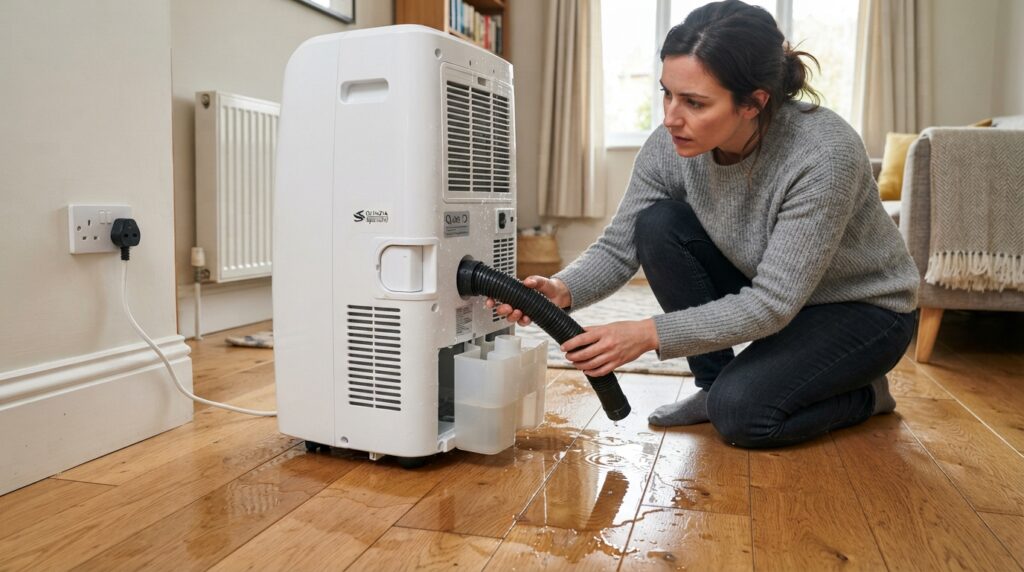
Most “leaks” are one of a handful of things: the internal tank is full and the water is overflowing rather than draining as designed (some units then shut off automatically — that’s the safety feature working, not a fault); the unit is not level, so condensate runs to one side of the internal tray and spills over; the drain hose is kinked or blocked on a continuous-drain setup; or it’s simply producing more condensate than usual because the room is unusually humid. A genuinely broken seal or cracked tank is possible but much less common than these everyday causes. Work through the list below before assuming anything’s actually broken.
A puddle under the unit is alarming the first time it happens, but it’s rarely a sign of a serious fault. Here’s how to work out what’s actually going on.
Cause 1: the internal tank is full
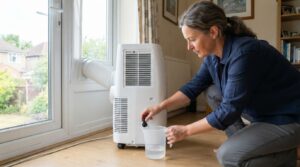
Most portable units without a continuous-drain hose connected collect condensate in an internal tank or reservoir. If it fills up, water has nowhere to go but out — and many models have a float switch that shuts the unit off automatically once the tank is full, precisely to stop this happening. If your unit has stopped cooling and there’s water underneath, check the drain point (usually a bung on the back or base) and empty it before doing anything else. This is by far the most common “leak,” and it isn’t actually a leak at all — it’s the tank doing exactly what it’s designed to do once full.
Cause 2: the unit isn’t level
The internal collection tray relies on being roughly level to catch and hold condensate evenly. If the unit is tilted — an uneven floor, one foot on a rug and others on hard flooring, or castors that sit unevenly — water can run to one side of the tray and spill over the edge rather than collecting properly. Check the unit is standing level and stable, and if your flooring is uneven, a thin shim under the low side often solves it.
Cause 3: the drain hose is kinked or blocked
If you’re running the unit in continuous-drain mode via a hose to a nearby drain or bucket, a kink, a dip that traps water, or a bit of debris in the hose can stop it draining properly — the water backs up and finds another way out. Check the hose runs in a reasonably straight, downward path with no low points where water can pool, and that nothing’s obstructing it.
Cause 4: high humidity is producing more condensate than normal
The more humid the room, the more moisture the unit pulls out of the air as it cools — that’s condensate, and in genuinely muggy UK weather it can be considerably more than the tank or drain is used to handling. If the “leak” only happens during a particularly humid spell and the unit is otherwise level and undamaged, this is likely just a higher volume of normal condensate. Emptying the tank more often, or switching to continuous drain if your model supports it, usually solves it.
Cause 5: ice has built up and then melted
Cause 6: condensation on the exhaust hose itself
In a humid room, the warm exhaust hose can cause moisture in the room air to condense on its outer surface — the same way a cold drink glass “sweats.” Drips from the hose itself, rather than the unit’s base, often point to this. Lightly insulating the hose (a purpose-made sleeve, or simply keeping it short and direct) usually stops it.
When it’s a genuine fault
If you’ve checked all of the above and the unit is level, the tank isn’t overflowing, the hose is clear, and there’s no ice — a cracked internal tray, a perished seal, or a clogged internal drain channel are possible but less common causes, and usually mean a repair. At that point:
- Check the warranty before attempting any repair yourself — opening the casing can void it.
- Contact the manufacturer or retailer if the unit is still under warranty; they may arrange a repair or replacement.
- Weigh repair against replacement for an older unit out of warranty — a call-out or parts cost can approach the price of a new unit, especially for a budget model.
Frequently asked questions
Is it normal for a portable air conditioner to produce water?
Yes — condensate is a normal by-product of cooling the air, similar to how a cold drink glass sweats. The issue is only when that water escapes the tank or tray instead of draining or collecting as designed.
Why has my unit stopped working with water underneath it?
Most likely the internal tank filled up and the float-switch safety feature shut the unit off. Empty the tank via the drain point and it should start again — this is the unit working correctly, not a fault.
Can I fix a leaking air conditioner myself?
The common causes — a full tank, an unlevel unit, a kinked drain hose, or high-humidity condensate — are all things you can check and fix yourself. A cracked internal part is a job for a repair or a warranty claim, not a DIY fix.
Does more humidity mean more water from the unit?
Yes — the more moisture in the air, the more condensate the unit collects as it cools it. In a very humid spell this can be noticeably more than usual, which is normal rather than a fault.
Sources
- Electrical Safety First — Electrical safety around water
- Energy Saving Trust — Keeping your home cool in summer
Related reading: our freezing-up troubleshooting guide and full maintenance guide.
A cracked drain bung or a kinked hose is a cheap fix. Compare current options at Amazon UK.