How Many Air Conditioners Does an Open-Plan House Need? (UK)
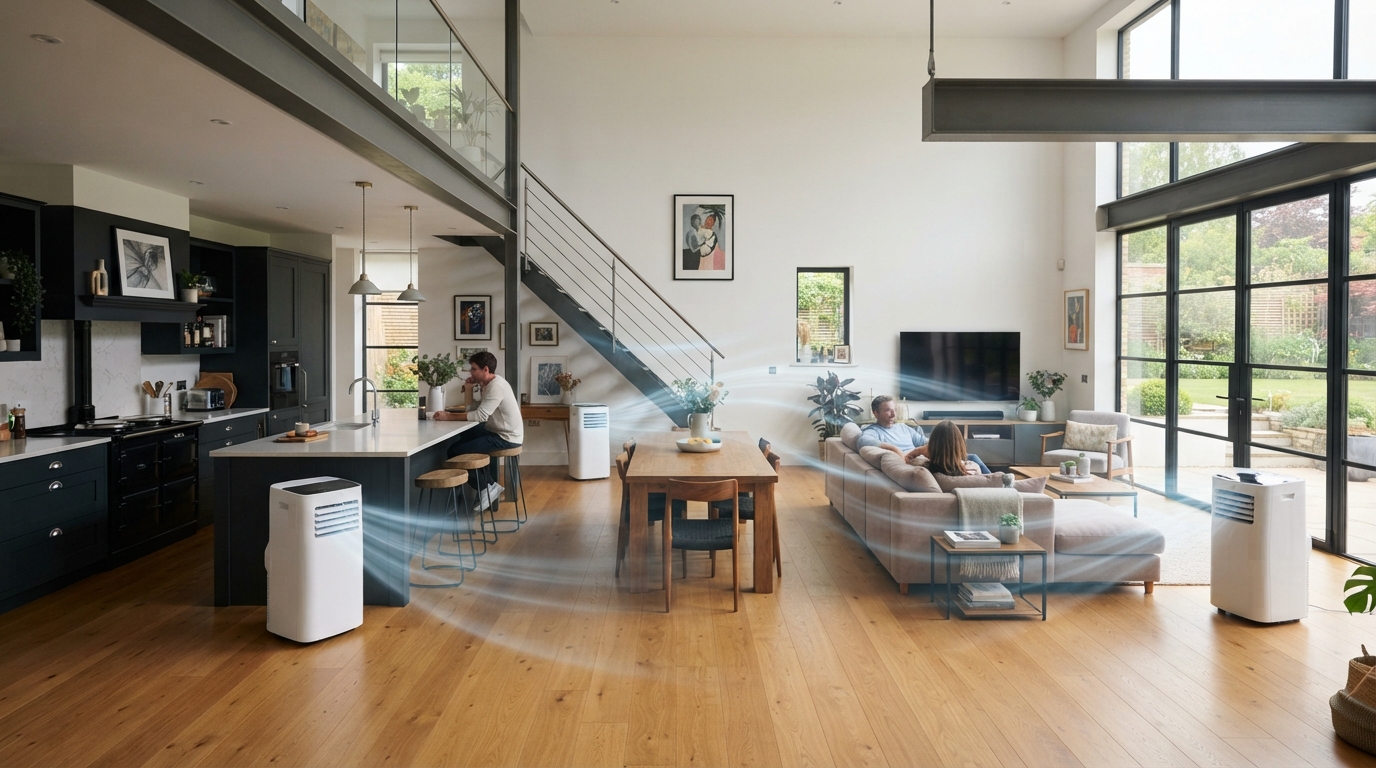
Often more than the one unit people start with. An open-plan kitchen-diner-living space is usually a much bigger cooling job than a single bedroom, for three reasons: it’s a larger volume of air (and if there’s a vaulted or double-height section, volume — not just floor area — is what a unit actually has to cool), it typically has more heat sources in one space (a kitchen’s appliances, more people, and often large glazing or bifold doors), and a single unit can struggle to push cooled air evenly across an L-shaped or long room. The realistic options are one appropriately sized unit positioned to cover the room’s real volume, or — more often the better answer for a genuinely large open-plan space — two smaller units or a multi-zone system covering different ends of the room, with a ceiling fan helping move air between them.
Open-plan living is one of the most popular layouts in UK extensions and new-builds — and one of the trickiest to cool properly with a single unit bought for a normal-sized room. Here’s why, and what actually works.
Why open-plan spaces are a bigger job than they look
It’s volume, not floor area
Cooling capacity has to deal with the volume of air in a room, not just its floor size. An open-plan extension with a vaulted roof, roof lantern, or double-height section over part of the space has considerably more air volume than a same-footprint room with a standard flat ceiling — our high-ceilings guide covers this in more depth. Any coverage figure printed on a unit’s box or listing is based on a standard ceiling height, so a soaring open-plan roof needs more capacity than the floor area alone would suggest.
More heat sources in one space
An open-plan kitchen-diner-living room typically has several heat sources working at once that a single bedroom doesn’t: an oven, hob and other kitchen appliances (even a fridge-freezer’s compressor gives off heat), more people gathered in one place, and — very often — a wall of glazing or bifold doors that let in significant solar gain on a sunny afternoon. Our kitchen extension and bifold doors guide looks specifically at that combination.
Getting cooled air to the far end of the room
A portable or single split unit blows cooled air a limited distance in a fairly direct line. In a long, L-shaped, or open-through space, the end furthest from the unit can stay noticeably warmer than the end next to it — the air simply doesn’t reach that far in useful volume. This is often the actual complaint behind “my air conditioner doesn’t work,” when the real issue is that one unit is being asked to cool a room it was never sized or positioned for.
Your options
One larger-capacity unit, positioned centrally
Simplest, if the space allows it
Lower upfront cost
Needs a sensible central position
For a moderately sized open-plan space without an extreme layout, a single unit sized generously for the room’s real volume (not the floor-plan average) and positioned centrally — rather than tucked in a corner — can cover it reasonably well, especially with a fan helping circulate the air. Check the coverage figure the manufacturer publishes for the specific model against your room’s genuine volume, including any vaulted section.
Good for: moderate open-plan rooms; one unit to buy, run and maintain; lower cost than multiple units.
Less good for: long, L-shaped or double-height spaces, where even a generously sized single unit struggles to reach the far corners evenly.
Two smaller units, or a multi-zone split system
Better for genuinely large or L-shaped spaces
Run only the zone you’re using
Higher upfront cost
For a large, long, or L-shaped open-plan area, two smaller units positioned at each end (or a multi-zone split system with an indoor unit per area) genuinely cools the whole space rather than leaving one end lagging behind the other. It also means you can run just the kitchen end while cooking and leave the sofa end off, rather than cooling the whole volume for one person.
Good for: large, L-shaped or double-height open-plan rooms; only cooling the zone in use; even coverage end to end.
Less good for: upfront cost (two units instead of one); and a fixed multi-zone split is a proper installation, not a plug-in job.
Helping a single unit do more
Whichever route you choose, a few things make real air-con capacity go further in a big, open space:
- A ceiling fan or two, set to the summer direction (blades pushing air straight down), helps carry cooled air across the room rather than letting it pool near the unit. Our ceiling fan direction guide covers this.
- Shade the glazing during the hottest part of the day — bifold doors and roof lanterns let in serious solar gain, and blocking it before it enters the room is far more effective than trying to cool it out afterwards. Our window and curtain guide covers options.
- Position the unit to blow along the room’s long axis rather than across it, so the cooled air has the best chance of reaching the far end.
- Close doors to rooms you’re not using if the open-plan area connects to a hallway or other rooms, so you’re not cooling space nobody’s in.
Frequently asked questions
Can one portable air conditioner cool an open-plan kitchen-diner-living room?
Sometimes, for a moderate-sized space with a standard ceiling and a generously sized unit positioned centrally. For a large, L-shaped, or double-height open-plan room, one unit often struggles to reach the far end evenly.
Do I need to size for floor area or the whole volume?
Volume. A vaulted ceiling, roof lantern or double-height section adds air volume that floor area alone doesn’t capture — check the manufacturer’s coverage figure against your room’s real volume, not just its square metres.
Is it cheaper to run two smaller units than one big one?
It depends on use — running only the zone you’re actually in (say, just the kitchen end while cooking) can use less energy than cooling the whole open-plan volume with one large unit continuously. Two units also cost more to buy upfront.
Sources
- Energy Saving Trust — Keeping your home cool in summer
- CIBSE — Building services and thermal comfort guidance
Related reading: our high-ceilings cooling guide and kitchen extension and bifold doors guide.
Compare current higher-capacity and multi-unit options at Amazon UK.