Blackout Blinds vs Thermal Curtains: Which Is Better for Heat? (UK)
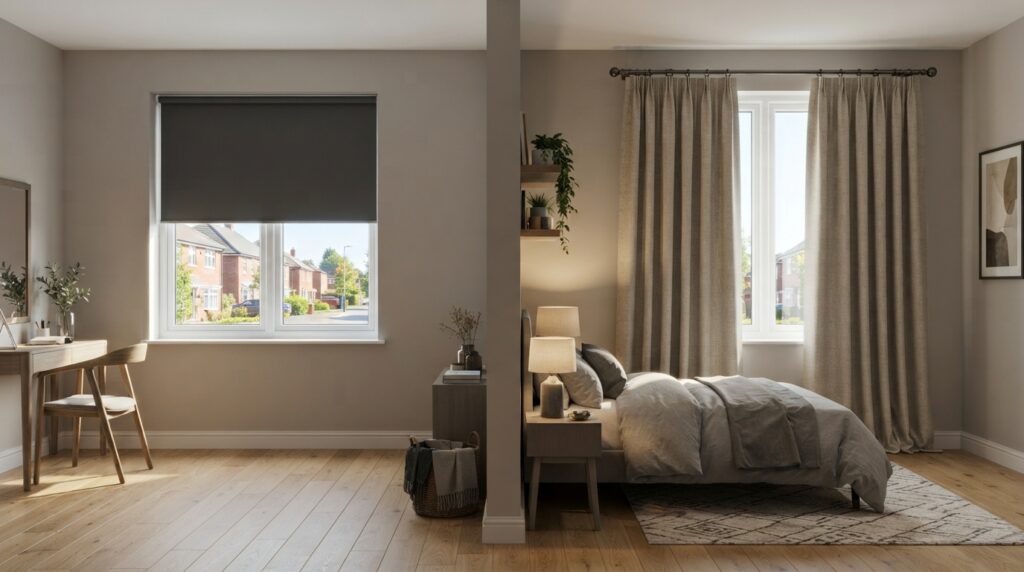
For blocking heat specifically, a well-fitted blackout blind usually has the edge, because it sits close to the glass and stops heat being drawn deeper into the room right at the source — whereas a curtain hangs further into the room, and any gap at the top, sides or floor lets warm air circulate around it by convection rather than being blocked. That said, the two aren’t really competitors: a heavy, well-lined thermal curtain adds genuine insulating value on top of blocking, which a thin roller blind doesn’t, and it earns its keep again in winter by holding heat in. For a genuinely hot room, the best answer is often both together — a close-fitted blind at the glass plus a curtain in front of it — and either way, nothing internal beats external shading for keeping heat out before it ever reaches the glass.
This question comes up a lot once people have read our general window and curtain guide and want to know which specific product to actually buy. Here’s the physics, honestly.
Why fit matters more than fabric
The single biggest factor in how well any window covering blocks heat isn’t the material — it’s how tightly it seals against the window. Heat doesn’t just radiate straight through fabric; a huge amount of it moves by convection, where warm air rises off the hot glass, curls around the top or sides of a loosely fitted covering, and circulates into the room. A gap of even a few centimetres at the top of a curtain, or light visible around the edges of a blind, is an open route for that warm air.
This is why a blackout blind fitted inside the window recess, sitting close against the glass with little to no gap at the sides, tends to outperform a curtain on pure heat-blocking — it intercepts the heat right at the glass, before it has room to convect into the space. A curtain, by contrast, typically hangs a few centimetres in front of the frame and often doesn’t reach fully to the floor or seal at the sides, leaving exactly the kind of gap that lets heat sneak around it.
Colour and backing matter for blinds and curtains alike
Blackout blinds: the case for them
A close-fitted blackout roller or Roman blind
Best pure heat-blocking
Minimal side/top gaps when recess-fitted
Full blackout for sleep
A blackout blind fitted inside the recess, cut close to the width of the window, gives the tightest seal of any common option — and the tightest seal is what actually stops convected heat entering the room. Roller blinds are the simplest and cheapest to fit well; Roman blinds add a softer look with a similar close fit when properly measured.
Good for: the closest fit to the glass and best heat-blocking of any internal option; full blackout for sleep; a cleaner, simpler look than curtains.
Less good for: insulating value — a thin blind adds little to winter heat retention compared with a lined curtain; and a poorly measured blind (too narrow, or surface-fitted with big side gaps) loses most of its heat-blocking advantage.
Thermal curtains: the case for them
A heavy, thermally lined curtain hung floor-to-ceiling width
Best all-round, year-round
Works in winter too
Wider fabric overlap possible
A properly lined thermal curtain does something a blind generally can’t: it adds a genuine layer of insulation, trapping a pocket of still air between the fabric and the glass. Hung on a pole that extends well beyond the window frame (rather than a track that stops at the frame edges), a wide curtain can overlap the wall on either side and pool on the floor, minimising the very gaps that let heat convect around it. Unlike a summer-only blackout blind, a good thermal curtain earns its keep in winter too, by holding indoor heat in.
Good for: year-round value (summer heat-blocking and winter heat retention); a wide pole overlap that reduces edge gaps; softening a room acoustically and visually as well.
Less good for: pure heat-blocking compared with a tight-fitting blind, unless hung and fitted very carefully; and bulkier curtains take up more space and cost more for good quality, lined fabric.
The combination: both together
For a genuinely hot room — south- or west-facing, or one that struggles through every heatwave — layering both is the strongest internal option: a close-fitted blackout blind right at the glass to intercept heat at the source, with a thermal curtain in front of it to insulate and catch anything that gets past. It’s more cost and effort than choosing one, but it’s the internal combination that comes closest to matching what external shading achieves on its own. Our window and curtain guide covers fitting both well.
Remember: internal is always second-best
Other things worth checking before you buy
- Measure for a recess fit if choosing a blind — an inside-recess fit gives the closest seal; a surface-fit (outside the recess, wider than the window) can actually help block more light and heat by overlapping the wall, so both are valid, but measure deliberately rather than guessing.
- Check the lining, not just the outer fabric, on curtains — “blackout” and “thermal” linings are sometimes sold separately from decorative outer fabric, and the lining is doing the actual work.
- Reflective film is a third option for the glass itself, and can be combined with either — see our reflective window film guide.
- Consider the room’s use — a bedroom benefits most from full blackout for sleep as well as heat, while a living room might prioritise the softer thermal-curtain look.
Frequently asked questions
Are blackout blinds better than thermal curtains for keeping a room cool?
For pure heat-blocking, yes, generally — a close-fitted blind at the glass stops more convected heat than a curtain hung further into the room. But a good thermal curtain adds genuine insulation and works in winter too, so it isn’t a straightforward “better,” just different strengths.
Can I use a blackout blind and a thermal curtain together?
Yes, and for a genuinely hot room it’s the strongest internal combination — the blind intercepts heat close to the glass, and the curtain insulates and catches what gets past. It costs more than choosing one, but it’s more effective than either alone.
Does the colour of the blind or curtain matter for heat?
Yes — a dark fabric absorbs more solar heat and can re-radiate some of it into the room, even while blocking light effectively. A light-coloured or reflective-backed covering reflects more heat back out through the glass.
Is external shading really better than either option?
Generally yes — external shading blocks heat before it reaches the glass, while any internal covering is dealing with heat that’s already entered the room. If external shading is possible for your home, it’s worth prioritising over the internal choice.
Sources
- Energy Saving Trust — Keeping your home cool in summer
- Energy Saving Trust — Curtains, blinds and draught-proofing
Related reading: our window and curtain guide and blackout thermal curtains buying guide.
Compare current blackout blinds and thermal curtains at Amazon UK.