Can You Leave a Portable Air Conditioner Running Overnight?
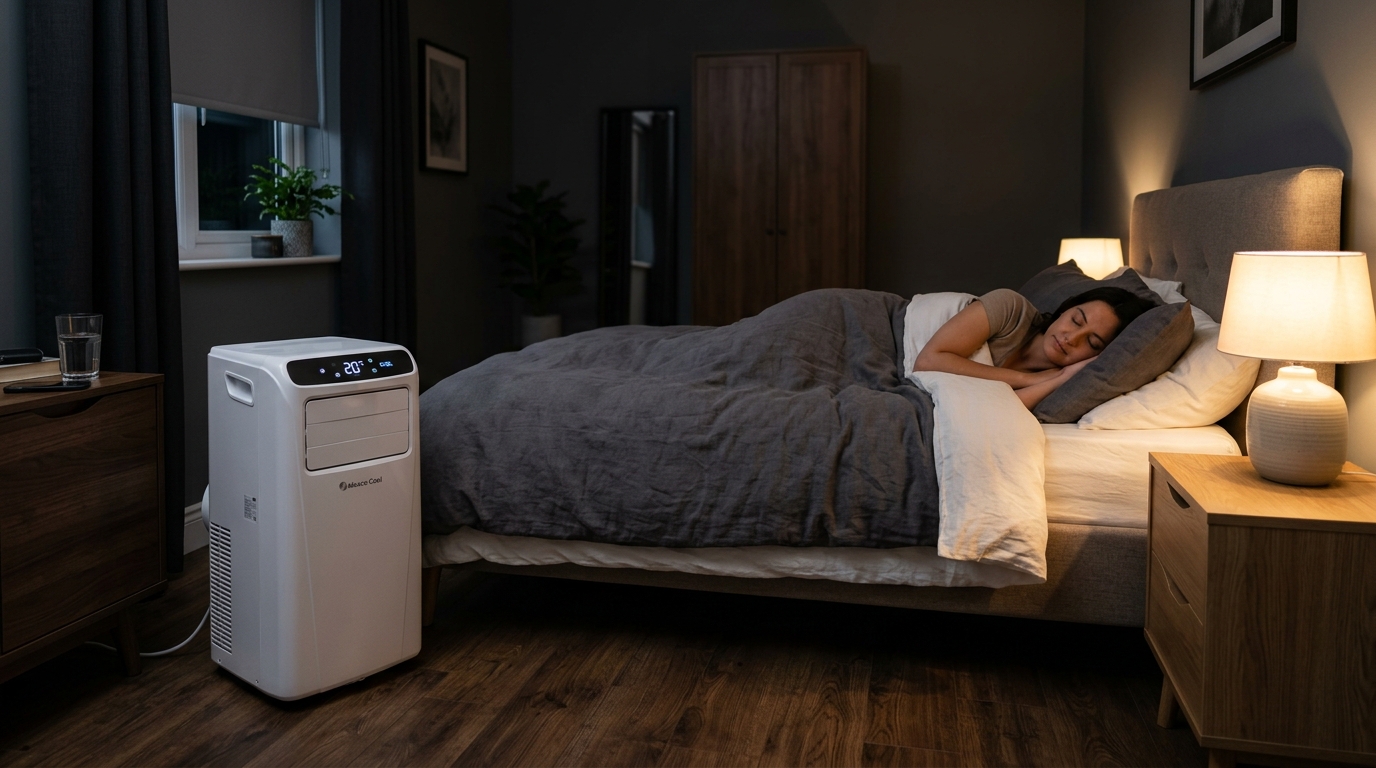
Yes — modern portable air conditioners are designed to run unattended, including overnight, and doing so is normal. But five things make it safe and sensible: plug it straight into a wall socket (never an extension lead or a smart plug that isn’t rated for the current it draws — this is the real fire risk), set up continuous drainage so it doesn’t shut off when the tank fills, give it the clearance the manual asks for and never cover it, use the timer or sleep mode so you’re not over-cooling an empty-headed room till morning, and keep the exhaust hose venting outside. Do those, and running it overnight is fine. The cheaper, quieter alternative is still to pre-cool the room and switch it off.
The short answer is yes. The useful part is how to do it without wasting money or creating a hazard — so this page leads with the safety points, because they’re the ones that actually matter.
The one that’s actually a fire risk: how it’s plugged in
This is the single most important thing on the page, which is why it’s first. Everything else is about comfort and cost; this one is about not leaving a hazard running while you sleep.
Continuous drainage: so it doesn’t stop at 3am
Every air conditioner condenses water out of the air as it cools. Left to collect in the internal tank, that water eventually fills it — and the unit shuts itself off to avoid overflowing, typically in the small hours when nobody’s awake to empty it. You wake up hot.
Most units have a continuous drain port: connect a hose from it to a drain, a floor gully, or a low container, and the water runs away on its own so the unit never stops. For overnight running this is the difference between waking cool and waking to a machine that quit at 2am. Our tank-full guide covers setting it up.
Clearance, covering and R290
- Give it the airflow gap the manual specifies around the intake and exhaust. Crammed against furniture, it can’t breathe and works harder — or overheats.
- Never drape or cover it. Not clothes drying on it, not a throw over it to muffle the noise. Blocking the airflow is both an efficiency and a safety problem.
- Most units use R290 refrigerant — refrigerant-grade propane, which is flammable. In normal sealed operation that’s not a hazard, but it’s a reason to respect the minimum room size, keep the unit undamaged, and not run one you suspect is leaking. Our R290 guide explains it.
- Keep the exhaust hose venting outside all night — a hose that’s slipped out of the window kit is dumping hot air straight back into the room.
Don’t over-cool: comfort, cost and your body
Running flat out at a low set point all night is wasteful and often uncomfortable — a room that’s too cold disrupts sleep as surely as one that’s too warm, and air blowing directly on you all night can dry your throat and airways.
- Set a sensible temperature rather than the lowest the dial goes — you’re aiming for comfortable, not cold.
- Use sleep mode if it has one — these typically let the temperature drift up gently through the night, matching the body’s own pattern and cutting run time.
- Angle the louvres away from the bed so you’re not in a direct draught. Our dryness guide covers why that matters.
- Mind the display light and any beeps — a bright LED or button chime can be its own sleep problem. Our quiet bedrooms guide covers overnight noise and light.
The cheaper, quieter option: pre-cool and switch off
Worth repeating because it genuinely works: a sealed, shaded room holds its temperature for hours. Run the unit for an hour or two before bed, then switch it off — a timer makes this automatic — and sleep in a cool, silent room with nothing running. No compressor cycling to wake you, no overnight electricity, no drainage worry.
This won’t suit the hottest, most humid nights, where you may want it running low all night with continuous drainage set up. But on a lot of British nights, pre-cooling beats leaving it on.
Frequently asked questions
Is it safe to sleep with a portable AC running?
Yes, if it’s plugged straight into a wall socket, not covered, has its airflow clearance, and vents outside. The main avoidable risk is running it through an unsuitable extension lead or smart plug.
Will it shut off overnight on its own?
It can, if the condensate tank fills — the unit stops to avoid overflowing. Set up continuous drainage through the drain port and it won’t.
Is it expensive to run all night?
It uses meaningful electricity, but the compressor cycles off once the room is cool rather than drawing full power continuously. A sensible set point, sleep mode and a well-sealed room keep the cost down — and pre-cooling then switching off costs least of all.
Can I put it on a timer or smart plug?
The unit’s own timer or sleep mode is ideal. A smart plug can work only if it’s rated well above the air conditioner’s power draw — many aren’t, and an underrated plug running for hours is a fire risk. Check the rating.
Sources
- Electrical Safety First — Electrical safety around the home (extension leads and overloading)
- GOV.UK — Fluorinated gases (F-gases): rules
- Energy Saving Trust — Home appliances and energy use
Related reading: our tank-full guide and quiet bedrooms guide.
A drainage hose lets it run all night without stopping. Compare current portable air conditioners at Amazon UK.