How Much Does It Cost to Run an Air Conditioner in the UK?
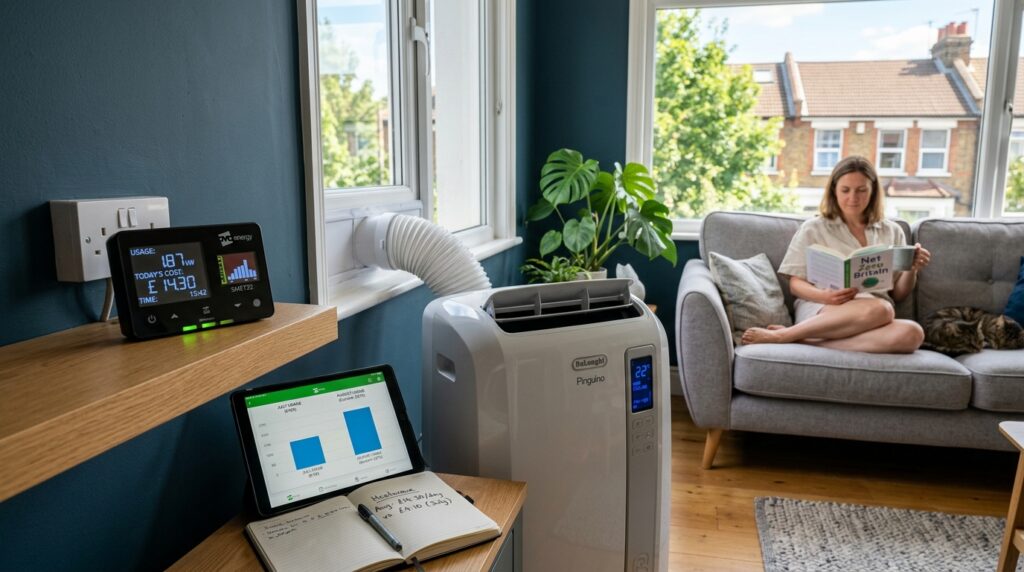
We won’t give you a figure in pence, because the price cap changes quarterly and any number published here would be wrong within months — which is exactly how people end up making decisions on stale data. Instead, here’s the calculation, which doesn’t change: wattage ÷ 1,000 × hours × your unit rate in p/kWh. Your wattage is on the rating plate. Your unit rate is on your bill, and Ofgem publishes current cap rates. Two minutes, and you’ll have a figure for your unit on your tariff — which is worth more than any national average.
This question gets answered badly all over the internet, usually with a confident figure that was true for one tariff in one quarter. Here’s how to get a real one.
The calculation
- Find the wattage. On the rating plate — usually a sticker on the back or underside — or in the manual. Look for the input power in watts. Portable units are commonly somewhere in the region of 800W to 1,400W.
- Divide by 1,000 to get kilowatts. A 1,000W unit is 1 kW.
- Multiply by hours used. Be honest — most people overestimate. UK cooling seasons are short.
- Multiply by your unit rate in pence per kWh, from your bill or your supplier’s app.
That gives you cost at full draw. Real cost is lower, because a thermostat means the compressor cycles rather than running continuously once the room reaches temperature.
What actually determines your bill
The wattage is only the starting point. These decide how many hours it runs:
Energy rating
An A-rated unit produces the same cooling from less electricity than a lower-rated one. Over a heavy summer that difference is real money, which is why the cheapest unit to buy and the cheapest to own aren’t always the same. Our budget guide covers that trade-off.
Sizing
Both directions cost you:
- Undersized — runs continuously without reaching temperature, never gets to switch off
- Oversized — short-cycles, and startup draws more current than running
Our sizing guide covers getting it right.
Sealing
The single biggest free variable. With a single-hose unit the room sits under slight negative pressure, actively pulling warm outside air in through every gap — so a poorly sealed window kit means the unit runs far longer for the same result. Our seal kits guide covers sealing properly, and our hose comparison explains the mechanism.
Shading
A unit fighting continuous solar gain through unshaded glass runs continuously. Closing blinds from mid-morning — before the room heats — reduces the load at zero running cost.
Set temperature
Every degree lower means more running time. Setting it much colder doesn’t cool any faster — the compressor works at its rate regardless — so you overshoot and pay for it. Our temperature guide covers sensible settings.
Filter condition
A clogged filter restricts airflow, so less heat is removed per minute and the compressor runs longer. A five-minute clean, fortnightly. Our maintenance guide covers it.
Measure rather than calculate
If you want the real number, a plug-in energy monitor gives it to you — actual kilowatt-hours consumed, over however long you run it.
This is worth doing once. It settles arguments in shared houses, tells you whether your assumptions were right, and usually comes in lower than people feared.
Reducing it, in order of effectiveness
- Shade the glass from mid-morning. Free, and it reduces the load rather than the price you pay for it.
- Seal the window kit properly. Foam tape, every edge, checked after a week.
- Close the door. You’re cooling one room, not a floor.
- Set a sensible temperature rather than the lowest available.
- Pre-cool and coast. A well-sealed, shaded room holds its temperature for hours. Running before you need it and letting it drift costs less than chasing a hot room all evening.
- Purge ventilate overnight so the unit starts from a cooler room the next day. Our timing guide covers it.
- Clean the filter.
- Use a fan alongside it — circulating cooled air lets you set the unit a degree or two higher for the same comfort, and the fan costs pennies.
- Consider your tariff, but carefully — our tariff guide covers why switching for cooling alone rarely adds up.
Cost in context
Worth framing honestly rather than alarming people.
UK cooling seasons are short — a few weeks of genuine heat in most years, not a season of continuous running. The annual cost of a portable air conditioner used sensibly is usually far lower than people expect, and lower than most assume before they do the sum.
Compare it against what you’d spend on the alternatives, and against what sustained sleep loss costs you. That’s a personal judgement, but it’s the right comparison — not the per-hour figure in isolation.
If you’re on a prepayment meter or worried about affordability, Citizens Advice can run a benefits check and your supplier may have support available. Those conversations are free.
Frequently asked questions
Is it cheaper to leave it running or switch it on and off?
For a short absence, leaving it on a moderate setting usually beats letting a room heat fully and cooling it from scratch. For a whole working day, a timer starting an hour or two before you get home is better than either.
Does dry mode cost less?
Usually a little, since the fan often runs slower — but it’s not a cheap way to cool. It prioritises moisture removal over temperature. Our dry mode guide covers when it earns its place.
Are fans much cheaper?
Dramatically — tens of watts against hundreds or over a thousand. But they don’t cool the room, they make you feel cooler. Our fans vs air conditioner comparison covers when each is the right answer.
Will it show up on my smart meter?
Yes, and watching the in-home display while you switch it on is a quick way to see the real draw. That’s often more convincing than any calculation.
Sources
- Ofgem — Energy price cap (current unit rates and standing charges)
- Ofgem — Energy advice for households
- Energy Saving Trust — Home appliances and energy use
- GOV.UK — Energy labelling of products
- Citizens Advice — Energy supply advice
- Electrical Safety First — Overloading sockets
Related reading: our BTU vs kW explainer and sizing guide.
Compare current specifications at Amazon UK. Check the input wattage and the energy rating — those two figures decide your running cost, not the BTU number.