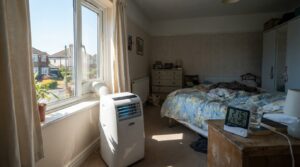
“Water Full” Light on Your Portable Air Conditioner: What It Means
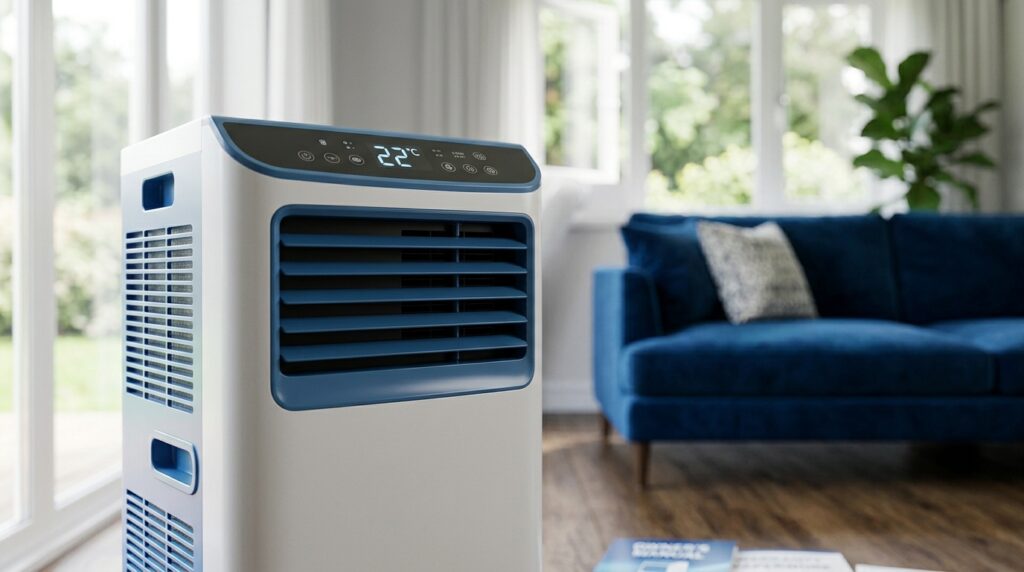
It means the internal condensate tank has filled and the unit has shut itself off deliberately rather than overflow onto your floor. That’s designed behaviour, not a fault. Drain it and it’ll restart. The more useful point: this is the single most common reason a portable air conditioner “stops working” overnight, and it’s permanently solvable — almost every unit has a drain port that lets you run a hose to a drain or sink, so the tank never fills and the unit never stops. Set that up once and you’ll never see this light again.
If your unit has gone quiet overnight or won’t start in the morning, check this before anything else.
Where the water comes from
An air conditioner doesn’t just cool air — it dries it. Room air passing over the cold evaporator coil gives up moisture, which condenses exactly as water beads on a cold drink.
That water collects internally. Depending on the model it’s either held in a tank, drained out continuously, or recycled onto the hot condenser and expelled as vapour through the exhaust.
How fast it fills depends on humidity, not how cold you’ve set it. On a muggy British day a tank can fill considerably faster than people expect. In dry mode it fills fastest of all, because that mode is specifically maximising moisture removal.
The immediate fix
- Switch off and unplug.
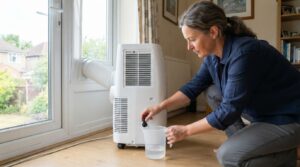
- Find the drain plug — usually low on the back of the unit. Some models have more than one; check the manual.
- Have a shallow tray ready. A roasting tin or a baking tray works — most units sit too low for a bucket.
- Remove the plug and let it drain fully. Tilt gently at the end to get the last of it, but don’t tip the unit over.
- Refit the plug properly. A loose plug is a common cause of a slow leak afterwards.
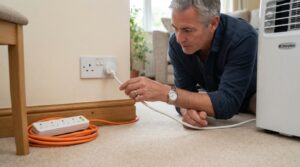
- Plug in and restart. Expect a restart delay before the compressor engages — commonly three to five minutes.
If the light stays on after draining, see the troubleshooting section below.
The permanent fix: continuous drainage
The thing worth doing today, and it takes ten minutes.
Almost every portable unit has a continuous drain port — usually a threaded or push-fit outlet, sometimes with a blanking cap. Connect a hose to it and run that hose to somewhere water can go, and the tank never fills.
Where the water can go:
- Into a floor drain or gully
- Over a sink or bath, discharging over the drain rather than pushed into it
- Out of the window alongside the exhaust hose, into a drain or gully outside
- Into a container you empty occasionally — better than the internal tank, since it’s bigger and you choose when
Our drainage guide covers the setup in more detail, including why “self-evaporating” doesn’t mean “no water ever”.
Why “self-evaporating” still fills up
A common source of frustration, and the listings don’t help.
Self-evaporating models recycle condensate onto the hot condenser coil and expel it as vapour through the exhaust hose. That works well in moderate humidity — most of the water leaves as vapour and you rarely see the tank.
But there’s a limit. On a very humid day the unit removes more moisture than it can evaporate, and the surplus goes to a reserve tank. When that fills, the unit shuts off exactly as any other would.
So “self-evaporating” means “usually doesn’t need emptying”, not “never”. If you’re running one unattended — overnight, or while out — set up continuous drainage anyway.
If the light stays on after draining
- Is there water left? Check for a second drain point. Some units have separate upper and lower reservoirs.
- Is the unit level? On an uneven floor or thick carpet, water pools away from the drain and the float reads full. Our carpet guide covers sorting this.
- Is the float switch stuck? It’s a small float that rises with the water level. Debris or limescale can jam it. If you can see it through the drain aperture, gently check it moves.
- Is the drain blocked? Mould and debris accumulate. If water drains slowly or not at all, that’s the problem.
- Has it been tilted? Moving the unit can slosh water somewhere it shouldn’t be. Stand it level and leave it.
- Is it actually a different error? Check the code against the manual — some units use a similar indicator for other faults.
If none of that works, our won’t turn on guide covers the wider diagnosis.
Reducing how much water it makes
You can’t stop it entirely — moisture removal is part of how it cools — but you can reduce it:
- Seal the room properly. With a single-hose unit, gaps pull humid outside air in, and that moisture ends up in your tank. Our seal kits guide covers sealing.
- Close the door.
- Don’t dry washing in the room. A load of laundry releases a substantial amount of water into the air.
- Use the extractor when cooking or showering elsewhere in the home.
- Don’t run dry mode unnecessarily. It maximises moisture removal by design.
- Set a sensible temperature. Running colder than needed means longer running and more condensate.
Is the water useful?
Occasionally asked. Condensate is distilled-ish water, but it has passed over a coil that may carry dust, mould and biofilm.
Don’t drink it, and don’t use it for anything food-related or for pets. Watering ornamental plants is generally fine. Otherwise, down the drain.
Frequently asked questions
How often should I need to empty it?
Enormously variable — humidity decides it. Some people go days; on a muggy night a tank can fill in hours. If you’re emptying it more than occasionally, set up continuous drainage.
Why does it always happen overnight?
You’re running it for a long unattended stretch, and overnight humidity is often highest. It’s the classic cause of a unit that’s “stopped working” by morning.
Can I leave the drain plug out permanently?
Only with a hose attached and running downhill to somewhere water can go. Leaving it open with nothing attached means water on your floor.
Is a lot of water a sign of a fault?
No — it means the unit is dehumidifying effectively, which is part of the job. Water where it shouldn’t be is the problem: our leaks guide covers that.
Sources
- GOV.UK — Damp and mould: health risks
- GOV.UK — Approved Document F: Ventilation
- Met Office — Humidity
- Energy Saving Trust — Home appliances and energy use
Related reading: our drainage guide and leaks guide.
Compare current specifications at Amazon UK — and check the listing confirms a continuous drain port if you plan to run the unit unattended.