7 Ways to Light Your Home in a Power Cut Without Candles (UK)
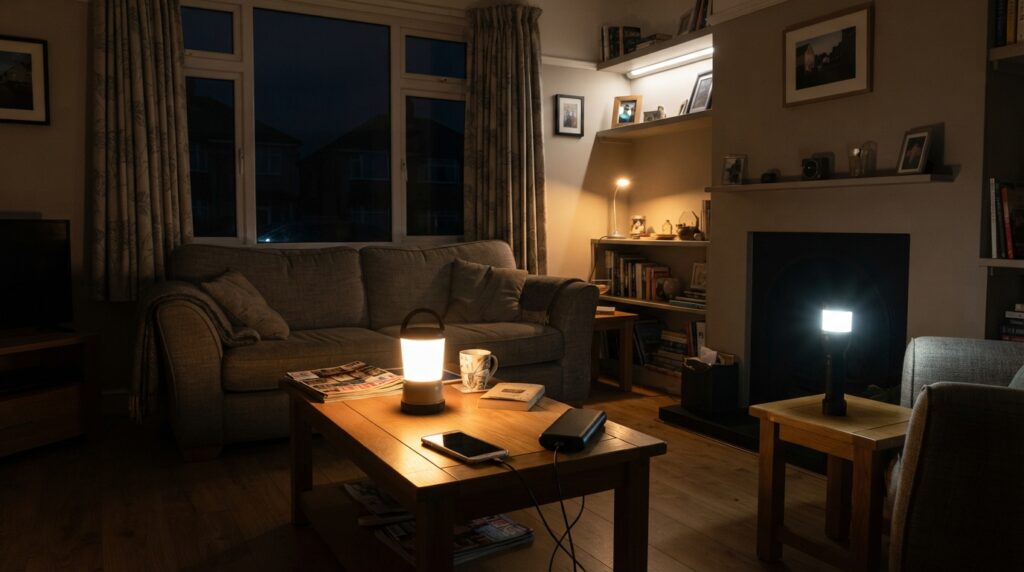
The government’s Be Ready advice is simple: “Torches are safer than candles.” The best set-up for most homes is: a torch for each person, kept where you can find it in the dark; a head torch for cooking and the stairs; an LED lantern to light the room you’re in; plug-in power failure lights, which switch on by themselves when the power goes; battery LED candles for a softer glow; motion-sensor stick-on lights for landings; and glow sticks as a backup. Don’t rely on your phone torch: Be Ready says it “will drain its batteries more quickly”.
When the lights go out on a winter evening, most of us reach for candles. But candles start hundreds of house fires every year. With storms and power cuts in mind, the government’s Be Ready campaign, launched on 22 October 2026, puts a torch and spare batteries on its emergency checklist. Here are seven safer ways to light your home, what each is best for, and the kit worth buying.
Why not candles?
Fire services across the UK say the same thing in a power cut: use battery lights. Scottish Fire and Rescue says: “During a power cut use battery-operated lights or torches as an alternative light source.”
The numbers back this up:
- Firefighters in England dealt with 940 fires started by candles in the year to March 2022, in which 11 people died and 301 were injured, according to insurer Zurich’s analysis of Home Office data.
- In London alone, London Fire Brigade said in 2019 that there were “around 270 candle fires every year”, and 40 deaths from candle fires over the previous 10 years.
Power cuts add extra risks: people carry candles from room to room in the dark, and fall asleep with them burning. London Fire Brigade recommends “battery-powered, flameless LED candles instead, which are safe even if you fall asleep”.
How bright is bright enough?
Lights are measured in lumens. A government lighting factsheet puts an old 40W bulb at 470 lumens and a 60W bulb at 800 lumens. A head torch such as the Petzl TIKKINA gives 100 lumens on its standard setting, which is plenty for moving around. To light a whole room, look for a lantern of several hundred lumens, ideally with a low setting so the batteries last.
1. A torch for everyone
Be Ready says: “Keep a battery or wind-up torch (and spare batteries) at home.” It also suggests keeping useful notes with your torch or radio, “in a place that’s easy to find in the dark”. A torch by each bed and one in the kitchen drawer means nobody has to cross a dark house to find one.
Don’t use your phone as your main torch. Be Ready warns that it will drain the battery faster, and you may need your phone for calls and updates.
2. A head torch for cooking and the stairs
A head torch leaves both hands free, which makes it the safest option for stairs, carrying children or pets, cooking on a gas hob, or fixing a tripped fuse. Head torches are light, and most run for many hours on their low setting.
3. An LED lantern for the room you’re in
A torch gives a narrow beam. A lantern spreads light around a room, so you can eat, read or play a board game. Put it in the room where everyone’s gathered, ideally the warmest one. Some rechargeable lanterns also have a USB port, so they can charge a phone in a pinch.
4. Plug-in power failure lights
These plug into a socket and charge from it. When the power fails, they switch on by themselves, lighting a hallway or landing straight away so you can find your torches. Many also work as a night light, and some lift out to use as a small torch. They’re especially useful for older relatives, or anyone who might fall in the dark.
5. Battery LED candles
If you like the look of candles, flameless LED candles give a similar glow with no fire risk. London Fire Brigade says they’re “safe even if you fall asleep”. They won’t light a room brightly, but they’re good for a living room or a child’s bedroom.
6. Motion-sensor stick-on lights
Battery-powered motion-sensor lights stick or screw to a wall and switch on when someone walks past. Fitted at the top and bottom of the stairs or in a hallway, they work the same whether the power’s on or off. Some, such as Auraglow’s cordless PIR light, run on AA batteries.
7. Glow sticks as a backup
Glow sticks need no batteries and can’t start a fire. Viking lists the 6-inch, 12-hour Cyalume SnapLight with “up to 12 hours of illumination” and a shelf life of up to 5 years. They’re not bright, but they’re good for marking a bathroom or a door, and for children who don’t like the dark.
If you do use candles
If you have no alternative, follow the fire service advice:
- Put candles in a proper holder, away from curtains and anything that can catch fire, as Be Ready advises.
- County Durham and Darlington Fire and Rescue says to leave at least 1 metre between a candle and any surface above it.
- Scottish Fire and Rescue says to “never leave a lit candle alone”, and not to use candles to light your way from room to room.
- Put them out with a snuffer or a spoon. County Durham and Darlington Fire and Rescue says blowing them out “can send sparks and hot wax flying”.
The kit worth buying
Auraglow plug-in night light and emergency torch
Best for: light the moment the power fails
Motion-sensor night light
Detachable torch
Auraglow says this light “senses when the electricity goes off and instantly activates a bright glow”. The rest of the time, it’s a motion-sensor night light, with a 3-metre range. It lifts out of its socket as a torch with a 10-metre beam and “1.5 hours of full-beam usage”. It has a 500mAh battery and gives 65 lumens of warm white light.
Good for: hallways and landings; older relatives; finding your torches in the dark.
Less good for: lighting a room. It’s only 65 lumens, the glow lasts about 2 hours, and it needs some clearance below the socket.
Ledlenser ML6 rechargeable lantern
Best for: lighting a whole room
USB output to charge a phone
Magnetic base
Ledlenser says the ML6 reaches 750 lumens at maximum, or 550 lumens for 3.5 hours, with a 5-lumen low mode that runs for much longer. It has a replaceable 3,200mAh rechargeable battery, a USB output for charging a phone, a red light mode, and a magnet so you can stick it to a metal surface. It weighs 280g.
Good for: lighting a living room or kitchen; camping.
Less good for: long power cuts on its bright setting, which lasts 3.5 hours. You can’t recharge it without power unless you have a power bank. For a lantern that runs on stored batteries, the Coleman BatteryGuard 800L takes 4 D cells and runs for about 30 hours on high.
Petzl TIKKINA head torch
Best for: hands-free light
3 x AAA or rechargeable
92g
Petzl says the TIKKINA gives up to 300 lumens and runs on three AAA batteries, which come included, or an optional CORE rechargeable battery. On AAA batteries, it lasts about 100 hours at 7 lumens and 10 hours at 100 lumens. It weighs 92g, is IPX4 rated and has a 5-year warranty.
Good for: stairs; cooking; checking the fuse box; walking the dog in the dark.
Less good for: night vision, as it has no red light mode, and the rechargeable battery costs extra.
Frequently asked questions
What is the safest light to use in a power cut?
Battery or wind-up torches and LED lights. The government’s Be Ready advice says “torches are safer than candles”, and UK fire services advise battery-operated lights instead of candles.
Are there lights that come on automatically in a power cut?
Yes. Plug-in power failure lights charge from a socket and switch on by themselves when the power fails. Many also work as night lights and lift out as small torches.
Are LED candles safe to leave on?
London Fire Brigade recommends battery-powered flameless LED candles instead of real ones, saying they’re “safe even if you fall asleep”.
How many lumens do I need in a power cut?
Around 100 lumens is plenty for moving around. For comparison, a government factsheet puts an old 40W bulb at 470 lumens. To light a room, choose a lantern with several hundred lumens and a low setting to save the batteries.
Should I use my phone as a torch in a power cut?
Not if you can avoid it. Be Ready says it will drain your phone’s batteries more quickly, and you may need the phone for calls and updates.
Sources
- GOV.UK Be Ready — Power cuts, Be ready for emergencies and Fires in the home
- Scottish Fire and Rescue — Power cuts; County Durham and Darlington Fire and Rescue — Safety advice in the event of power disruption
- London Fire Brigade — No reduction in candle blazes (2019) and Warning after spate of candle fires (2025)
- Zurich UK — Candle fires
- GOV.UK (DECC) — Lighting factsheet (PDF)
- Auraglow — Plug-in PIR night light and emergency torch; B&Q — Auraglow cordless PIR light
- Ledlenser — ML6; Blacks — Coleman BatteryGuard 800L; Petzl — TIKKINA; Viking — Cyalume SnapLight
Related reading: what size power bank you need for a 3-day power cut, which radio station to tune to in an emergency, emergency kit items that expire and our storm-proofing guide.
Compare LED lanterns for power cuts at Amazon UK.