Which Radio Station Should You Tune to in a UK Emergency? BBC Local Radio FM Frequencies
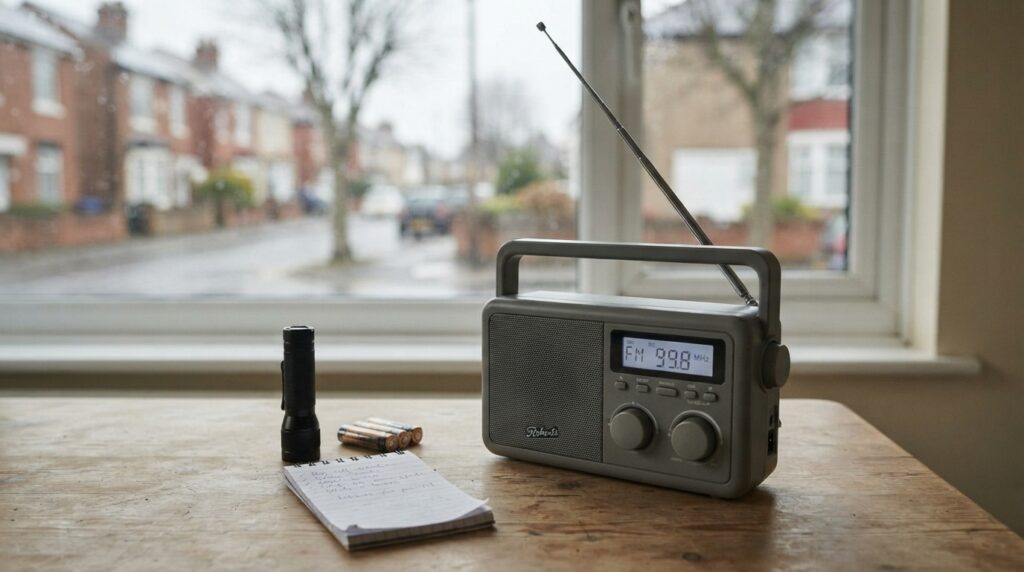
In most UK emergencies, tune to your BBC Local Radio station on FM, or to BBC Radio Scotland, BBC Radio Wales, BBC Radio Cymru or BBC Radio Ulster. The government’s emergency planning guidance says “the BBC’s local radio service is recognised as an emergency broadcaster for the UK”. The government’s Be Ready campaign lists an FM radio (battery or wind-up) for your emergency kit, and says to “write down frequencies of any national or local radio stations you use for news”. Stick to FM rather than AM: BBC Radio 4’s long wave service ended on 27 June 2026, and the BBC plans to close its AM network by the end of 2027. The tables below give the FM frequencies for every BBC local and nations station.
Since the government launched its Be Ready campaign on 22 October 2026, retailers including Maplin and Robert Dyas have reported a jump in radio sales. But a radio is only useful if you know where to tune it. Be Ready’s own power cut advice warns: “You would lose internet connection and possibly mobile signal during a power cut.” Here’s which station to choose, the frequency to write down for your area, and the radios that keep working without mains power.
What the government’s Be Ready advice says
The Be Ready checklist includes an “FM radio (battery / wind up)”, with this note: “For updates during outages, write down frequencies of any national or local radio stations you use for news.” Its other pages add:
- Power cuts: “There might be updates communicated by radio during a power cut.” Write the frequencies down “on paper”, and “use a battery or wind-up radio to search for stations that are still broadcasting”.
- Phone and broadband outages: “your mobile phone, landline and broadband connection could all be down”, and “Updates may be given on the radio during an outage.”
- Major incidents: people affected “may be asked to ‘Go in, Stay in and Tune in'” to local or national radio.
Be Ready also says its own website “will not be updated with live information during an emergency”. During an incident, the updates come from broadcasters, emergency services and Emergency Alerts on your phone.
Why BBC local radio?
The government’s emergency preparedness guidance for councils and emergency services says that “the BBC’s local radio service is recognised as an emergency broadcaster for the UK”, and that “radio, in particular, is the most resilient form of mass communication”. The same guidance says the news media “remain the primary means of communication with the public”.
There are formal arrangements behind this too:
- The BBC must broadcast emergency announcements. Under the BBC Framework Agreement with the government, a minister can ask the BBC to broadcast an announcement in an emergency, and the BBC “must comply with the request”.
- Backup power has been assessed. In December 2025, the government told Parliament that the BBC’s plan for an extended national power outage includes “a detailed assessment of back up power generation capacity and capabilities” at key BBC sites “and transmitter sites operated by third-party providers”. The plan is designed “to maintain broadcasts of key BBC radio channels nationally”.
- Commercial stations can be directed too. Under the Communications Act 2003, the government can require Ofcom to direct licensed broadcasters “to include an announcement” in their services.
So your favourite commercial station may carry official messages as well. But BBC local radio is the station emergency planners rely on, so it’s the one to write down first.
FM, not long wave or medium wave
Older advice often said to tune to Radio 4 on long wave. That no longer works:
- Radio 4 long wave has gone. The BBC confirmed that “Radio 4’s Long Wave (LW) service will close on the 27th June 2026”, and it did.
- Medium wave is closing too. The BBC is switching off Radio 5 Live’s medium wave transmitters area by area, under its plan to close the AM network by the end of 2027. 5 Live will stay on DAB.
- Most BBC local stations have already left AM. FM is now the main analogue band for local news.
What about DAB?
DAB is fine if you already have it. Digital Radio UK says DAB coverage is 98% for BBC national stations and 91% for local DAB. A radio with both DAB and FM gives you two ways to find a working station. Be Ready specifically asks for FM, though, and many wind-up radios are FM-only.
Don’t assume DAB will drain your batteries much faster. Battery life depends on the model: Panasonic, for example, lists about 40 hours on DAB and 30 hours on FM for its RF-D10 with alkaline batteries. Check the spec of the radio you buy.
Will radio still work in a power cut?
A battery or wind-up radio doesn’t need mains power, so it keeps working at home. The transmitters are the other half of the picture. Arqiva, which runs much of the UK’s broadcast network, has said it keeps “more than 300 fixed and portable generators” as backup if a site loses power. The BBC has also assessed backup power at its key sites and transmitter sites.
Transmitters can still fail. In August 2021, a fire at the Bilsdale transmitter in North Yorkshire knocked out TV and radio for an area of up to 670,000 homes, and Ofcom later said “better site-specific planning could have pre-empted” some of the delays. That’s why Be Ready says to search for stations that are still broadcasting, and why it’s worth writing down a second frequency.
BBC local radio FM frequencies
These are the FM frequencies for each BBC station, taken from published station listings. The first column shows the frequency for the main area each station serves. Coverage varies by transmitter, so tune in at home now to check which frequency is clearest where you live.
Scotland, Wales and Northern Ireland
| Station | FM (main area) | Other FM frequencies |
|---|---|---|
| BBC Radio Scotland | 92.5–94.7 (varies by area) | — |
| BBC Radio Orkney (local opt-out from Radio Scotland) | 93.7 | — |
| BBC Radio Shetland (local opt-out from Radio Scotland) | 92.7 | — |
| BBC Radio nan Gàidheal | 103.5–105 (varies by area) | — |
| BBC Radio Wales | 103.9 (south-east Wales) | 90.2–92.3 and 93.9–96.1 elsewhere |
| BBC Radio Cymru | 96.8 (south-east Wales) | 93.1 Blaenplwyf; 94.2 Llanddona; 93.7 Haverfordwest |
| BBC Radio Ulster | 92–95 (varies by area) | — |
| BBC Radio Foyle | 93.1 | — |
North East and Cumbria
| Station | FM (main area) | Other FM frequencies |
|---|---|---|
| BBC Radio Newcastle | 95.4 (Tyne and Wear, County Durham, south Northumberland) | 96.0 Northumberland; 103.7 Tyne Valley; 104.4 Newcastle and Gateshead |
| BBC Radio Tees | 95.0 (Teesside) | 104.0 Darlington (temporary transmitter); 95.8 Whitby |
| BBC Radio Cumbria | 95.6 (north Cumbria) | 96.1 Morecambe Bay and Barrow; 95.2 Kendal; 104.1 Whitehaven; 104.2 Windermere |
Yorkshire and Lincolnshire
| Station | FM (main area) | Other FM frequencies |
|---|---|---|
| BBC Radio Leeds | 92.4 (most of West Yorkshire) | 95.3 Halifax and Wharfedale; 102.7 Keighley; 103.9 Leeds |
| BBC Radio Sheffield | 88.6 (Sheffield, parts of Rotherham) | 104.1 Barnsley, Doncaster and north Sheffield; 94.7 Chesterfield |
| BBC Radio York | 103.7 (York, Harrogate, Malton) | 104.3 Ripon, Thirsk and Northallerton; 95.5 Scarborough |
| BBC Radio Humberside | 95.9 | — |
| BBC Radio Lincolnshire | 94.9 | 104.7 Grantham |
North West
| Station | FM (main area) | Other FM frequencies |
|---|---|---|
| BBC Radio Lancashire | 103.9 (central and west Lancashire) | 95.5 central and east; 104.5 Lancaster and Morecambe Bay |
| BBC Radio Manchester | 95.1 | 104.6 Saddleworth and Tameside |
| BBC Radio Merseyside | 95.8 | — |
Midlands
| Station | FM (main area) | Other FM frequencies |
|---|---|---|
| BBC Radio Derby | 104.5 (Derby, Burton, Uttoxeter) | 95.3 Peak District; 96.0 Buxton |
| BBC Radio Nottingham | 103.8 (Nottingham, south Nottinghamshire) | 95.5 Mansfield and Ashfield; 95.1 Newark |
| BBC Radio Leicester | 104.9 | — |
| BBC Radio Northampton | 104.2 (Northampton, south and west) | 103.6 Kettering and Corby |
| BBC Radio WM | 95.6 | — |
| BBC CWR (Coventry and Warwickshire) | 94.8 (Coventry, Rugby) | 103.7 Warwick, Leamington and Stratford; 104.0 Nuneaton and Hinckley |
| BBC Hereford and Worcester | 94.7 (Herefordshire) | 104.0 Worcester and Malvern; 104.4 Bromsgrove and Redditch; 104.6 Kidderminster |
| BBC Radio Shropshire | 96.0 (Telford, Shrewsbury, Oswestry) | 95.0 Ludlow; 90.0 Church Stretton; 104.1 Clun |
| BBC Radio Stoke | 94.6 (Stoke, Crewe, Nantwich) | 104.1 Stafford and Stone |
East of England
| Station | FM (main area) | Other FM frequencies |
|---|---|---|
| BBC Radio Cambridgeshire | 96.0 (Cambridge, Ely) | 95.7 Peterborough |
| BBC Radio Norfolk | 95.1 (Norwich, east Norfolk) | 95.6 north Norfolk; 104.4 west Norfolk |
| BBC Radio Suffolk | 103.9 (Ipswich, south-east Suffolk) | 104.6 west; 95.5 north-east; 95.9 east |
| BBC Essex | 103.5 (most of Essex) | 95.3 Southend and Basildon |
| BBC Three Counties Radio | 103.8 (Luton, Dunstable) | 95.5 Bedford and Hitchin; 90.4 Welwyn, Hertford and Stevenage; 92.1 Hemel Hempstead, Watford and St Albans; 104.5 Milton Keynes; 94.7 Aylesbury; 98.0 High Wycombe |
London and the South East
| Station | FM (main area) | Other FM frequencies |
|---|---|---|
| BBC Radio London | 94.9 | — |
| BBC Radio Kent | 96.7 (Medway, Maidstone, north and west Kent) | 104.2 Canterbury, south and east Kent; 97.6 Folkestone |
| BBC Radio Sussex | 95.3 (Brighton and Hove, Worthing) | 104.5 East Sussex; 104.8 West Sussex and Chichester; 95.0 Newhaven; 95.1 Horsham |
| BBC Radio Surrey | 104.0 (Reigate, Redhill, Crawley, East Grinstead) | 104.6 Guildford |
| BBC Radio Berkshire | 104.4 (Reading) | 95.4 Slough, Windsor and Maidenhead; 104.1 Basingstoke, Andover and West Berkshire; 94.6 Henley |
| BBC Radio Oxford | 95.2 | — |
| BBC Radio Solent | 96.1 (Hampshire, Isle of Wight, east Dorset) | 103.8 central and west Dorset |
South West and the Channel Islands
| Station | FM (main area) | Other FM frequencies |
|---|---|---|
| BBC Radio Bristol | 94.9 (Bristol) | 104.6 Bath; 103.6 Weston-super-Mare |
| BBC Radio Gloucestershire | 104.7 (Gloucester, Cheltenham) | 95.0 Stroud; 95.8 Cirencester |
| BBC Radio Wiltshire | 103.6 (Swindon) | 104.3 Chippenham and west Wiltshire; 103.5 Salisbury; 104.9 Marlborough |
| BBC Radio Somerset | 95.5 | — |
| BBC Radio Devon | 103.4 (most of Devon) | 95.8 Exeter; 95.7 Plymouth; 104.3 Torbay; 94.8 Barnstaple; 96.0 Okehampton |
| BBC Radio Cornwall | 95.2 (east Cornwall) | 103.9 west Cornwall; 96.0 Isles of Scilly |
| BBC Radio Jersey | 88.8 | — |
| BBC Radio Guernsey | 93.2 (Guernsey, Sark) | 99.0 Alderney |
How to write down your frequencies
- Find your station in the tables above.
- Test it at home now. Tune your battery or wind-up radio to each listed frequency and note which is clearest. Save it as a preset if your radio has them, but write it down too.
- Add a backup. Note a second station, such as a neighbouring BBC local station or your national station.
- Write it on paper with other emergency numbers. Be Ready’s “Make a plan” section lists “frequencies of radio stations you use for news updates” among the things to keep on paper, along with the power cut number: 105 in England, Scotland and Wales.
- Keep the note with the radio, plus spare batteries if it uses them.
Emergency Alerts on your phone
The government’s Emergency Alerts system sends warnings to mobile phones “in a life threatening emergency”. It works on “all 4G and 5G phone networks in the UK”, and your phone doesn’t need mobile data or wifi. You won’t get alerts if your phone is “turned off” or connected to a 2G or 3G network.
Alerts are a warning, not a news service. GOV.UK says: “Emergency Alerts will not replace local news, radio, television or social media.” Keep your phone charged and switched on, and use the radio for updates.
The radios worth buying
Philips TAR1609 portable radio with torch
Best for: an all-in-one emergency radio
Crank, solar, USB-C or 3 x AAA
Up to 32 hours
Philips says the TAR1609 has FM/AM analogue tuning and can be charged by USB-C, hand crank or solar panel, with space for 3 AAA batteries as a backup. It quotes “up to 32 hours of radio playback”. There’s a built-in torch, an SOS alarm and a USB-A port to charge other devices.
Good for: emergency kits; keeping a torch and radio in one place.
Less good for: DAB listeners, as it’s analogue only. Philips doesn’t state the battery capacity, so don’t rely on it as a power bank. AM is of little use now the BBC is closing its AM network.
Sangean MMR-88 DAB+ emergency radio
Best for: DAB and FM in a wind-up radio
40 presets
Crank, solar or USB-C
Sangean lists DAB+ and FM RDS with 40 presets (20 of each), so you can save your local station on both bands. It charges by hand crank, solar panel or USB-C, has an 850mAh lithium battery with an 8-hour playtime, and adds an LED light with SOS. It weighs 377g.
Good for: anyone who wants both DAB and FM; saving backup stations as presets.
Less good for: charging a phone. Its USB output is just 5V/0.3A from a small battery, so it will barely top one up. Sangean lists no AA battery option.
Sony ICF-P26 pocket radio
Best for: long battery life on AA batteries
2 x AA
About 100 hours on FM
Sony lists about 100 hours of FM listening through the speaker from two AA batteries, in a radio that weighs about 190g. With a pack of spare batteries, that’s weeks of news bulletins, with no cranking.
Good for: a simple, cheap backup radio; older relatives who don’t want to crank a handle.
Less good for: DAB, presets or charging anything. It has an analogue dial and no crank or solar, so you need spare AAs in your kit.
Frequently asked questions
Which radio station gives emergency information in the UK?
BBC local radio. The government’s emergency planning guidance says “the BBC’s local radio service is recognised as an emergency broadcaster for the UK”. In Scotland, Wales and Northern Ireland, that means BBC Radio Scotland, BBC Radio Wales or Cymru, and BBC Radio Ulster or Foyle.
Should my emergency radio be FM or DAB?
The government’s Be Ready checklist asks for an FM radio, battery or wind-up. A radio with both DAB and FM gives you two ways to find a working station. Avoid relying on AM, as the BBC plans to close its AM network by the end of 2027.
Can I still listen to Radio 4 on long wave?
No. BBC Radio 4’s long wave service closed on 27 June 2026. Use Radio 4 on FM or DAB, or your BBC local station.
Will FM radio work in a power cut?
Yes, if your radio runs on batteries, a crank or solar. Broadcasters keep generators and backup power at key transmitter sites, but individual transmitters can still fail, so write down a second frequency and scan for stations that are still broadcasting.
What does “Go in, Stay in, Tune in” mean?
It’s the core advice for many emergencies, such as a large fire or chemical leak: go indoors, stay inside, and tune in to local radio or TV for updates. Be Ready says people affected “may be asked to ‘Go in, Stay in and Tune in'”.
Sources
- GOV.UK Be Ready — Be ready for emergencies, Power cuts, Phone and broadband outages and Be informed about hazards
- GOV.UK — Be Ready launch press release (22 October 2026) and Be Ready home page
- The National — Radio sales rise after the Be Ready launch
- Cabinet Office — Emergency Preparedness, Chapter 7: Communicating with the public (PDF)
- DCMS — BBC Charter and Framework Agreement, with 2022 and 2025 updates
- UK Parliament — Written question 100801: BBC power outage planning
- legislation.gov.uk — Communications Act 2003, section 336
- RadioToday — BBC sets June date for Radio 4 long wave closedown and BBC Radio 5 Live to close more AM transmitters
- WorldDAB — Radio 4 broadcasts on long wave end on 27 June 2026
- Digital Radio UK — Can I get DAB digital radio anywhere in the UK?
- Arqiva — Keeping TV and radio services on air; Ofcom — Bilsdale transmitter fire review
- GOV.UK — Emergency Alerts and How alerts work
- Wikipedia — List of BBC radio stations (frequencies, cross-checked with each station’s page)
- Philips — TAR1609 portable radio with torch; Sangean — MMR-88 DAB+; Sony — ICF-P26 specifications; Panasonic — RF-D10 specifications
Related reading: UK storm names for 2026/27, our storm-proofing guide, how to store emergency drinking water and what should be in a home first aid kit.
Compare wind-up and battery FM radios at Amazon UK.