What Size Power Bank Do You Need for a 3-Day Power Cut? (UK)
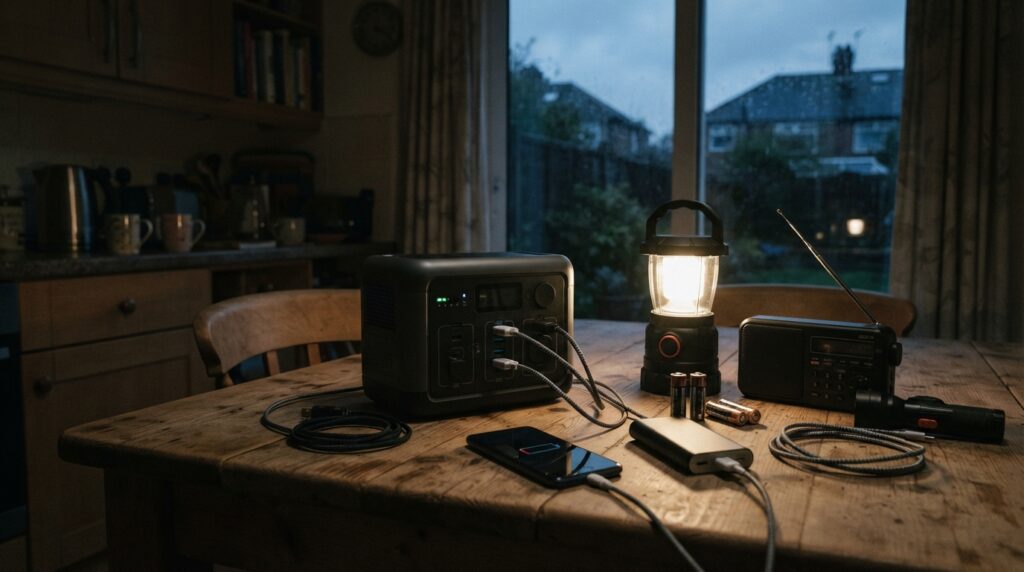
To keep one phone going for 3 days, starting with it fully charged, you need roughly 12,000–17,000mAh of power bank per phone. Smaller iPhones are at the low end, and big Samsung, Pixel and Pro Max phones at the high end. If the phone might start the power cut nearly flat, allow about 18,000–25,000mAh per phone. That’s because a power bank delivers only part of its rated capacity: Anker says to expect “roughly 60% to 75% of the rated mAh as usable output”. For most households, that means one 20,000mAh power bank per phone, kept charged and topped up every three months.
A “charged power bank” is on the government’s Be Ready emergency checklist, launched on 22 October 2026, which asks households to be ready for 3 days of disruption. But the checklist doesn’t say how big. Buy too small and your phone dies on day two. Buy one of the huge, cheap “100,000mAh” banks sold online and you may get far less than it claims. Here’s how to work out the right size for your phones, using the makers’ own figures.
Why a 20,000mAh power bank doesn’t give 20,000mAh
The mAh figure on a power bank is the capacity of its battery cells, measured at their own voltage of about 3.7V. Anker explains that power banks then “convert this energy to 5 V or higher for charging devices, which reduces the usable mAh”. Its rule of thumb is to “expect roughly 60% to 75% of the rated mAh as usable output”.
Anker’s own figures show this in practice:
- Anker says a 20,000mAh power bank will usually charge an iPhone 16 “around 3–4” times, and an iPhone 17 Pro Max “about 2–3” times.
- For its Prime 26K power bank, rated at 26,250mAh, Anker says it delivers “about 15,200 mAh to your devices”, which is about 58%.
So we’ve used 60% in our calculations. It’s at the cautious end of Anker’s range, which suits emergency planning. Real results can be a little lower, so round up when you buy.
How big is your phone’s battery?
| Phone | Battery | Source |
|---|---|---|
| iPhone 16 | 3,561mAh | Apple (rated capacity) |
| iPhone 17 | 3,692mAh | Apple (rated capacity) |
| iPhone 17 Pro | 3,988mAh | Apple (rated capacity) |
| iPhone 17 Pro Max | 4,823mAh | Apple (rated capacity) |
| Samsung Galaxy S25 | 4,000mAh | Samsung (typical) |
| Samsung Galaxy S25 Ultra | 5,000mAh | Samsung (typical) |
| Samsung Galaxy A-series (A16 to A57) | 5,000mAh | Samsung (typical) |
| Google Pixel 10 | 4,970mAh | Google (typical) |
For another phone, search for its model name and “battery capacity mAh”. Apple lists the rated capacity on its European spec pages.
What size power bank for each phone
We’ve assumed each phone needs one full charge a day. That’s cautious. Apple’s EU energy label for the iPhone 17, for example, rates it at 41 hours per full charge, and a phone in low power mode uses less. But in a power cut you may lean on your phone more than usual, and cold homes can drain batteries faster.
If your phone starts fully charged, it covers day 1 and the power bank covers days 2 and 3. If it starts nearly flat, the power bank covers all 3 days.
| Phone | Phone starts full (2 charges) | Phone starts flat (3 charges) |
|---|---|---|
| iPhone 16 | About 11,900mAh | About 17,800mAh |
| iPhone 17 | About 12,300mAh | About 18,500mAh |
| iPhone 17 Pro Max | About 16,100mAh | About 24,100mAh |
| Galaxy S25 | About 13,300mAh | About 20,000mAh |
| Galaxy S25 Ultra or A-series | About 16,700mAh | About 25,000mAh |
| Pixel 10 | About 16,600mAh | About 24,900mAh |
Our calculation: phone battery (mAh) x number of charges, divided by 0.6. These are estimates, not lab tests, so round up when you buy.
Examples for a household
- A couple with an iPhone 16 and a Galaxy A-series phone, both charged at the start: about 28,500mAh in total. Two 20,000mAh power banks would cover it with room to spare.
- A family of four with phones averaging 4,500mAh, all charged at the start: about 60,000mAh in total, or three 20,000mAh power banks.
- Someone living alone with one phone: a single 20,000mAh power bank is plenty for 3 days if the phone starts charged.
Your phone may not have a signal
A charged phone doesn’t guarantee a working network. Be Ready warns that “your mobile phone might stop working if your local mast is in the affected area”, though the network “may still temporarily work in specific regions with backup power”. An Ofcom technical report from February 2025 found power backup at around 20% of UK mast sites for at least one hour, and that only about 5% of sites have backup of at least 6 hours.
A charged phone is still worth having. Signal can come and go, the masts may come back before your power does, and your phone holds your contacts, photos of documents, and offline maps and notes. Emergency Alerts also reach phones that are switched on and in range of a working 4G or 5G mast. And keep a battery or wind-up radio for news.
If you rely on a landline, check how it’s connected. Ofcom says “a digital phone will only work in a power cut if it has a battery back-up”, which providers should offer free to people who depend on their landline. Ofcom’s guidance says it should give at least one hour of access to the emergency services.
Make your battery last
- Turn on low power mode. Apple says Low Power Mode “reduces background activity to extend battery life”. Google says the Pixel 10 can reach “up to 100-hour battery life” with Extreme Battery Saver.
- Don’t use your phone as a torch. Be Ready says it “will drain its batteries more quickly”. Keep a proper torch.
- Keep your phone warm. Apple says iPhones are designed for 0 to 35°C, and that very cold conditions outside that range “may temporarily shorten battery life”. Keep it in a pocket in a cold house.
- Charge up when there’s a warning. When a storm is forecast, charge every phone and power bank to full.
Keep the power bank itself charged
A power bank in a drawer slowly loses charge. Anker says “it’s best to recharge it every three months”. Put a reminder in your calendar, and always top it up before a storm.
Buying safely
- Beware huge, cheap capacity claims. When Australian consumer group CHOICE tested 31 power banks in 2023, “not a single power bank in our test delivered what it promised”. One sold as “500,000mAh” measured just 6,052mAh.
- Buy a known brand from a reputable seller. Electrical Safety First advises buying from “a reputable retailer rather than a third-party seller online”. On Amazon, check that it’s sold by Amazon or by the brand.
- Charge it safely. Electrical Safety First says not to charge battery packs “overnight or while you are out of the house”, and to stop using one that’s swollen, cracked or damaged.
- Avoid extreme temperatures. London Fire Brigade says to avoid storing, using or charging batteries at very high or low temperatures.
Flying with your power bank
Under Civil Aviation Authority rules in force since 27 March 2026, power banks must go in your hand luggage, can’t be recharged on board, and you can take a maximum of two. Power banks up to 100Wh need no approval; 100–160Wh needs the airline’s approval. To work out the Wh, Anker’s formula is mAh x voltage / 1,000. At 3.6V, a 20,000mAh bank is 72Wh.
What about solar chargers and the car?
- Solar is weak in a UK winter. Anker’s solar arm says cloud cover “can cut solar output by 50–90%” compared with a clear sky. It also notes that midwinter days have only 7 to 8 hours of daylight, against 16 to 17 hours in midsummer. Treat solar as a bonus, not your plan.
- Charging from the car works, but never run the engine in a garage. The NHS says “do not leave vehicles or other engines on in enclosed spaces (such as a garage)”, as it can cause carbon monoxide poisoning. Be Ready gives the same warning about using a car radio: in severe weather, “it might be safer to stay inside”.
The power banks worth buying
Anker Prime Power Bank (26K, 300W)
Best for: two phones, still under the 100Wh flight limit
Two 140W USB-C ports
Flight-approved
Anker lists the Prime at 26,250mAh (99.75Wh), with two USB-C ports at up to 140W each, a 22.5W USB-A port and 300W in total, so it can charge three devices at once. Anker says it delivers “about 15,200 mAh to your devices” and calls it “flight-approved”. By our table, that’s enough to see two charged iPhone 16 or 17 phones through 3 days, or one Pro Max or Galaxy Ultra that starts flat.
Good for: couples; big phones; travel.
Less good for: pockets, as it weighs 600g. There’s no wall charger in the box, and fast recharging needs a 140W charger you buy separately.
UGREEN Nexode Power Bank 20000mAh 100W
Best for: one phone
100W USB-C
Recharges in 1.6 hours
UGREEN lists this power bank at 20,000mAh (72Wh), with a 100W USB-C port, a 30W USB-C port and a 22.5W USB-A port. It says it gives “up to 4.5 charges for iPhone 15 Pro” and 3 charges for a Galaxy S23 Ultra, and can be fully recharged “in just 1.6 hours”. UGREEN calls it airline-approved.
Good for: one person with one phone, even a big phone that starts the power cut charged.
Less good for: two or more phones on its own. Only one port gives the full 100W, it weighs 420g, and the fast recharge needs a high-powered charger.
Anker 737 Power Bank (PowerCore 24K)
Best for: fast top-ups before a storm
140W USB-C
140W two-way charging
Anker lists the 737 at 24,000mAh, with two USB-C ports at up to 140W and an 18W USB-A port. Anker says it supports 140W two-way fast charging, so with a 140W wall charger it refills quickly when a storm warning comes in late. By our calculation, at 3.7V (the voltage Anker uses in its own example) that’s about 89Wh, under the 100Wh flight limit.
Good for: topping up quickly before a forecast storm; laptops as well as phones.
Less good for: carrying around, as it weighs 630g. Anker doesn’t give a phone charge count or Wh figure, and the 140W charger is extra.
Frequently asked questions
What size power bank do I need for a power cut?
For 3 days, roughly 12,000–17,000mAh per phone if it starts fully charged, or 18,000–25,000mAh if it starts flat. A 20,000mAh power bank suits one phone. Two phones need a bigger bank, or one each.
How many times will a 20,000mAh power bank charge my phone?
Anker says a 20,000mAh power bank usually charges an iPhone 16 around 3–4 times, and an iPhone 17 Pro Max about 2–3 times. Bigger phone batteries get fewer charges.
Why doesn’t my power bank give its full mAh?
The rating is for the battery cells at about 3.7V. Converting that to the 5V or more your phone needs loses energy, so Anker says to expect roughly 60–75% of the rated capacity.
How often should I charge a power bank I’m not using?
Anker recommends recharging every three months. Top it up whenever a storm is forecast too.
Will my mobile phone work in a power cut?
Maybe not for long. Be Ready says your phone might stop working if your local mast is in the affected area, and Ofcom found that only about 20% of mast sites have at least an hour of backup power. Keep a battery or wind-up radio for news.
Sources
- GOV.UK Be Ready — Be ready for emergencies and Power cuts
- Anker UK — How to check the capacity of a power bank and Is a 20,000mAh power bank too much?; Anker — How long does a power bank hold a charge?
- Apple — iPhone 16 specs, iPhone 17 specs, iPhone 17 Pro specs, Low Power Mode and Operating temperatures
- Samsung UK — Galaxy S25 vs S25 Ultra and Best battery life; Google Store — Pixel 10 specs
- Civil Aviation Authority — Changes to rules on power banks
- Ofcom — Mobile network power resilience technical report (PDF) and The future of landline calls; ISPreview — Ofcom guidance on emergency calls in a power cut
- Electrical Safety First — Power banks; London Fire Brigade — Batteries and chargers
- CHOICE — Power banks that don’t live up to claimed capacity
- Anker Solix — Charging a portable power station with solar; NHS — Carbon monoxide poisoning
- Anker — Anker Prime 26K 300W and Anker 737 Power Bank; UGREEN — Nexode 20000mAh 100W
Related reading: how to cool a room during a power cut, how to store emergency drinking water, UK storm names for 2026/27 and our storm-proofing guide.
Compare 20,000mAh power banks from known brands at Amazon UK.